
Old School. Biblically Independent.
By Dustin Rowles | Film | June 11, 2026
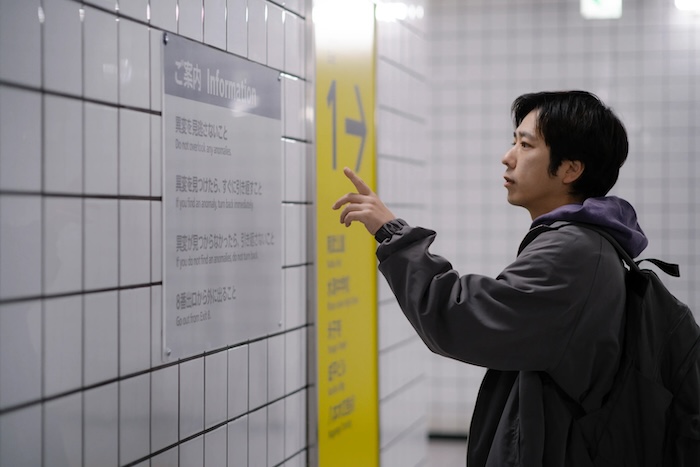
Exit 8 is a 2025 Japanese psychological horror film directed by Genki Kawamura and based on the 2023 video game of the same name. I don’t know anything about the video game, except that watching the film feels not unlike watching someone else play a video game. Like The Backrooms, it involves someone getting lost in a series of liminal spaces (here, subway tunnels), and also like The Backrooms, it’s a lot more interesting to think about than it is to watch.
Honestly, I don’t begrudge either Exit 8 or The Backrooms for that. For a generation with attention deficit issues that has apparently stopped reading, movies like these are great vehicles for teaching metaphor and parable, and — like a few of the great American classic novels — they can occasionally be a bit of a slog. It comes with the territory.
To its credit (perhaps), Exit 8 is a less complicated metaphor than The Backrooms, in that it’s about as subtle as a sledgehammer to a back molar. It centers on a character referred to only as The Lost Man (Kazunari Ninomiya). In the opening scene, he overhears a businessman on the subway berating a mother whose child is crying. The Lost Man does nothing except continue listening to his headphones.
When The Lost Man gets off the subway, he gets a call from an ex-girlfriend. She’s pregnant, she’s at the hospital, and she’s asking The Lost Man what she should do. The Lost Man is indecisive, both in this moment and in life. As he traverses the subway corridors, however, he discovers that he’s stuck in a loop, and the only way out is to spot the anomalies along the hallways and turn back.
In other words, he has to pay close attention to his surroundings and act decisively in order to escape, lest he end up like the Walking Man — forever trapped in the corridors. He must also help a little boy stuck in the hallways find his way out. If The Lost Man doesn’t pay close enough attention and misses an anomaly, he resets to zero. The goal, ultimately, is to escape through Exit 8.
It’s a parable, and not a particularly complicated one at that: You can’t passively drift through life. You can’t stubbornly push forward when you notice something is wrong. You must, occasionally, turn back. And if you can manage all of that, you might just become a better adult and, eventually, a decent father.
I suspect that, as the player in this situation, it’s probably satisfying to spot the differences and react accordingly. As a viewer, it’s considerably more frustrating to watch The Lost Man navigate the same subway hallways over and over. At 90 minutes, it’s shorter than The Backrooms, but there’s also a lot less going on. A few horror elements occasionally break up the tedium, but it’s easy — like The Lost Man — to zone out from time to time. That’s probably the point.
Is it good? It’s fine. Is it interesting? Not as interesting as The Backrooms, but it also doesn’t require the same mental investment. Would it make for an excellent 9th-grade English assignment on parables and metaphors? Absolutely!
(Hat Tip: Dan Hamamura for the suggestion)


