Old School. Biblically Independent.
By Dustin Rowles | Film | July 17, 2026
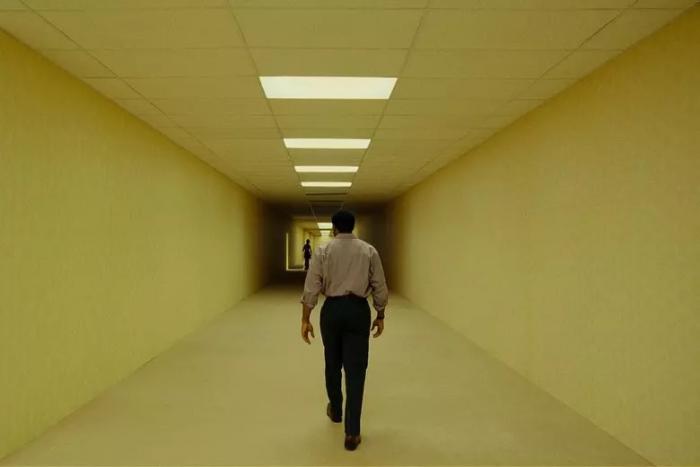
I’ll be honest with you: I didn’t particularly like Backrooms, and I kind of figured I wouldn’t when Mae described it as one of the most “interesting” films of the year. As a horror movie, it’s not very scary. As a narrative film, it’s a slog.
But as an object of deconstruction, it’s wildly fascinating. And I love that it’s a massive hit — $81 million domestic opening weekend, A24’s biggest ever, a B- CinemaScore, and a soft recommend — because the gap between those numbers tells you a lot (beyond the terrific job A24 did with its marketing). The people who loved it, loved it. Why? I don’t know. The people who showed up because they heard it was great came out vaguely dissatisfied, which is also great, because it means millions of people are thinking and arguing about what Backrooms means. It didn’t work for me as a movie. As a thought experiment, however, it gets an A+.
So what does Kane Parsons’ Backrooms actually mean? That question is open to interpretation, though any interpretation still has to fit the framework of the film itself — which is why I had to throw out my own original theory. My first instinct was that the Backrooms were a manifestation of Mary’s mind, that Clark didn’t even exist except as a metaphor, and that the entire movie was a (deeply boring) trip through her brain. It was also wrong.
Clark is the entry point. Mary only enters the Backrooms because she goes in after him. So that’s out.
If you need the backstory and don’t have a Gen Zer in your life who will insist on explaining the entire mythology to you, go read Kayleigh’s piece. Here’s the gist of mine.
The Backrooms Are the Universe’s Subconscious
Yeah, well, duh. The Backrooms aren’t a manifestation of one person’s mind. They’re a manifestation of the entire universe’s mind. The film describes them as the molecular memory of the universe — a material afterlife where nothing ever disappears cleanly and everything may return, but misassembled and wrong. It’s the universe’s subconscious, growing endlessly underneath a furniture store that offers predatory credit lines to its customers. For the Trump era? That tracks.
The universe’s subconscious, much like our own, misremembers things. It misassembles memories into liminal spaces and drags along every bit of psychological baggage it absorbs from the people who pass through it. Those creatures — the Still Life entities — aren’t demons or ghosts. They’re the Backrooms’ broken attempts to replicate human beings from faulty memory. Recognizably human in shape. Viscerally wrong in every other way.
Pirate Clark Is Clark’s Id
The most discussed image in the film — the huge, grotesque entity in Clark’s store mascot costume — is also its clearest metaphor. Pirate Clark is the ugly physical manifestation of Clark’s own fury and self-righteousness. Clark felt safer in the Backrooms than he felt in his real life because the Backrooms offered him something the real world had stopped providing: a sense of mastery and purpose. He knew this place. He understood it. He was somebody here. He enjoyed the food!
Then Mary arrived. And Mary, being a therapist, did what therapists do: she forced Clark to look at himself. She forced him to confront the thing the Backrooms had already built out of his worst qualities. And once Clark was compelled to see his own demons — to acknowledge that he, not his wife, not his failed architecture career, not the universe’s indifference, was responsible for the wreckage of his life — Pirate Clark bit him in the neck and killed him. In other words, the Backrooms didn’t destroy Clark. Clark’s refusal to reckon with himself did.
Mary’s Childhood Is Already Being Absorbed
Mary’s traumatic backstory — her mother was institutionalized after she refused to leave their home when it was being demolished to build condos, clinging to the place until she broke — is not just backstory. The Backrooms is already eating it. By the end of the film, rooms built entirely from Mary’s memories are materializing inside the Backrooms, and a Still Life entity modeled after Mary herself is beginning to form. The dimension absorbed her psychological landscape while she was inside it, and now it’s building her. The Backrooms learns you, and then keeps a (misremembered) copy.
Async and the MRI Machine Problem
And then there’s Phil (Mark Duplass), who works for Async, the research entity lurking at the edges of the film and of Parsons’ YouTube mythology. At the end of the film, Phil reveals that Async used to manufacture MRI machines. Through events he declines to fully explain, they stumbled upon the Backrooms and pivoted their entire operation to mapping it.
An MRI machine maps internal space using electromagnetic fields. It produces images of what’s inside — the brain, the body’s hidden architecture. Async started by imaging brains, discovered something that behaves like a brain, and has spent the years since trying to understand it. Phil is collecting data. He’s not sure what it means yet. Nobody is.
What Backrooms is, ultimately, is a film about the terror of interiority — about what happens when the things inside us (our rage, our grief, our mothers who refused to leave) get externalized, replicated, and turned into monsters that move through yellow-lit hallways forever. The Backrooms didn’t create those monsters. We did. The Backrooms just remembered them … badly.
And god, it was boring.
(Hat Tip: My Gen Z son, who hated the film but couldn’t stop talking about it and ultimately disabused me of my original theory).


