
Old School. Biblically Independent.
By Kayleigh Donaldson | Film | July 17, 2026
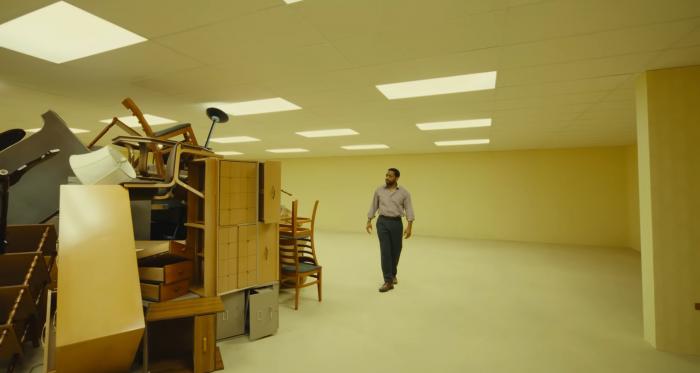
This Friday sees the release of Backrooms, A24’s latest foray into horror. Chiwetel Ejiofor plays a furniture store owner who discovers that his shop contains a portal to a seemingly endless maze of rooms and spaces that seem familiar enough but slowly unravel to reveal uncanny terrors. Much of the hype surrounding Backrooms has focused on its 20-year-old director, Kane Parsons, who got his start making 3D horror shorts on YouTube and Adobe After Effects and Blender. His feature debut is adapted from those shorts, which were his spin on a sprawling lore that has become one of the defining narratives of internet-based horror fiction.
Online horror and urban legends have been a thing for almost as long as the internet has existed. How many of us received a weird chain email telling us we had to pass it onto five friends or risk being cursed? Sites like 4chan and Reddit became the hubs for a kind of pass-it-on community storytelling exercise that blended nostalgia, classic cinema, memes, and campfire scares. Creepypasta was the name given to it, to define a horror-related legend or narrative that would be copy and pasted around the internet. Details would change, things would be added, and the mythos could be infinitely expanding. Most of the popular creepypastas revolved around the supernatural, usually some kind of monster or cryptid. Many were centred on video games or classic TV shows. Slender Man became one of the most popular stories in creepypasta history, spawning a YouTube series, some video games, and a terrible Hollywood movie.
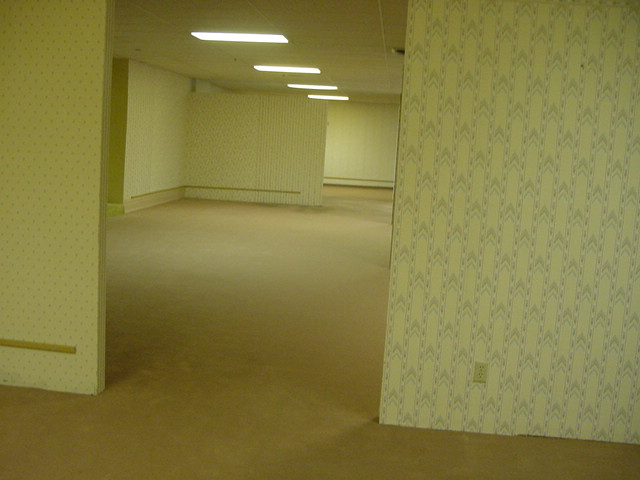
The Backrooms started life on 4Chan’s paranormal themed board, /x/, where users were asked to share images of disquieting things or places that just seemed “off.” A picture of what looked like an abandoned hotel with yellow walls and overhead lighting was shared, with the accompanying text:
“If you’re not careful and you noclip out of reality in the wrong areas, you’ll end up in the Backrooms, where it’s nothing but the stink of old moist carpet, the madness of mono-yellow, the endless background noise of fluorescent lights at maximum hum-buzz, and approximately six hundred million square miles of randomly segmented empty rooms to be trapped in God save you if you hear something wandering around nearby, because it sure as hell has heard you.”
Soon, a new fandom was born, and people made the Backrooms expand into infinite realms. People like Kane Parsons made their own short films. Video games were developed. Everyone had their own take on what did and didn’t work, but they were bound together by shared influences: H.P. Lovecraft, creepypasta, David Lynch, video games, Mark Z. Danielewski’s House of Leaves, lofi hip-hop anime beats to relax to, and urban explorers, to name but a few. The Backrooms are often described as levels, like a video game, that go on and on with bosses to fight or outrun. The original 4chan story talked about “clipping” out of reality, a nickname given to when the player finds a way to get into a part of the game’s build that was never meant to be accessible.
They were also inspired by so-called liminal spaces, a popular internet aesthetic focused on empty or abandoned spaces whose mundanity has curdled into unnerving. Think of how the familiarity of an office space becomes the opposite of that once it’s stripped of its people and furniture, or when you’re in a hotel with hundreds of rooms and keep getting lost trying to navigate it (been there, done that.) The Backrooms are often warehouses or office spaces, but sometimes they’re suburban houses or cellars filled with water. Being utterly alone in a space so vast and seemingly endless is eerie. A lot of the psychology behind it is similar to old-school horror scares, like haunted houses. What happens when a comforting and familiar space becomes imbued with a sense of something undeniably un-human?
I must admit that the Backrooms lore really fascinates me, and yes, it freaks me out. If you’ve ever been in an empty hospital at one in the morning, or done a night shift in a building with seemingly endless staircases, you know why Backrooms are scary. I’m particularly unnerved by that ephemeral space where the totally ordinary suddenly becomes cosmically terrifying. David Lynch excels at this, and so does the best Backrooms lore. What is it like to be confronted by something you think is safe, only to realize it’s beyond your comprehension? There’s a hopelessness to the Backrooms that gets to me.
It’s also extremely of the internet in a way that traditional cinematic horror has largely failed to tap into (one exception is Jane Schoenbrun, whose films We’re All Going to the World’s Fair and I Saw the TV Glow acutely capture internet culture’s ability to provide both community and abject isolation.) You don’t need a creepypasta PhD or work experience with 4chan to get the Backrooms, but it makes so much more sense if you’re familiar with online horror and its recurring fears. Millennials and Gen Z-ers are perennially stuck in a liminal space of financial and cultural crisis. Raised on video games and nostalgic throwbacks, we imagine a world of never-ending space where life has been abandoned and something existential has taken over that’s completely out of our control. The game is broken. We used to have haunted gothic mansions and now we have abandoned office spaces. Truly, we’re in a recession.
Parsons has been careful to note that his Backrooms is not definitive and that the creepypasta will continue to evolve and expand beyond one movie or series of videos. Therein lies the magic of communal storytelling. It can be anything you want it to be, and there will always be new ways to scare the world. In the backrooms, there will always be another level to explore, another room to go into. And then another. And another. And another…


