Old School. Biblically Independent.
By Dustin Rowles | TV | July 23, 2026
Inspired, weirdly, by something I read recently about David Foster Wallace, I just finished reading Lonesome Dove and immediately watching the 1989 CBS miniseries based upon it. And the thing that I can’t get over — aside from the preposterous river snakes in the miniseries — is the realization that Taylor Sheridan basically owes his entire career to Larry McMurtry’s book, which might actually explain my problematic fondness for so much of Sheridan’s work.
Sheridan has built an entire Paramount-backed empire on one very specific archetype: that laconic, uber-competent, secretly ruined cowboy who grunts for forty minutes before delivering a gruff monologic truth, and I’m a sucker for it. Yellowstone, Landman and Dutton Ranch run on it, and so does Wind River. Hell or High Water — still his masterpiece — runs on it, too. That’s Woodrow F. Call. That’s Gus McCrae, if you give him better jokes and let him enjoy his goddamn whiskey.
To be fair to Sheridan, this isn’t a plagiarism charge. He’d be the first person to tell you McMurtry is his North Star. He’s been effusive about McMurtry for years and even recorded the foreword for a recent edition of the Lonesome Dove audiobook. He generally writes the stoic tragedy better than most of his critics give him credit for. (I’m sorry. It’s true!)
The problem really isn’t the homage. The problem is what he also what he inherited from McMurtry (and the genre itself): a bone-stupid belief that the most interesting thing about a man is what he can’t bring himself to say, and that the only function of a woman is to be the wise clairvoyant who already knows why he’s not saying it.
McMurtry’s West is populated almost entirely by sex workers. Lorena, Elmira, the women of the Dry Bean (Margo Martindale!) — the primary currency of the trail is “pokes,” and the women are the ones selling. To McMurtry’s credit, they are also the ones with actual clarity. Lorena understands her reality better than any man riding alongside her. Clara is, by a wide margin, the smartest character in the novel. McMurtry knows it, too. Yet she still exists largely as a moral compass for broken men to ride toward when they require absolution or judgment.
Sheridan took that exact narrative architecture and, in the lord’s year 2026, added push-up bras and very short shorts. His women are consistently the wisest figures on screen — Beth Dutton (Yellowstone), Angela Norris (Landman) and Cheyenne (also Landman, a full-blown Manic Pixie Dream Stripper). Yet he still can’t write a brilliant woman without first deciding what she’s almost wearing. The perspicacity and the lingerie arrive as a package deal. It’s a genre trope older than the state of Montana, but Sheridan is the guy perpetuating it on a massive budget when he could simply, you know: Not.
And that brings us to 1883. That show remains the single best piece of television Taylor Sheridan has ever made, and probably ever will. It runs circles around Yellowstone and honestly, is right up there with Hell or High Water. And the reason it works so well? He ripped it off from McMurtry.
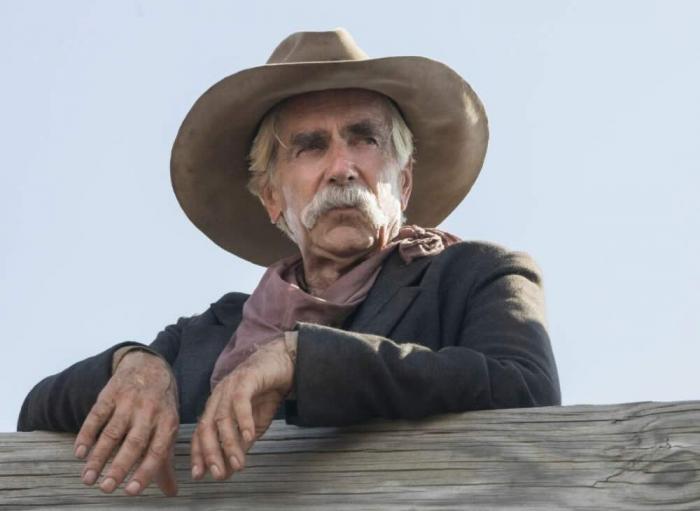
I mean: A punishing cattle drive to Montana through country actively trying to murder everyone on it. A tough, soft-spoken war veteran with a haunted past. A doomed young woman whose tragedy is telegraphed in the opening scenes and delivered anyway. A voiceover from beyond the grave, which is just another iteration of Lonesome Dove’s ending used as a framing device. Sam Elliott’s Shea Brennan is Woodrow Call with his trauma dragged to the surface. Isabel May’s Elsa Dutton is Lorena rewritten as our tragic narrator. Sheridan gives her the best writing of his career, and then … still insists on the male gaze.
There’s a lesson in there that Sheridan seems determined to ignore in everything he writes. Left to his own, he writes Yellowstone. But handed McMurtry’s scaffolding, he crafts something genuinely brilliant. I mean, Lonesome Dove is basically The Odyssey set on the frontier. The narrative is already written for him, freeing Sheridan to do what he does best: capturing vast landscapes, heavy silence, weathered faces, and unforgiving skies.
And that brings me back to the original 1989 miniseries, a classic I want to defend without completely blinding myself to its many, many flaws, mostly technical. It is ugly as hell.
Lonesome Dove has aged like 1980s network television ages. The entire production looks like it was shot on a budget that wouldn’t cover a month’s mortgage payment on Sheridan’s ranch. That infamous water moccasin attack in the Nueces River is hard to watch — we are literally watching actors thrash around with rubber props. It’s beyond silly. The night scenes are crap, the sound mix is crap, and the interior sets look like they were dragged out of Gunsmoke. 1883, whatever its faults, looks stunning. You can’t argue otherwise.
And yet, none of the cheap production value matters, because Robert Duvall and Tommy Lee Jones deliver two of the absolute greatest performances in the history of American goddamn television. Holy sh**.
Duvall’s Gus McCrae is the flashier role, and he doesn’t miss a beat. He is everything that the book promises — his sly charm used as defense mechanism, the way he talks endlessly because he refuses to be alone with his thoughts. I cannot even think about him without my heart breaking a little. Jones does something even better: he plays a man who has systematically murdered his own capacity for joy, conveying a torrent of emotion through a face that absolutely refuses to move. The scene where Call cannot bring himself to acknowledge Newt as his son remains one of the most quietly devastating moments ever put on film, and truly captures what McMurtry conveys in his novel. It works because Jones gives you almost nothing, and you feel every bit of it. Kevin Costner, Cole Hauser, and Billy Bob Thornton — all great actors — cannot hold a candle to the same character archetypes (I’ll grant that am Elliott and Harrison Ford come closer).
Sheridan will never reach the heights of McMurtry’s Lonesome Dove, but with 1883, he got closer than he had any right to. He has the sweeping vistas, the patience, and Paramount’s loot. What he still lacks — thirty-seven years after McMurtry set the standard — is the nerve to write a woman who gets to save the world without having to take her clothes off first (and no, Lioness doesn’t count).
——
I still don’t know what I think about an actual Lonesome Dove remake (which is apparently in development). They’ll never recapture the performances of Duvall and Tommy Lee Jones, but I do love that source material, and I could see someone like James Mangold and Scott Cooper making something at least worthwhile. It is hard to imagine, however, anyone beating that original cast: Duvall, Jones, Danny Glover, Diane Lane, Angelica Huston, Steve Buscemi, Robert Urich, and Chris Cooper, among others. I just wish they had a better director, a bigger budget, and modern technology to shoot it. Just keep Sheridan away from it (probably).


