
Old School. Biblically Independent.
By Dustin Rowles | TV | July 17, 2026
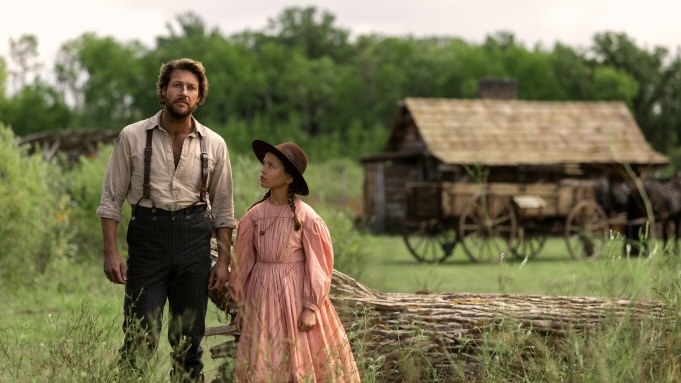
I obviously had an idea of what to expect from Netflix’s reboot of Little House on the Prairie despite the fact that I’ve never seen the original LHotP. But I have seen all of Taylor Sheridan’s work (god bless me), and I am currently reading Lonesome Dove (don’t ask), which has a foreword written by … Taylor Sheridan. I have been conditioned to expect certain things from these settler Westerns, and I’ll grant Little House on the Prairie this much: It’s a refreshing surprise to watch a narrative like this that doesn’t end in the worst way imaginable.
That doesn’t mean that Little House on the Prairie is particularly good, although I suspect that fans of the original will get what they want out of it: a sweet, overly sentimental Hallmark version of the Old West that at least attempts to reckon with the fact that White settlers literally squatted on the land of the Osage, which is more than we can say for Laura Ingalls Wilder’s books or NBC’s original series. I suspect, however, that doing so reads as “woke” to much of the audience drawn to the reboot in the first place: “How dare Little House on the Prairie attempt to humanize Native Americans!”
But that’s where I actually think Taylor Sheridan’s account of the Old West is at least more honest. Sheridan is a lot like Supreme Court justice Neil Gorsuch: conservative in most ways, but sympathetic enough to Native Americans that he’s not going to sanitize land theft or paint white settlers as good, well-intentioned people just trying to further progress. Sheridan may love his repetitive character tropes, but he doesn’t shy away from the fact that his white characters ruthlessly stole land from the Natives and cruelly assimilated Native children in boarding schools. The whole premise of the 1883, 1923, and Yellowstone arc is: The white folks kind of got what they deserved for trying, over 150 years, to hang on to land that wasn’t theirs to begin with.
Anyway, I couldn’t help but think through the entirety of Little House on the Prairie about how Taylor Sheridan (or Larry McMurtry, for that matter) would treat the exact same storylines.
Episode 1: The Ingalls trek from Wisconsin across the Midwest to stake a claim to land owned by the Osage in Kansas. While crossing a river, their stagecoach nearly tips over, but Charles Ingalls barely manages to save them, although the dog falls into the river and floats away. But worry not: Laura Ingalls leaves a trail of breadcrumbs and, by the end of the episode, their dog Jack has found its way back home to them.
Taylor Sheridan’s Version: We’ve seen this before. The stagecoach tips over, half the people drown, most of the food is lost, and a few people with dysentery literally sh** themselves to death. The dog survives the river by is eaten by a bear.
Episode 2: The Ingalls meet Mr. Edwards, a nice man with a drinking problem owing to the fact that his wife and daughters died while he was away in the war. The Ingalls believe in the best of him, and Mr. Edwards helps them build their new house on the land they’re squatting on. Caroline calls him out because his alcoholism threatens the safety of her family, so Mr. Edwards leaves for a few episodes, but Laura’s faith in him eventually leads him toward sobriety and a fresh start with the Ingalls.
Taylor Sheridan’s Version: A drunken Mr. Edwards tries to prey on the Ingalls’ women but is bitten by a rattlesnake in the process. Instead of seeking treatment, Mr. Edwards downs a bottle of whiskey and quietly lets the rattlesnake poison do its job.
Episode 3: A couple of young Osage men force their way into the Ingalls’ home and steal a few supplies and a doll that Caroline’s father gave her, as compensation for stealing their land. But the mother of one of the Osage men makes her son give the doll and the coffee back, though she agrees to hang onto the other supplies.
Taylor Sheridan’s Version: The Osage men take the doll, the coffee, and the supplies, and no one’s mother makes anyone give anything back, because in Sheridan’s West the only people who return what they stole are the ones about to be shot for it.
Episode 4: The Ingalls family comes down with a terrible fever, as does an Osage family (the Mitchells), but after Laura attempts to go into town to get the doctor for both her family and the Mitchells, the two families start to grow close. After receiving quinine from the doc, they all recover.
Taylor Sheridan’s Version: Most of them die of malaria because they refuse to accept medicine from a Black doctor (this is also The Gilded Age version).
Episode 5: Mr. Edwards is wrongfully accused of being a horse thief, but Charles Ingalls is determined to prove his innocence, which he does by finding the actual horse thieves, whom he decides to let go as long as they leave town and never return.
Taylor Sheridan’s Version: Mr. Edwards is tragically hanged for being a horse thief before Charles Ingalls can prove his innocence. However, he does locate the actual horse thieves, who are also hanged in the town square for all the citizens of Independence to see.
Episode 6: It’s a Christmas miracle when Caroline gives birth a month early to a beautiful new baby!
Taylor Sheridan Version: Caroline definitely dies in childbirth.
Episode 7: The Osage convene for a crucial tribal council where the future of their land is at stake. They must decide whether to take an offer from the government or fight for their land.
Taylor Sheridan’s Version: There is no council, because there is no choice to deliberate. The offer arrives as a massacre, the survivors are marched into Indian territory, and their children are shipped off to boarding schools to be beaten out of their language and into Protestants. Sheridan’s version isn’t crueler than what happened. It’s just the version that admits it did.
Episode 8: After the Osage agree to a deal, a fire threatens to destroy the town on Founder’s Day, but Laura Ingalls sings a song and the wind changes direction, saving the town. In the end, however, both the Ingalls and the Mitchells are screwed out of their land by the government.
Taylor Sheridan’s Version: Both the Ingalls and the Mitchells are still screwed out of their land by the government, but that fire also destroys half the town and leaves a trail of charred bodies for which Charles Ingalls has to dig a mass grave.
So, no, I’m not going to tell you Little House on the Prairie is the honest account of how the West was won. It isn’t. Sheridan’s is — the land was stolen, the children were taken, and nobody’s mother made anyone give it back. But there’s something to be said for a show that lets a dog find its way home, that lets a fever break, that lets a family survive the winter intact. Sheridan tells you the truth. Little House tells you a lie and pats you on the head and there are people who still call it too woke.


