
Old School. Biblically Independent.
By Dustin Rowles | TV | December 15, 2025
One of my favorite sequences from Vince Gilligan’s Better Call Saul is the opening of season three episode “Expenses,” in which Mike Ehrmentraut (Jonathan Banks) meticulously disassembles a car. The sequence is several minutes long and wordless, as Mike methodically removes the panels, the seats, and even drains the mechanical fluids while searching for a tracking device. It’s quintessential Gilligan: an obsessive character given the screen time to be genuinely, methodically obsessive. It’s one of my favorite qualities about his work - his refusal to rush craft.
The seventh episode of Gilligan’s new series Pluribus may have actually taken that philosophy too far. This is a 45-minute episode that most television showrunners would have condensed into a three-minute montage. The fact that Gilligan does not is what makes him such a remarkable showrunner. But also? Even by his standards, this one tests your patience.
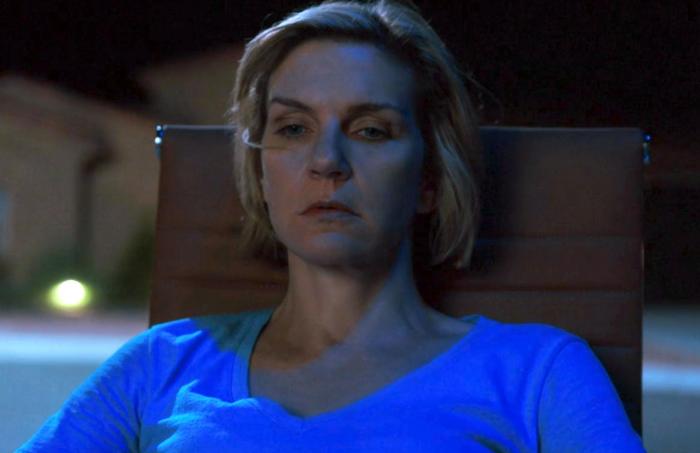
The episode runs on two tracks. First, there’s Carol, isolated from the hive mind in Albuquerque. She’s not just alone; she’s spiraling. She howls at wolves because it’s the closest thing she can find to conversation. She calls the hive-mind recording to request an ice-cold Gatorade, not because she wants one, but because she needs to hear a human voice. She sings to herself. Steals a Georgia O’Keeffe painting from a museum for her house. Has the hive mind prepare an elaborate dinner at her favorite restaurant, then eats it alone. She drives golf balls through skyscraper windows out of pure, soul-crushing boredom. By the episode’s end, she’s so numb to existence that she stares blankly into the barrel of a massive firework that shoots past her head by inches and ignites the house behind her.
Finally, completely broken, Carol paints a desperate plea on the pavement of her cul-de-sac, begging the hive mind to return. When Zosia finally arrives, Carol collapses into tears. She hates what humanity has become, but she also recognizes that she can’t survive without it.

Meanwhile, our Paraguayan friend is waging war against the very concept of help. He drives from Paraguay to New Mexico along the Pan-American Highway, refusing every offer of aid from the hive mind. He runs out of gas and walks miles through brutal heat, turning down water. When he reaches the Darién Gap - 100 miles of unforgiving rainforest, swamps, and mountains - he plunges in alone. After falling backward onto the spikes of a Chunga Palm, impaled and bleeding, he keeps walking, muttering his rehearsed English phrases for Carol. He collapses only when his body gives out entirely and is rescued by helicopter, almost certainly against his will.
The parallel journeys couldn’t be starker. Carol discovers that radical individualism is a slow-motion suicide. She has every material thing she could need, and it’s killing her. The Paraguayan, meanwhile, would rather be literally impaled than accept the hive mind’s help. Where Carol learns she needs people even when she despises them, the Paraguayan clings to self-reliance beyond reason or survival. One proves that autonomy without connection is unbearable; the other tests whether pure individualism can sustain life at all. Spoiler: it can’t. Both are shattered by their extremes, and Gilligan makes us watch every excruciating second.
It’s a brilliant, challenging thought experiment. It’s also kind of exhausting to watch. You keep waiting for something, anything, to happen: a plot twist, a revelation, a break in the monotony that mirrors Carol’s cabin fever and the Paraguayan’s suffering. Yes, the episode matters. Gilligan clearly has something important to say about the tension between individuality and collectivism. But he makes you feel the cost of that lesson in real time.
Still, I love that Gilligan has this much faith in his audience. And we’ve earned enough trust from his previous work - and the first six episodes of Pluribus - to believe the episode serves a larger purpose. But I’d be lying if I said a small part of me didn’t wish he’d just given us the damn montage.


