
Old School. Biblically Independent.
By Dustin Rowles | TV | December 8, 2025
There was a lot going on in this week’s episode of Pluribus, and it felt unusually eventful. My immediate takeaway, though, is that the hive mind isn’t as nice as we might have assumed. They’re edging into genuinely evil territory, and not just because they apparently derive nutrients from corpses (although that’s disturbing enough), but because of that ending. The hive mind chose the Paraguayan’s mother to pressure him into joining them. That’s beyond manipulative. And they’re using John Cena as a literal vessel to normalize their whole “nutrients from dead bodies” message.
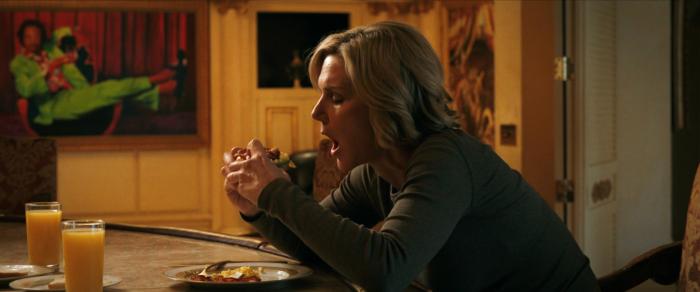
But that’s not even the moment in Plurubis that stuck with me. I was most struck by Mr. Diabaté quietly mimicking Carol while she ate breakfast, adding the avocado, eggs, and bacon to her toast. Why was this so interesting? It reveals a few things.
First, it suggests Diabaté is craving individuality. In the poker scene, he was irritated by the hive mind guy who slipped out of character. He’s living out this extravagant fantasy, yet it’s starting to feel unsatisfying. If you could get anything you wanted, anytime you wanted, eventually the predictability would wear you down. Nothing feels earned. Carol offered something new: a flavor combination he didn’t even know to request from the hive mind.
Put another way, if the hive mind represents AI, then AI only answers the prompts you already know to give. Carol’s breakfast gave Diabaté something he couldn’t have asked for because he didn’t know it existed.
The scene also shows how the hive mind erases culture because everyone shares the same experience. Yes, Carol is a basic white lady eating avocado toast, but even that basic white lady culture has been flattened. For Diabaté, it was a genuine discovery. He learned something new about her world.
He also seemed genuinely delighted by it. There was a small, almost childlike curiosity in the way he copied her movements. It was the first time we’ve really seen him react with anything approaching wonder. That moment felt more human than anything we’ve seen from him so far, and it came from the simplest interaction imaginable.
And that’s what makes the contrast between Carol and Diabaté so interesting. She’s not powerful or a supermodel. She’s just living her life, and somehow that gives her a kind of accidental leverage. The hive mind can control massive networks of bodies and intelligence, but what they can’t replicate is the messy little details that come from actually being human. They can imitate, but imitation isn’t the same as understanding.
That gets at the bigger theme of the show: The hive mind believes it knows what’s best for humanity because it can think collectively. But what makes being human worthwhile isn’t collective thinking, it’s individual experience. The things we stumble into by chance, like breakfast combinations. Those aren’t flaws in humanity, they’re the point of it.
So if this episode is building toward anything, it might be this: the hive mind doesn’t actually value what makes people human. It wants compliance, not curiosity. And that may end up being its weakness because I think, in Diabaté, they’re losing their grip on another outsider who may just find Carol’s indidivualistic approach to life more rewarding.


