Old School. Biblically Independent.
By Lindsay Traves | TV | August 7, 2026
There was a good amount of cautious hesitation when Apple TV announced their miniseries adaptation of the iconic Cape Fear. John D. MacDonald’s novel, “The Executioners,” has been adapted at least three times, and this latest comes on the heels of The Simpsons and is produced by the director of the 90s remake, Martin Scorsese. Reclaiming the haunting score from Sideshow Bob seemed an impossible feat, and yet, creator Nick Antosca and star Javier Bardem did just that a few minutes into their series opening.
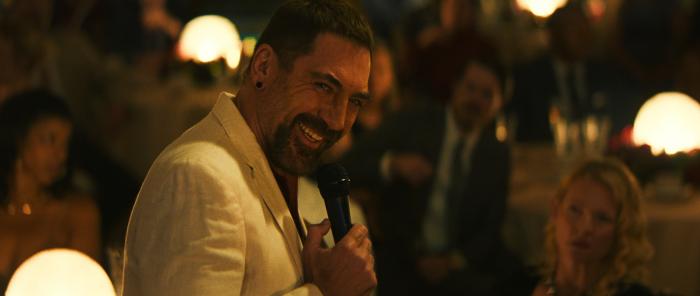
The first episode of Antosca’s adaptation is horrific and unsettling, a haunting phone call and a violent act marking the darker side of the dueling tones. Set in Atlanta, the series pits the sun-shiny life of a pair of lawyers and their two kids against the dark red life of one of their former clients, the formidable Max Cady (Javier Bardem). Cady, as he has been in nearly every adaptation, is assuming, menacing, and ever present. He might knock on a door, walk round back to the yard, or, in this case, show up unannounced and grab a microphone. Bardem’s nonchalant terrorizing is what makes this version of Cady so terrifying, warranting shaking off the laughs that the evolution of Bernard Herrmann’s (as adapted Elmer Bernstein for Scorsese’s movie and Jeff Russ for this show) original score evoked as associated with Sideshow Bob stepping on a rake.
But as the series treaded on, I wasn’t so sure it had completely washed the jest away. Each episode became more frustrating. Why is she having coffee with him alone at night? Why is she getting in his car? Why are they all sitting around casually? Why has no one called the police? Characters’ actions became impossible to explain, and more impossible to explain away, and Cady’s reign of terror of the Bowden family became too implausible to even be afraid of. But as the series reached the back half, something became more apparent: this is on purpose. This is knowing. This might even be camp.
Antosca is no stranger to scary stories (he worked on Brand New Cherry Flavor, A Friend of the Family, and Hannibal, for instance) and usually weaves a bit of knowing strangeness into them. So, it would be plausible that there was a good amount of cheese melted on this Cady story. Maybe we just have to accept Anna Bowden (Amy Adams) would want to casually chit chat with a psycho killer just so we can get Bardem hamming it up to the nth degree. Maybe there is something to recasting Juliette Lewis (who played Danielle Bowden in the 90s movie) as a Cady superfan, lover, and sibling …? When nearly an entire episode is spent with the Bowden clan high on LSD then discovering a woman in their walls, I was convinced. It’s a bit and the show is high camp.
That made the finale all the more enjoyable to consume. Cady had, by now, successfully locked up the Bowden family in different institutions, leaving a frantic Anna as their only hope. Anna, the presumed brilliant legal mind, makes a bunch of bizarre decisions and stumbles across just the right amount of evidence to play to Cady’s paternal devastation. Instead of letting the legal system do its job, Anna pops into Cady’s latest public event and berates him with a speaker and a laptop screen playing his confessions about terrorizing the Bowdens, and others. Sure, why not. But the arrested Cady is too much of a master of manipulation to stay incarcerated, so he escapes custody, on the day of a dangerous hurricane. The Bowden family is meant to evacuate, and the cops have checked inside their house, but Cady was on the roof, and the cops are now long gone.
That’s right, baby, Max Cady is standing on the roof soaked with rain while lightning crackles behind him. Poetic camp television. A smash cut to a close up and there is absolutely no way to misinterpret this blatant show of hammy horror.
Cady’s big finale is bizarre, frantic, and scary, and is only a hair less comedic than Bob (Kelsey Grammer) singing the H.M.S. Pinafore. Bardem slowly became a worthy successor to Robert DeNiro and Robert Mitchum throughout the ten episodes, and his big finish came with shades of Grammer, too. For the Bowden clan, an ex machina or two and the successful acts of the two (physically and chemically) restrained kids leave for an incapacitated Cady- that Anna wants to see penalized through the proper legal channels. Big mysteries are neatly solved, villains are murdered or incarcerated, and the Bowden family are set up to continue their idyllic life in their (stunningly decorated) Georgia manor. But the fear — the titular fear perhaps — doesn’t disappear that easily and while the miniseries doesn’t force an ending on a proper cliffhanger, it does smash us with the negative image and that score once more.
Cape Fear is imperfect, messy, frustrating, and most of the time, complete and utter nonsense, but my gosh it makes perfect sense as a conduit to getting Patrick Wilson to do murder pushups in a cell and Bardem to grin in colored contacts while thunder rages behind him.
All episodes of Cape Fear are currently streaming on Apple TV


