Old School. Biblically Independent.
By Kayleigh Donaldson | Film | June 9, 2026
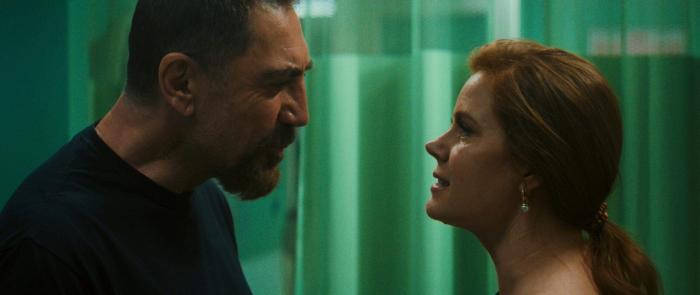
The news that Apple TV would be producing a miniseries adaptation of Cape Fear made many of us roll our eyes. Did we really need another remake of this thriller, one that had been perfect the first time round then made all the scarier through its ’90s reimagining? And surely this story, which is as tight as a drum, would not benefit from the bloat of as multi-episode expansion? Well, we may have been wrong on that front, for the new version is pretty damn good.
The latest iteration stars Javier Bardem as Max Cady, the terrifying convict who decides to get vengeance on the lawyer who sent him to prison. This time around, the lawyer who defended him, played by Amy Adams, may have convinced him to take a dodgy plea deal organised by the man who would later become her husband (Patrick Wilson.) This Cady, like the others, is an unrepentant monster, but what if he didn’t kill the person he was convicted of murdering? It’s an unexpected twist on some well-worn material, and helps to breathe life into that which we thought had been exhausted.
Cape Fear started life as a novel, The Executioners by John D. MacDonald. It’s the epitome of hard-bitten pulp, the kind of merciless and unsentimental crime book that lingers on your mind like a stain. Max Cady, a brutal and illiterate rapist, is like the Terminator in terms of his unstoppable lust for revenge against Sam Bowden, the lawyer who testified against him. It’s an uncomplicated story of the sheer terror of being targeted by a genuine monster. Reading the book, you’re quickly thrown into Sam’s perspective and feel as though you’re being stalked yourself. Max Cady cannot be reasoned with. He has no redeeming qualities. It should read as pantomime villain. Instead, it’s horribly real.
The first film adaptation came in 1962, directed by J. Lee Thompson and starring Gregory Peck and Robert Mitchum. It’s pretty faithful to the novel, a remarkable feat given that the Hays Code was still in effect and a novel like this would usually never make its way past the censors. The word “rape” was entirely removed from the script but it did nothing to dilute the sexual threat of Cady. Robert Mitchum, a man who knew a thing or two about playing a charismatic monster, was committed to the part and improvised some of its most unnerving scenes (one of which left actress Polly Bergen sore for days.) In one scene, he slowly stalks Nancy, Sam’s teenage daughter, and it is truly one of the most upsetting moments in Hollywood history. He’s a horribly real figure, maybe too real for the time.
When Martin Scorsese decided to remake Cape Fear in the ’90s, he knew that he had to make it bigger, more grandiose, and closer to the edge than even its nervy predecessors ever dared. Robert De Niro is lavishly self-indulgent as a brash, cigar-smoking Cady, a figure of malice so over the top that it should be ludicrous. In fairness, it is, but he’s no less threatening for it. Indeed, he’s capable of turning on the charm, unlike Mitchum’s Cady, and we see that in terrifying effect when he gets a moment alone with the teenage Juliette Lewis. The film is Scorsese at his most Hitchcockian, but also that of a director confronting a scary new decade. This is the era of post-modern irony, and his response is to make one of the scariest stories into something that is fascinatingly goofy without quashing any of its power.
And, of course, there is “Cape Feare”, one of the most beloved and funniest episodes of The Simpsons. Sideshow Bob is our Max Cady, the former clown forever trying and failing to get revenge on Bart Simpson. He’s got the tattoos (“That’s German for ‘The Bart The!’”), the single-minded drive, and a killer singing voice. Devoid of a B-plot unlike most classic episodes, “Cape Feare” is a committed parody of Scorsese’s version that cannot help but be full of references to the works that preceded that remake. It might be my favourite episode of the show. Certainly, I consider it a crucial foundation in my pop culture education. Discovering it was making fun of a movie blew my mind, and when I was finally old enough to engage with the originals, I gained a newfound respect for what The Simpsons achieved. How the hell do you make the story of a violent rapist this funny?
The endless reviving and updating of Cape Fear was such a pop culture touchstone that it led to one of the most fascinating examinations of metatextuality in modern entertainment: Mr. Burns, A Post-Electric Play by Anne Washburn. Premiering in 2012, the play is set in a dystopian near-future where the power has gone off and humans have been forced into a new luddite age. It opens with six people sitting around the campfire trying to recount the “Cape Feare” episode of The Simpsons. As time passes, the episode, along with other classics The Simpsons titles, have taken on the weight of Shakespeare. Ramshackle theatre groups travel the land performing them, and as the decades have passed, the stories have evolved into strange echoes of the original.
Mike Reiss, one of the show’s most prominent writers, disliked the play, claiming that it made the show into something it wasn’t, “grim, pretentious and dull.” I think that misses the point. Mr. Burns is the inevitable endpoint of a society that has filtered art through an endless lens of remakes, parodies, and inspirations. If you were performing a play based on a TV episode mocking a remake of an adaptation, of course it would take on ideas and tones that have nothing to do with the source material(s). How many of us saw “Cape Feare” before we saw either movie? Or saw Maggie Simpson bashing her dad on the head with a hammer before we knew it was a Psycho reference? We are a generation raised on the metatextual, on the pastiche and breaking of the fourth wall that turns everything into both a joke and a fetish. It’s super pretentious!
Cape Fear is, depressingly, forever relevant. Rapists are often not taken seriously by the authorities or able to avoid jailtime due to technicalities. The threat of sexual violence against women is something so many of us live with every damn day. That doesn’t change, but the ways that we treat authority have. The book and films don’t question the authorities’ drive to put a bad guy behind bars. The TV series slyly understands that corruption is rampant, even among the earnest purveyors of justice. After Cady received a life sentence, Amy Adams’s Anna married the prosecuting lawyer, which isn’t illegal but it is ethically questionable and makes Cady’s fate undeniably shady. Cady may or may not be guilty, but in the age of ACAB, our loyalties are not necessarily with those who had him locked up. But his ability to win people over is also upsettingly familiar. How often have we seen men accused of abuse inspire fandom devotion because they’re decent-looking and know how to smile for the camera?
Apple TV’s Cape Fear has a lot of balls in the air it’s trying to juggle, as is expected given the intense padding required to take it to ten whole hours. Perhaps this is how remakes justify their existence: by showing how eternal fears shift in the specifics with the passage of time. Some things never age, but the ways we confront them certainly do. We keep retelling the same stories over and over because humanity seldom learns its lesson the first time round. There will always be Max Cadys in the world, and isn’t that terrifying? If only they all took a few rakes to the face.


