
Old School. Biblically Independent.
By Dustin Rowles | Film | February 26, 2026
Netflix releases a lot of movies. A lot of those movies quickly surface in the algorithm, compel us to watch them, and then are so bland and algorithm-friendly that we completely forget them. But occasionally, Netflix will release a decent movie that gets completely forgotten by the algorithm before we've even had a chance to watch. Here are seven of those films (or rather, six plus one OK film that no one remembers existed).
The Hand of God -- In the 1986 World Cup, the Argentinean soccer player Diego Maradona scored a goal against the Brits using his hand -- a no-no in that game -- but at the time nobody could prove he used his hand, and so the goal stood. Maradona was quoted later saying that he made the goal "a little with the head of Maradona, and a little with the hand of God," giving the now legendary and legendarily infamous play -- not to mention the sprawlingly novelistic and impassioned new coming-of-age film The Hand of God from The Great Beauty and The Young Pope director Paolo Sorrentino their shared names. Sorrentino's film, a full feast and a wonder that's loosely based on Sorrentino's own teen years in Naples over the course of a few weeks in the mid-80s, shows us that goal on the T.V. as our main characters see it and as they immediately process it into the stuff of legend. Our main character Fabietto (Filippo Scotti) is seized on the arm by his uncle, wild-eyed and dizzy with the kind of triumph only sports fans or U.F.O. cultists truly know, who proceeds to tell him that the play was an act of revolution, clearly intended as a slap in the face of the British who'd just fought a war with the Argentines a few years earlier. He declares Maradona a god, and the greatest player who's ever lived. - Jason Adams

Fair Play -- It was all bliss when Luke (Alden Ehrenreich) moving up in the company was the idea. But when Emily (Phoebe Dynevor) gets promoted instead of him, it's no longer a cause for celebration. She is now Luke's boss, and he says he's proud but drinks away his frustration. He distances himself. The passion in their relationship completely fizzles out. His words are no longer loving, but harsh and judgmental. How their relationship changes is fascinating to watch because you know nothing would have changed between them if the roles had been reversed. In the cutthroat corporate world of finance, she runs circles around everyone, making more big calls than her colleagues, but the men around her expect more for less. They, including Luke, look at Emily with contempt and assume that the only way she got to the top was by sleeping her way up. The script twists the couple's relationship into a sick power play. He plays with her head and she takes his advice instead of going with her gut - she still carries that notion that men know best. She's not allowed to be a confident, successful woman in business, and god forbid she makes a few mistakes along the way. It may not be as taut as it hopes to be, the film overstaying its welcome a bit, but its screenplay is something to admire. Domont knows how to build tension, and it grows increasingly volatile between the couple, building slowly until it rises to volcanic heat. And explodes in the most satisfying way. It's a brutal and intoxicating takedown of gender workplace politics, male fragility, and ego. Not only are we fully emerged in Emily's plight and the changing dynamic that forms between the film's leads, but the film never loses us in the Wall Street mumbo jumbo. Despite not understanding the finance lingo, you can feel both the losses and the wins. -- Sara Clements
I Don't Feel at Home in This World Anymore -- There's not a lot of subtext here beyond gaining a new perspective on life by virtue of seeing others lose theirs. I Don't Feel at Home in This World Anymore starts slowly and contemplatively in one genre and crescendos until a hell of a final act that seems to take place in another genre altogether, one that has more in common with Jeremy Saulnier's Green Room (which featured director Macon Blair in an acting role). However, the two genres play well together. Melanie Lynskey is -- as always -- superb, as she evolves into this generation's Parker Posey, while Elijah Wood continues a streak of oddball indie roles designed to ensure that no one ever finds him sexually appealing again. It's not an earth-shattering film, but it makes for solid Netflix fare for a Saturday night, and it's a must-see for the Lynskey enthusiasts among us.

6 Balloons -- It's a searing depiction of an addicted father and his co-dependent sister, and there's something about seeing Dave Franco and Abbi Jacobsen in those roles that makes it so much more relatable. They're like people we know. A young father. A woman who just wants to give her boyfriend a party. We have no idea how Seth ended up in the situation he is in, but it hardly matters. It really could happen to almost anyone. Addiction is an ugly, painful, horrifying thing that takes sons away from mothers, fathers away from daughters. Six Balloons personalizes that, and it makes that story our own, or at least one that could be our own. It's a powerful, restrained, and weirdly beautiful film about addiction, about co-dependence, about siblings, and about family, and about that one night when a sister had to buy her brother heroin so that he wouldn't die.
His House -- I say all that as a precursor to His House, one of the most engrossing horror films I've seen in a long time. Remi Weekes's film has heavy, unrelenting weight, but it's also elegantly constructed, visually adventurous, and grounded by a pair of excellent performances. Most impressive is how Weekes weaves together typical horror elements - jump scares, spooky kids = with the film's more inward-minded exploration of the damage we carry with us and the transgressions we might never get over. His House manages that tricky combination of things that tangibly go bump in the night and things that creep into your memory, and it's an attack from all angles. -- Roxana Hadadi
Apostle -- Apostle comes from Gareth Evans, the writer/director behind the mind-blowing and spine-snapping The Raid. But fans anticipating jaw-dropping fight scenes in the Apostle will be disappointed. This Netflix release is less action and more horror. In Apostle, Dan Stevens stars as Thomas Richardson, a drug-addled former-preacher whose tasked with rescuing his beloved sister from a mysterious cult. To access their private island, Thomas must go undercover as a believer. But ritual bleedings, a charismatic prophet (Michael Sheen), bizarre sermons about a crop-giving goddess, and a sketchy secret passage suggest he may be in over his head. With a methodically paced first act, Evans brews dread as he keeps us close to Thomas, whose eyes coldly take in the scene of these believers who'll blithely give their blood for the promise of paradise. It's not long before the prophet Malcolm is on his scent. A game of cat and mouse plays through the humble cabins, across rotting fields, and through a river of blood. At every step, Stevens is riveting. His feckless rage burns so hot it scorches the screen. His steely calm in the face of Malcolm and his armed minions made me think briefly he'd make a keen James Bond. But such a role would be a waste of Steven's truest talent: getting, down, dirty, and wildly theatrical. -- Kristy Puchko
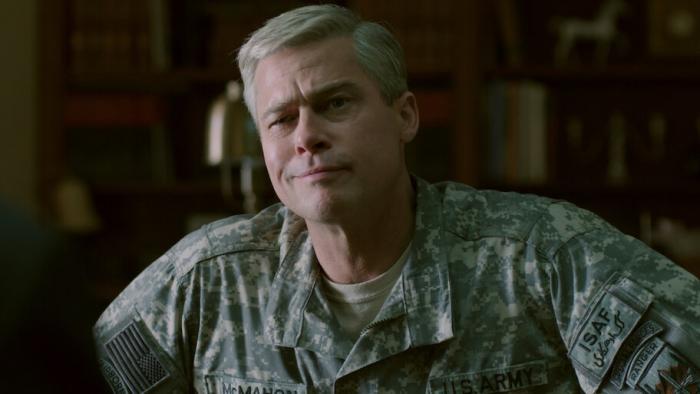
War Machine -- (This one wasn't actually very good, but it seems impossible that Brad Pitt released a film starring Lakeith Stanfield, Anthony Michael Hall, Alan Ritchson, Topher Grace, and Tilda Swinton that I have zero memory of, despite the site having reviewed it). The film is inspired by Michael Hastings' 2012 book titled The Operators, which is a behind-the-scenes look at the high-level military machinations around the war in Afghanistan, and in particular the downfall of General Stanley McChrystal, the man in charge of U.S. and international forces in the country. In fact, McChrystal's downfall came about after Rolling Stone published a profile of the General, also written by Hastings, who spent a month with McChrystal and his closest men. The article depicted these men -- the ones ultimately leading the U.S. policy in Afghanistan -- getting "shitfaced" and insulting Vice President Biden, amongst other things. It got the General fired. Perhaps a confused movie about a confusing military operation is appropriate. And to be fair, I walked away from this movie feeling like I learned something about the reality of the situation in Afghanistan -- namely, the frustration of soldiers who are trained to kill and to win, who are putting their lives on the line while being rewarded for showing restraint and not killing. Soldiers who are expected to win, but have no idea what that even means after so many years, while general after general cycles in to fix things and politicians around the world decide their fate. Soldiers protecting people who just want them to leave (and rightfully so). -- Tori Preston


