Old School. Biblically Independent.
By Kayleigh Donaldson | Celebrity | October 16, 2025
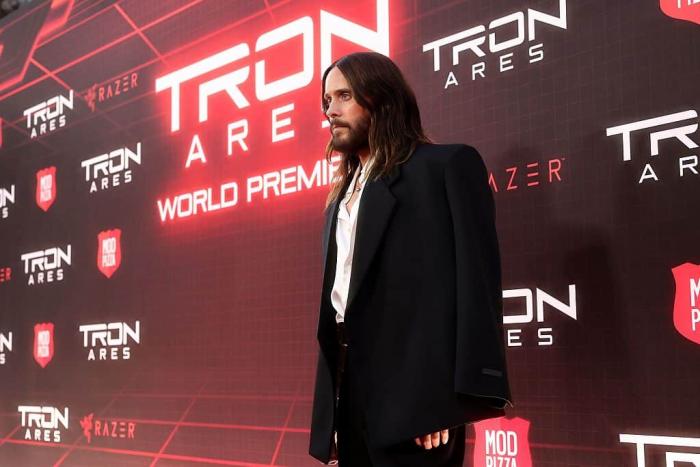
Tron: Ares premiered this past weekend to middling reviews and a box office gross to match. Disney’s continued attempts to make fetch happen with the Tron franchise are arguably more interesting than the movies themselves. This latest reboot-slash-sequel was preceded by a lot of discourse over why it even existed. Who was it for? Would it succeed this time when the previous two films failed to become mega-hits? The opening weekend numbers suggested that not even the biggest ’80s nostalgia nerd or Nine Inch Nails fan wanted Tron: Ares. Or, maybe it was that they didn’t want more of its star.
We’ve talked a lot about Jared Leto on this website. Every time he pops up in yet another movie, we’re forced to reckon with his baffling omnipresence in an industry that increasingly has no want nor need for him. How is it that this man keeps getting opportunity after opportunity to make middling movies that commercially disappoint? In a more sensible timeline, he would have been put out to pasture a long time ago, and that was before he was revealed to be an alleged sex criminal. Alas, we have to have this conversation once more. I am Sisyphus pushing this boulder up the hill.
Those of us of a certain age remember the good days. We remember Jordan Catalano and Leto’s era of being a sensitive heartthrob who appealed to the smart girls with his big eyes and poetic charm. We watched Girl, Interrupted and Urban Legend. We were sad to see Edward Norton pummel his face to pieces in Fight Club, and Patrick Bateman axe him to death in American Psycho. As he grew into a more niche indie actor, it seemed interesting, at least until we all got wind of his tedious method acting.
I remember when he signed up to play Mark David Chapman in Chapter 27 and the faint whispers of Oscar buzz that accompanied it. The headlines were in awe and repulsion at his weight gain to play John Lennon’s killer, detailing with glee his diet of microwaved pints of ice cream mixed with soy sauce and olive oil. It was a process that gave Leto gout and left him in physical agony during production. That was positioned as a grand artiste’s sacrifice, as well as his insistence on staying in character during the shoot. The film flopped (although its Wikipedia page is hilariously selective in its reviews, suggesting that a Leto fan wrote it.) It was a folly for a man trying way too hard.
But trying way too hard won him an Oscar when he played a trans woman in The Dallas Buyers Club. It’s a victory that aged like milk, and not just because of the questionable gender politics of once again having a cis man play a trans woman. Leto’s performance is cliché-ridden, although the script also does him no favours. But it was considered ‘brave’ and ‘transformative’, so of course he won Best Supporting Actor. And of course he spent that entire awards season talking about his great body and overlooking all the trans voices the story was built upon. How could he get any more annoying? Well, have you heard of this character called the Joker?
We don’t need to relitigate the absolute nightmare that was the production of Suicide Squad, which remains one of the absolute worst films I have ever seen. We’ve talked about it so many times before and it’s now practically the stuff of Hollywood lore. But it’s still fascinating how Leto’s tyrannical reign of faux-method nonsense and workplace harassment was intended to be a grand display of the movie’s dark and highly marketable soul. We were supposed to be dazzled by the idea of Leto inducing mental terror in his colleagues by sending them live rats and used condoms. It was meant to be fascinating to us that Leto engaged in such ceaseless self-flagellation to play this nefarious character. Oh, you thought Heath Ledger ‘went too far’ (a nasty falsehood of the late actor’s life and process that has sadly been latched onto his legacy?) Wait for the rats.
That it resulted in a mere ten-minute cameo in an ineptly edited mess of tones and intentions was almost too on the nose. It would have needed to be one of the greatest performances of all time to even come close to justifying the jackassery at its heart, and Leto didn’t even come close. The ‘method’ became the story, and audiences were sick of this pattern. From thereon, Leto didn’t improve or take a step back from his increasingly trademark theatrics. He doubled down and added a culty element to it. Possibly literally so.
From a purely professional perspective, Leto’s post-Oscar career is very odd. It’s sporadic but mostly defined by blockbuster roles that could have been played by anyone. Did you even know that he was in The Haunted Mansion? More ‘actorly’ roles did little to eschew the narrative that Leto was doing too much. In The Little Things, he played a stock weirdo who distracted more than he unnerved. In House of Gucci, he slathered himself in prosthetics and a fat suit to ham it up to the nines, and some people appreciated it, but I found it to be a deeply misjudged reading of the film’s tone. Audiences had long stopped being interested in Leto performances. His presence began to feel like a liability.
Earlier this year, AirMail published a detailed report into allegations of sexual misconduct and impropriety by Leto towards at least nine women. It was an exposé that was shocking but not surprising. Frankly, people had been waiting a long time for such a piece. The stories were numerous and oft-repeated, both among the entertainment industry and online. It was such an open secret that James Gunn joked about it on Twitter. This was a long time coming… and it didn’t even make a dent in the cultural discourse. People moved on with record speed, simply shrugging at a thing they knew sucked but couldn’t change. Disney didn’t hide Leto from view during the Tron: Ares junket cycle, although he hasn’t given as many interviews as his co-star Greta Lee. The company just had to push forward with this middling film that audiences didn’t want, headlined by an accused sex criminal and box office flop.
We keep talking about Leto because his endless falling upwards is baffling even by the standards of an industry built upon it. Typically, when someone has this many financial disappointments and critical maulings to their name, they don’t get handed a $180 million franchise tentpole flick to headline (and Leto is bad in Tron: Ares, predictably.) Maybe he no longer sends live animals to his co-stars, but is he still worth the hassle and losses of profit and credit? Who is Jared Leto for? Why is Jared Leto?
One could go mad trying to figure out the answer, but I think the answer is wearily simple: the people in charge like him and they don’t care about anything else. They don’t have to pretend to care about hostile workplaces or misogyny now that the #MeToo backlash is in full force. They’ve fully cloistered themselves and their pals from the faintest shred of accountability, aided by vast sums of money, a political system that benefits from such toxicity, and even fans who cheer on accused abusers as a point of pride. So, why not keep up this ridiculous charade? Why not line Leto’s pockets with more and more money, even as audiences reject him? They’ll get over it eventually, right?
Leto’s next role is as Skeletor in the long-delayed He-Man movie that people have definitely been asking for. If Leto’s track record continues, expect it to underperform financially, receive meh reviews, and inspire yet another cycle of ‘why is Leto’ discourse. The snake will never stop eating its own tail.


