Old School. Biblically Independent.
By Dustin Rowles | TV | March 2, 2026
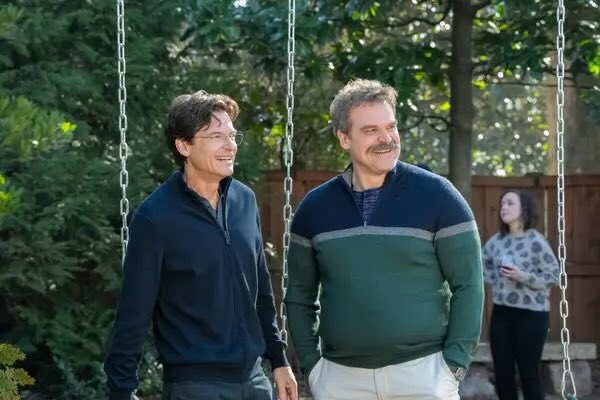
DTF St. Louis premiered on HBO Max this week. The series comes from writer-director Steven Conrad, and even putting aside the cast — Jason Bateman, David Harbour, Linda Cardellini, Richard Jenkins — there’s a small, cult-like audience that will follow Conrad anywhere. He created the phenomenally idiosyncratic Patriot and the wonderfully offbeat Perpetual Grace LTD, and I count myself among his devoted followers, even if I had to endure the delightfully (?) nonsensical Ultra City Smiths.
Neither Patriot nor Perpetual Grace LTD ever drew the audiences they deserved, and Conrad — who can also write for more mainstream fare (Wonder, The Secret Life of Walter Mitty, The Pursuit of Happyness) — seems to be attempting in DTF St. Louis to marry his sensibility to a concept that viewers might actually show up for in large numbers. And if you’re going to borrow from a current prestige television trend, you might as well borrow from one of the best in The White Lotus.
After one episode, it’s not entirely clear whether DTF St. Louis is a murder mystery, but it does feature the death of a major character halfway through the premiere, along with a promise to fill in that backstory. The fact that Richard Jenkins and Joy Sunday — who play detectives — are series regulars suggests that the show will follow a long investigation told in flashback.
The signature Conrad offbeat quality, however, comes less from the concept than from the tone. So far, DTF St. Louis feels like a morose, pitch-black comedy, the kind where a detective scrolls nonchalantly through Indiana Jones internet porn while casually discussing it with a colleague (this detective, we’re told, is “porn positive”).
But what, exactly, is DTF St. Louis about? Jason Bateman plays Clark Forrest, a television weatherman who befriends his sporadically employed ASL interpreter, Floyd Smernitch (David Harbour), who learned sign language because of his Peyronie’s disease, a condition that results in a noticeable bend of the penis. How the shape of his member led to a career in ASL has not yet been explained, but that’s precisely the kind of bizarre detail one expects from Conrad.
Smernitch is an overweight, intermittently employed, broke stepfather and a somewhat pathetic husband to Carol (Linda Cardellini). Their sex life has been on the skids since Carol began moonlighting as an umpire at Little League games, mostly because Floyd is turned off by the constant image of her in her unflattering umpire getup, nevermind the fact that Floyd walks around shirtless with his gut hanging loose — another Conrad flourish.
Clark, meanwhile, skews Bateman slimy. Though he claims to be happily married, he introduces a reluctant Floyd to the DTF app, which apparently allows married people to have their more unusual needs met outside the marriage. The two meet at an Outback Steakhouse to work on their profiles — yet another Conrad touch.
We don’t yet know what happens between the decision to join the DTF app and Floyd’s unusual death in an abandoned pool house, except that Clark embarks on an affair with Carol and that, at some point, Floyd finds out. The detectives, Homer (Richard Jenkins) and Jodie (Joy Sunday), arrest Clark for Floyd’s murder while he’s delivering a live weather report. The remainder of the series, it seems, will fill in the blanks.
In that respect, it’s very The White Lotus, though the structure isn’t exactly Mike White’s invention. It’s simply a popular framing device at the moment, and knowing Conrad, he’ll likely play within those boundaries while also finding ways to subvert them. There will no doubt continue to be flashes of black comedy, some of which may land a little too close to home, given what we’ve recently learned about David Harbour, in part from his ex-wife Lily Allen’s album about him.
Ultimately, the question isn’t whether DTF St. Louis can sustain its mystery, but whether it can strike the delicate balance Conrad seems to be aiming for: marrying his peculiar sensibility to a story sturdy enough to keep a broader audience hooked. The premiere suggests a show that’s darkly amused by human frailty — especially the humiliations we inflict on ourselves in pursuit of connection. If Conrad can tether his strangest impulses to the emotional fallout of Floyd’s death, it could be the rare series that satisfies both his cult devotees and viewers just looking for the next prestige-adjacent obsession. The jury’s still out.


