
Old School. Biblically Independent.
By Dustin Rowles | TV | June 17, 2026
If you found yourself deeply disappointed by the most recent season of For All Mankind (join the club; we had jackets made, even if the finale mostly managed to stick the landing), there is a very good reason for it. It turns out creator Ronald D. Moore was busy pouring all his creative ideas into Star City, a morally complex spin-off that reminds us why we fell in love with his brand of sci-fi in the first place (see also Battlestar Galactica).
Set in the same alternate timeline, Star City back to 1969 to follow the space race from the Soviet perspective. And good news for the uninitiated: you don’t need to have watched For All Mankind to jump in. All you need to know is that in this universe, the Soviets didn’t just beat America to the moon, they landed both a man and a woman there first.
So, the Soviet space program must be absolutely stoked, right? They won the ultimate Cold War dick-measuring contest.
Alas, that is not how it works inside the crushing gears of the Soviet apparatus. In this world, victory isn’t a cause for a parade; it’s just a brand-new set of existential threats to manage. The second you get ahead, the paranoia ratchets up because now you have something to lose. The cosmonauts aren’t treated like national heroes; they’re cogs in a rusty machine. State surveillance doesn’t take a holiday just because you planted a flag. If anything, having a win worth protecting means the meat grinder just works twice as hard.
That adds a layer of tension to Star City that the more hopeful For All Mankind never quite captured. These cosmonauts aren’t just fighting the laws of physics, they are actively trying to survive their own government just to do their damn jobs. Everyone lives under a permanent cloud of suspicion, and in mid-century Moscow, that suspicion can harden into a death sentence at a moment’s notice.
Take Yana Akhmatova, who was slated for the Luna 16 mission and expected to be the first woman on the moon. However, she is wrongfully accused of being a CIA asset. Even after the accusation is proven completely bogus, KGB surveillance chief Col. Lyudmilla Raskova has her imprisoned and executed anyway. Why? Because the Soviet Union is never wrong, comrade. If the USSR says you’re a spy, you’re a spy, and damn pesky things like “evidence” or “reality.”
This is the bleak environment the Soviet space program calls home. Engineers and cosmonauts are watched around the clock. Marriages are arranged by the bureacracy. Even Anastasia Belikova (Alice Englert), who gets rushed onto Luna 16 with a grand total of three days’ preparation and somehow still becomes the first woman on the moon, is immediately grounded from future flights. Her crime? Having the sheer audacity to thank the women who paved the way for her, including the late Yana Akhmatova, instead of directing 100% of her gratitude toward the glory of the State. (That she was the first woman on the moon was all that saved her from execution).
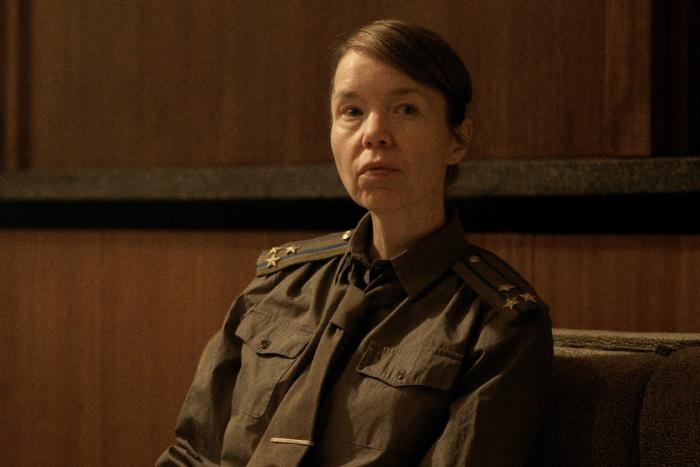
But the real reason to watch this show is Col. Lyudmilla Raskova, played with an spine-chilling brilliance by Anna Maxwell Martin. She is the Soviet system’s most faithful servant and, in a delicious twist of irony, its most likely next victim. She’s a decorated WWII tank commander turned KGB enforcer, known by her terrified subordinates as the “Night Witch.” She is controlling, cold, and surgically precise in the way she dismantles human beings.
The horror of her brilliance is infectious, too. Irina (Agnes O’Casey), Lyudmilla’s protégée, watches her boss execute Yana Akhmatova on explicitly faulty intel, and she doesn’t recoil exactly. She looks at her with something bordering on admiration. Irina wants to be the next Lyudmilla, because this is what peak competence looks like inside a paranoid totalitarian state: You don’t make mistakes; you make decisions, and then you force the State to validate them retroactively.
I want to call Lyudmilla the Aunt Lydia of Star City, but honestly, that’s doing a disservice to how terrifying she is. Lydia occasionally betrayed a microscopic ounce of human sympathy for the girls beneath her. Lyudmilla’s only true loyalty is to the apparatus, and that loyalty holds firm even when it becomes blindingly obvious that she is next on the chopping block.
Because the Soviet Union doesn’t give a damn about your loyalty any more than it cares about your innocence. If the party needs a scapegoat to cover up a mistake, years of faithful service don’t mean a thing. When Lyudmilla suspects American sabotage aboard a Soviet rocket, she actively jeopardizes the mission and the lives of the crew to disable it. A cosmonaut dies. And despite doing exactly what she was trained to do, she is blamed for the disaster anyway, because someone has to take the fall. It turns out that “someone” is always whomever the bureaucracy finds most convenient to crush. She is the perfect instrument of the state, destined to be used and discarded under the exact same logic she applied to everyone else.
Lyudmilla knows this, and she shows up for work anyway.
It is a testament to Anna Maxwell Martin that it’s hard not to feel a deeply complicated, nauseating kind of pity for her. She doesn’t play Raskova as a villain, exactly; she plays her as the machine itself, humming along exactly as programmed. And watching the machine inevitably get chewed up by its own gears is some of the most compelling television on the air right now.
She is, for all intents and purposes, the space-age reincarnation of Lavrentiy Beria, Stalin’s notorious secret police chief who built the modern terror apparatus, ran it faithfully, and was promptly lined up against a wall and shot the second he became more useful as a scapegoat than an enforcer. Just as Beria helped destroy his predecessors, Lyudmilla gave her entire life to a system that doesn’t give a good goddamn about her. The tragedy of Star City isn’t that she doesn’t see the knife coming for her back. It’s that she sees it perfectly, affixes a target to the back of her uniform, and goes back to work.


