Old School. Biblically Independent.
By Dustin Rowles | TV | July 14, 2026
Spoilers for the Star City finale
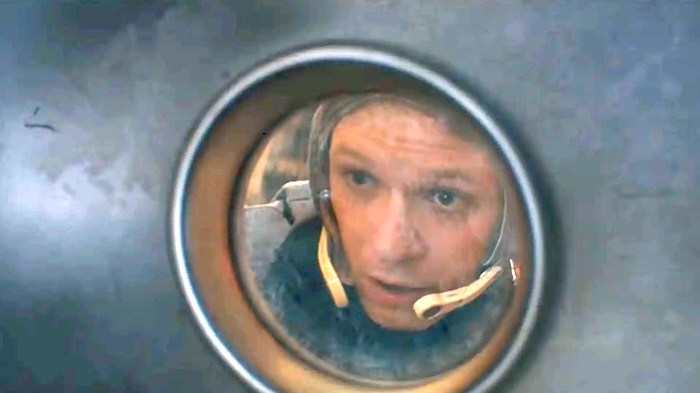
The Star City finale kills Valya (Adam Nagaitis) by dropping him to the surface of Venus in a bathysphere (basically a spherical deep-sea submersible ) and letting the pressure crush him. He laughs at the view. He implodes. It’s the best shot in the episode and it echoes the Titan submersible. Co-showrunner Matt Wolpert told SYFY there was “definitely some research” behind it, then immediately admitted he doesn’t know if it’ll “hold fully up to the scrutiny of physics,” and joked that there’s only one way to find out.
There is not only one way to find out. The Soviets actually did this in 1970 and there are receipts.
There is a real Venera 7 — the show borrowed the name, so the show gets the comparison — and it was a seamless titanium ball, no welds, no holes, rated to survive 180 atmospheres. Venus’s surface pressure is 90, so they overbuilt the damn thing. All they had in it was a thermometer and a barometer — basically, two gauges in a cannonball, because the Soviets had lost enough probes to Venus by then that the only question they had left was can anything down there survive at all.
Venus doesn’t crush titanium spheres. It cooks them. Surface temperature is 475°C — hot enough to melt lead — and that’s what actually killed Venera 7. It wasn’t an implosion, as in Star City. It baked. The battery and the transmitter slowly boiled to death until they quit.
And it gets worse for Valya, because the pressure wouldn’t have been the first thing kill him. The bathysphere in the show is an unmanned instrument probe, repurposed on the fly. It was never built to hold a person — no life support, no insulation — so he cooks during entry, before he ever sees the surface. But let’s say he doesn’t. The real Venera 7 hit the ground at 17 m/s with a parachute, and it tore. Valya’s craft doesn’t have one. The deceleration alone would have turned him into a human-sized bloody ink splotch.
So the show basically had four honest ways to kill this man and picked the fifth because it looked cooler on film.
Which is fine — sci-fi fudges, For All Mankind has fudged for six seasons and I’ve enjoyed every one of them. But the thing about Star City is that it’s basically been running a Chernobyl con for eight episodes, and if you’re going to borrow from history, borrow for history, especially when what actually happened is better and might have made for an even more dramatic finale.
That’s because Venera 7’s parachute tore on the way down. It fell for another twenty-nine minutes, hit the surface hard, bounced, and tipped onto its side — pointing the antenna at the Venusian sky instead of at Earth. Back in the Soviet Union, ground control watched the signal die, called it a failure, packed up their bags, and went home.
But here’s the catch: Weeks later, a radio astronomer named Oleg Rzhiga went back through the tapes. Buried in what everyone had written off as hiss was this: twenty-three minutes of faint signal. The probe didn’t actually die on impact. It had been lying on its side on the surface of another planet, broadcasting into the wrong part of the sky, talking to nobody. It was written off, presumed dead, transmitting anyway, and somebody found it on a tape.
And maybe that’s the season two premiere (if it’s renewed, and it better be): Weeks later, someone at Soviet ground control finds the transmission and hears both confess his love for Valya and maybe share a few state secrets, ensuring that the mission stays buried in Soviet forever.
Interestingly, the program continued after Venera 7. The Soviets ultimately flew thirteen probes to Venus and landed ten of them, and every one of them died, although one lasted for two hours, which remains the record for anything humanity has ever built existing on the surface of Venus. And the short lifespans weren’t the failure. They were the results. That was how we learned what Venus does to things. And in 1975, Venera 9 lasted long enough to send home a photograph — the first picture ever taken from the surface of another world.


