
Old School. Biblically Independent.
By Dustin Rowles | TV | January 19, 2026

The second-season finale of Landman aired this week. Spoilers: Everything turned out peachy-keen for Tommy (Billy Bob Thornton), who was fired as president of Cami Miller’s (Demi Moore) oil company last week. He promptly started a new oil company with his son, Cooper (Jacob Lofland), whose murder charge was dropped (don’t ask), along with the same core group he worked with at Cami’s company. The new venture is being bankrolled by Gallino (Andy Garcia), a guy who made his fortune in the drug trade. Hooray.
But that’s not what we’re here to talk about. I was prepared to let this go after last week’s episode, but I can’t resist. Last week, the eternally annoying daughter, Ainsley (Michelle Randolph, who is currently dating Glen Powell), enrolled at TCU, where she joined the cheerleading squad. She was assigned a roommate who is the most extreme, Fox News-fed caricature of a “woke” college student imaginable.
Their name is Paigyn Meester (pronounced Pagin, not Pagan), played by Bobbi Salvör Menuez, who, like the character, is a queer, trans, non-binary actor who uses they/them pronouns. Paigyn is immediately presented as deeply unpleasant, essentially judging Ainsley on sight. They are in sports medicine. They are from Minneapolis (of course). They own a ferret that smells. They oppose air fresheners as toxic petrochemicals. They ask Ainsley her pronouns, and Ainsley expresses bewilderment because they/them is “not grammatically correct.” They are “triggered” by Ainsley’s use of the word “penetrate” to describe the power of coconut oil because it allegedly invokes “the patriarchal power of the phallus.” They insist Ainsley not eat meat or bring animal products into the room. They meditate. They don’t like music. They insist the room is their “safe space.”
“I need my room environmentally crafted to support my mental health,” they explain.
They are openly hostile to Ainsley, who leaves the room in tears and calls her mother to arrange a roommate change. Angela returns to the dorm to shame Paigyn for dismissing her daughter and for failing to seize the opportunity to “make a friend.”
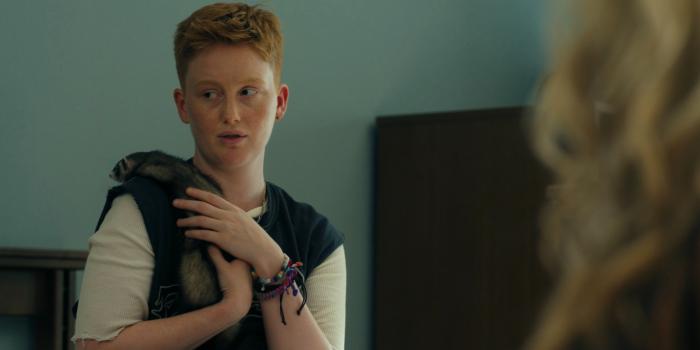
Needless to say, Paigyn was the talk of the Internet all week. The handful of viewers on the left who still watch Taylor Sheridan shows expressed annoyance at the caricature, though anyone familiar with his work could not honestly be surprised. Viewers on the right, meanwhile, treated it like a victory lap, shrugging and saying, “What did you expect from a conservative show?”
Here’s the thing about the caricature. My son has friends who fall into the activist, non-binary category. They can be a lot, sure, but they are not hostile, joyless authoritarians policing everyone else’s behavior. They are mostly trying to figure out who they are, not demanding ideological conformity from strangers. And one thing is absolutely certain: none of them would ever voluntarily attend TCU, a conservative Christian school in Texas. That detail alone tells you Sheridan is not interested in plausibility, only in signaling.
Still, there was no chance Sheridan introduced a character like this, and no chance a queer, trans, non-binary actor would agree to play them, without some kind of payoff. That payoff arrived in the finale, which managed to be just as cartoonish while apparently convincing Sheridan he was making a profound statement about unity.
Ainsley struggles during cheerleading training. Paigyn, conveniently, is a trainer for the cheerleaders, notices and decides to help, offering advice, taping her ankles, and generally displaying sudden warmth, as though feeling mildly bad about driving Ainsley out of the room. When some nearby high school boys start mocking Paigyn, Ainsley leaps to their defense, belittling the boys and daring them to “whip out their penises” if they think they’re so impressive. “Girls like us don’t date rude little boys like you,” she says. “So gawk away. This is the closest you’re ever going to get.”
Cue the kumbayah. Ainsley is praised for standing up for a teammate. Paigyn softens. “I didn’t mean to run you off,” they say. “I just think we should have some ground rules.” Ainsley agrees, suggests they make the rules together, and magically decides to move back in.
In other words, Taylor Sheridan gets it both ways. He introduces a grotesque, bad-faith caricature of a “woke” non-binary person from Minneapolis and crowns Ainsley a hero for ultimately accepting them. See? We can all get along. What we cannot do, apparently, is write characters who resemble actual human beings. Sheridan already struggles to write women with any dimensionality at all (this season also gives us Cheyenne, a Manic Pixie Dream Stripper), and when he turns his attention to queer or progressive characters, he seems to rely entirely on whatever caricatures he’s absorbed from cable news. The result isn’t provocative or daring. It’s just lazy, smug, and increasingly embarrassing.


