
Old School. Biblically Independent.
By Dustin Rowles | TV | December 22, 2025
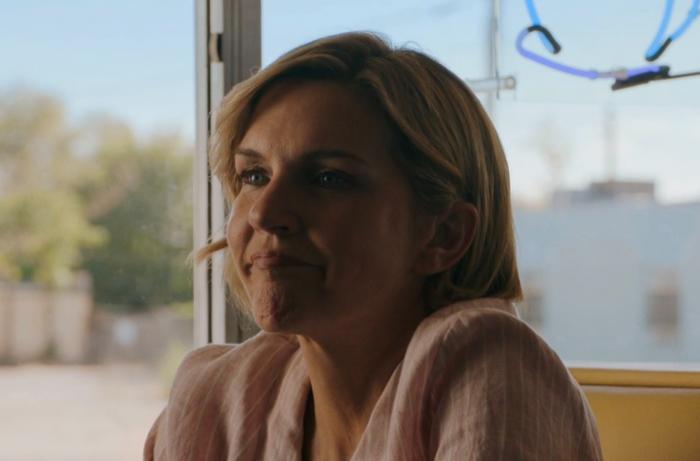
I had a lot of feelings about this week’s excellent penultimate episode of the first season of Pluribus. I admire the way the Paraguayan continues to cling to his pure individualism, never mind the danger it poses to himself. Carol, by contrast, seems to accept that her own brand of radical individualism no longer works. She needs human connection, even if that connection can only be approximated through a human-like entity.
What struck me most, though, was the episode’s tension between nostalgia and novelty. Carol is relieved when Zosia returns, but at first they have nothing to say to one another. Zosia suggests a board game. Carol rejects Bananagrams and chess because there’s no joy in playing against what is essentially a supercomputer at those games. Instead, Zosia lands on Spit, a game from Carol’s past. Playing it isn’t about discovery; it’s about excavation. It’s about pulling memories from a happier, earlier version of Carol’s life. Zosia even floats the idea of one of Carol’s cousins stopping by, which Carol quickly dismisses, because being with Zosia already feels like being with everyone from her past all at once.
From there, Carol and Zosia drift into what feels unmistakably like a series of dates: a hike, stargazing, a game of croquet. There’s flirting, too, and Zosia draws on her knowledge of Carol’s tastes, right down to the kind of trash talk Carol enjoys (“You suck, Carol!”). All of it builds toward an enormous romantic gesture in which Zosia — or the hive mind — reconstructs the old diner where Carol began writing Wycaro, replicating every detail and even flying in her favorite waitress from Miami. It’s nostalgia bait, a full resurrection of Carol’s most cherished memories.
Carol knows exactly what it is. She calls it “manipulative bulls***,” a calculated attempt to derail her investigation into the hive mind and her effort to restore the world to what it was. But it works. Faced with the prospect of being alone again, Carol sleeps with Zosia. She’s attracted to her. She enjoys the attention and the dates. But what she’s really responding to, I think, is the trace of Helen — and of every meaningful relationship she’s ever had — still embedded within the hive mind. It’s also telling how intimate Zosia feels in the moment she shares her own memory of mango ice cream. For once, the connection isn’t engineered; it’s reciprocal. They meet in memory. In nostalgia.
And yet nostalgia isn’t enough. When you possess all of human knowledge, when you have access to every memory ever recorded, there’s something electrifying about encountering something genuinely new. You can see it light up Zosia when she learns about Carol’s love of train horns (“the loneliest sound in the world”). It’s information neither she nor the hive mind already possessed. It’s novel. She seems genuinely delighted by it.
The same excitement carries over to new chapters of Wycaro. Yes, distracting Carol is part of the agenda. But Zosia’s giddiness feels sincere. The hive mind has read every book ever written, and perhaps it doesn’t want to spend eternity recycling memory and longing. The reaction feels like an AI being fed its first original data in months, except it sparks whatever human circuitry still remains. It’s the pleasure of sitting in a movie theater and watching a truly great original film, not another recombination of over-mined IP.
Zosia loves learning something new about Carol because new knowledge, unlike nostalgia, still has the power to surprise her. And that’s what Vince Gilligan is trying to impart: Nostalgia can sustain connection for a while, but it can’t replace growth. It can comfort, seduce, and even manipulate, but it is ultimately static. Novelty, by contrast, is risky and cannot be perfectly curated or reconstructed from memory.
Carol is torn between the two. Nostalgia offers her safety, familiarity, and the illusion that nothing truly has been lost. New experiences threaten her sense of control but also give her purpose, whether that’s writing new chapters of Wycaro or continuing to learn about a world that no longer makes sense. Zosia, meanwhile, stands at the opposite end. She contains everything that has already been lived, but what excites her is the sliver of humanity that still lies beyond her grasp. The things Carol hasn’t shared yet. The memories that don’t exist. The ideas that haven’t been written. God, it’s good stuff.
If nostalgia is the hive mind’s greatest weapon, novelty may be its greatest weakness. That’s where Carol still has leverage because I think there may be mutual interest on both sides. Carol fears being alone. Zosia fears stagnation. They meet in the space between memory and possibility.
And then the Paraguayan enters America.


