Old School. Biblically Independent.
By Andrew Sanford | News | April 29, 2026
Leaving Neverland was released on HBO Max in 2019. The film documented allegations of abuse levied against Michael Jackson by Wade Robson and James Safechuck, who claim the singer sexually abused them when they were children. Jackson’s estate fought hard to have the film removed, and succeeded in doing so in 2024. A few months earlier, filming had wrapped on Michael, which was produced by Jackson’s estate and, at the time, dramatized the events of a 1993 lawsuit against Jackson. Then, the filmmakers learned that they could not show that trial due to a clause in a settlement that they could not reference Jordan Chandler, one of Jackson’s other accusers.
Rumors have suggested that the third act was going to vindicate Jackson, giving his legacy a platform that his accusers have been denied. While that hasn’t been concretely proven, the director, Antoine Fuqua, told the New Yorker (via Variety) that “sometimes people do some nasty things for some money,” when discussing the allegations, so we at least have an idea where his head was at. He’s not wrong. People do nasty things for money, and creating a film whose sole purpose seems to be to whitewash the legacy of an alleged predator so his estate can keep catching those sweet checks sounds like some nasty work to me.
That nasty work is incredibly popular. It’s made over $200 million at the box office in a short amount of time, and it doesn’t appear to be slowing down anytime soon. A big reason why is that the movie-going public seems perfectly happy to gobble down what the film is selling: a sanitized look at the pop icon that ignores what is arguably the darkest aspect of his life. It’s not unlike many biopics that have come before it, but with all of the bits of added context, like the changing of the third act or the fact that one of the heads of Jackson’s estate is played by Miles Teller despite no one knowing who the hell he is, I hoped people may be able to see through what feels like a transparent attempt at keeping a gravy train rolling. I was wrong.
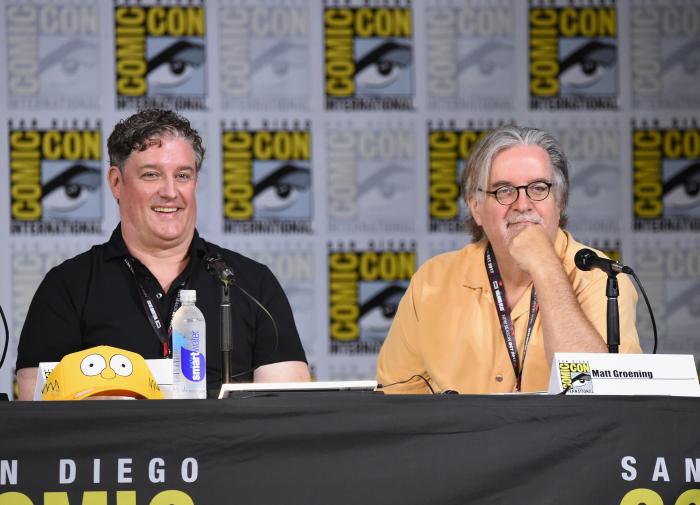
While the movie is making plenty of money and people are happily (and often defensively) talking about how much they like it, some folks aren’t falling for it. Al Jean, a longtime producer and writer on The Simpsons, was part of the decision in 2019 to remove the episode Stark Raving Dad from circulation. Despite being uncredited, Jackson voiced a mental patient in the episode who helps Bart write a birthday song for Lisa. It’s super sweet and, in 2019, Jean and several other heads at The Simpsons (including creator Matt Groening) decided to pull the episode from circulation. When asked why, Jean was blunt in saying, “I think it was part of what he used to groom boys.”
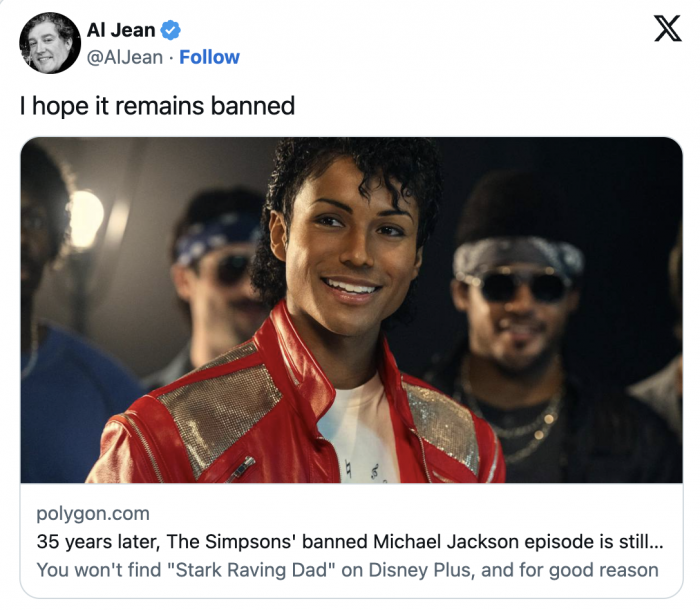
I appreciate the bluntness. He has retained that mindset. Yesterday, a Polygon article about the episode being removed (referred to as “banned” in the article) was shared on Twitter by Jean, with the caption, “I hope it remains banned.” Plenty of folks are crying censorship, even though if an artist doesn’t want their work out there because they believe it was used to hurt people, they are more than allowed to remove it. But, this is all playing out in the court of public opinion, and the public is on the side of the King of Pop, despite the copious amounts of awful things you can read about him, or that was testified in court, or that he said directly, of which there is enough to make you question whether or not he was more of a monster than his father.
I’ve had several conversations with friends and family members who proudly (and, again, defensively) saw Michael over the weekend, and the accusations against Jackson are often referred to as “controversies” or “sensitive subjects.” And everyone is allowed to be entertained by a feature film. But the reasoning behind this one’s existence stinks to high heavens. Regardless, it seems it has won. But at least it won’t be getting any help from America’s favorite yellow family.