
Old School. Biblically Independent.
By Dustin Rowles | Film | April 27, 2026
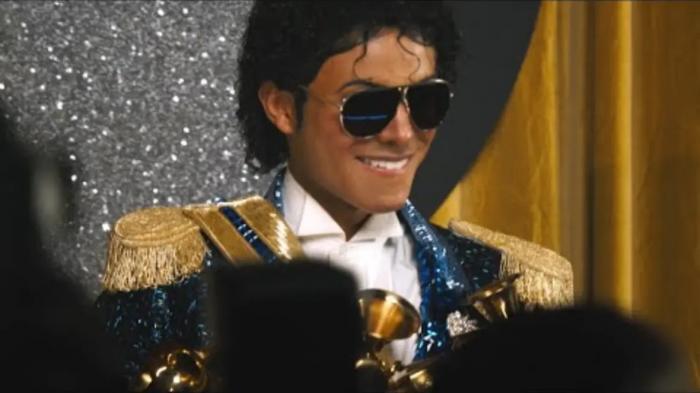
Michael Jackson’s Thriller was the first record I ever owned. I remember where I was when I first listened to it. I remember memorizing Vincent Price’s “rap” on “Thriller” with my siblings in my grandmother’s garage. I remember the living room I was in the first time I watched the “Billie Jean” video. I remember the smell of the skating rink that projected the “Thriller” video on the wall on Halloween. I remember sensing that my mind had been blown when I witnessed — along with millions of others — Michael Jackson debut his legendary moonwalk on the Motown 25 music special.
Antoine Fuqua’s Michael managed to evoke all of these memories in me, the way that only certain pieces of music can. This is particularly notable because I was very young, and now I’m not. I only remember the name of one teacher I had prior to the 9th grade, but I remember wearing a white glove to class in the second grade. That’s how ridiculously evocative and transportive Michael Jackson’s music can be. I even remember the feeling of invincibility I had the first time I saw a skinny, almost frail man dance around in the music video for “Bad,” as his voice and those moves could somehow create a force field around both him and me.
I loved MJ’s music, not in the sense that he was my favorite musician (I was too young to have a favorite musician), but in the sense that Michael Jackson was just the most interesting, most popular, and most omnipresent celebrity in the world to an elementary school kid at that time.
I realized while watching Michael that those memories largely remain untainted. What Michael Jackson did 15 or 25 years later (or what I found out that Michael Jackson did 15 or 25 years later) doesn’t really disturb those earlier, mostly positive memories I associate with the music, even if my association to Michael Jackson the man has obviously been completely transformed by the many, many allegations made against him.
It’s an interesting phenomenon, and I assume that I am not alone in that regard. A great movie could probably excavate that phenomenon and explore it, examine the relationship between the music and the man who made it, and maybe even dig into why a man so clearly warped by fame, his family, and the loneliness of celebrity could produce music that could genuinely unite millions of people. There’s a great movie that explores MJ’s Neverland fixation, connects it to his arrested, childlike view of humanity, and ties it into the disturbing actions of his adulthood. That movie might even reckon honestly with Leaving Neverland — with Wade Robson and James Safechuck — and ask what it means to hold all of it at once: the genius, the damage, and the wreckage left behind.
Needless to say, Michael is not that movie. Michael is a very bad movie with very good music that Antoine Fuqua deploys to disguise the fact that Michael is a very bad movie. Michael Jackson is one of the most complicated celebrity figures in the history of music, and he remains one of the most mysterious. Michael provides zero insight. There is nothing in Michael that could not be gleaned from People articles from the 1980s. The Wikipedia entry on Michael Jackson is legitimately 10 times more probing and informative. This is what happens when the Jackson estate co-produces its own mythology: you get a film that is legally and financially incapable of asking any question that might produce an uncomfortable answer.
Michael is a 135-minute music video broken up occasionally by Joe Jackson (Colman Domingo) yelling at his son, Michael, or whipping him with a belt. But Fuqua can’t even sit in the parental abuse long before he moves onto the next song. “Michael Jackson’s father hit him when he was 10. Oh, hey! Here’s ‘Rockin’ Robin.’ (Tweet. Tweet. Tweedle-lee-dee).” There is zero examination of Michael Jackson’s personality, or his obsession with plastic surgery, or the real story behind his vitiligo, or anything about what inspired his music or the lyrics beyond, you know, a local news story he saw once about the Bloods and the Crips. Here’s MJ walking around his studio. Now, here’s MJ performing the song he made up while walking around his studio. That’s it. That’s kind of the movie, plus or minus a freakishly good cameo from Mike Myers (who apparently does all the music biopics now) and a complete and total waste of Miles Teller.
I understand why the movie made $100 million over the weekend. I think moviegoers just wanted to see Michael Jackson’s performances on the big screen (and credit to Jackson’s nephew, Jaafar Jackson, who is a dead ringer for his uncle — even if no amount of physical resemblance can compensate for a script that refuses to let him play a fully human being). But you can still provide that without obscuring Jackson’s entire legacy. This is just Michael Jackson agitprop. It is pathetic, but godddamn, it has a great soundtrack.


