Old School. Biblically Independent.
By Dustin Rowles | Miscellaneous | January 26, 2026
For those who aren’t active TikTok users, here’s what you should know: Last week, TikTok’s U.S. business was spun into a new, majority-American joint venture led by Oracle, Silver Lake, and the Abu Dhabi-based MGX. Together, they now control just over 80 percent of the U.S. company, while ByteDance retains a 19.9 percent minority stake.
With that shift came a newly retrained, U.S.-controlled version of TikTok’s recommendation algorithm, with American user data stored on Oracle’s cloud. Oracle’s billionaire founder, Larry Ellison, is a longtime Republican mega-donor and the father of David Ellison, who recently took control of Paramount and brought in Bari Weiss to run CBS News. His fingerprints are also all over the cancellation of Stephen Colbert’s Late Show.
Over the weekend, as the U.S.-controlled system went live, a lot of users began reporting that their For You feeds had effectively reset. Instead of the hyper-specific niches they’d spent years training, many were suddenly served a bland, generic feed dominated by U.S. political content, culture-war clips, election commentary, and more ads and branded posts, rather than videos from the niche creators their old algorithms reliably surfaced. The retraining has also coincided with outages and glitches, leaving some videos stuck at zero views or feeds refusing to refresh altogether.
All of this reflects the new reality of TikTok. The platform now appears more focused on brand safety and advertiser friendliness, and there’s growing concern that political levers can be turned to downplay messy protests while amplifying narratives friendlier to those in power. In other words, users are watching TikTok slide into the familiar enshittification phase, where corporate and political interests begin to outweigh the chaotic, user-driven weirdness that (apparently) made the app addictive in the first place (I never got into it beyond following The Secret Lives of Mormom Housewives drama).
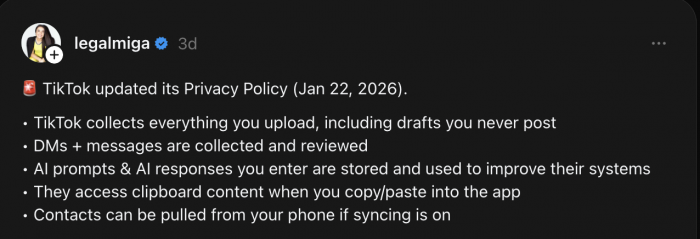
That hasn’t sat well with a lot of users, nor have the updated terms of service, which emphasize expanded data use and explicit permission to use posts for AI training. What really set people off, however, is that the new terms pop-up forces users to accept before they can even access the account-deletion screen, effectively trapping users into consenting just to get out.
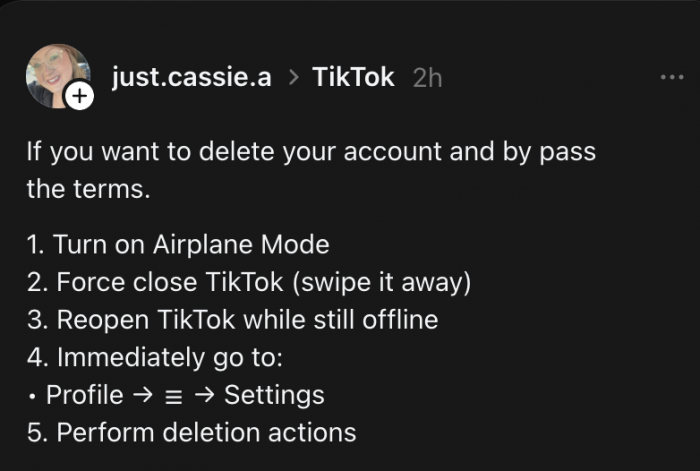
So yes, while there’s now less concern about China accessing U.S. user data, there’s more concern about how that data might be used by our own government and American corporations (which at this point, feel more nefarious than foreign actors). For a lot of folks, this feels less like a safety fix and more like swapping one government’s potential leverage for another’s, in a system that’s now even more openly surveilled and politically entangled.
In other words, burn it all down.


