
Old School. Biblically Independent.
By Dustin Rowles | Miscellaneous | February 16, 2026
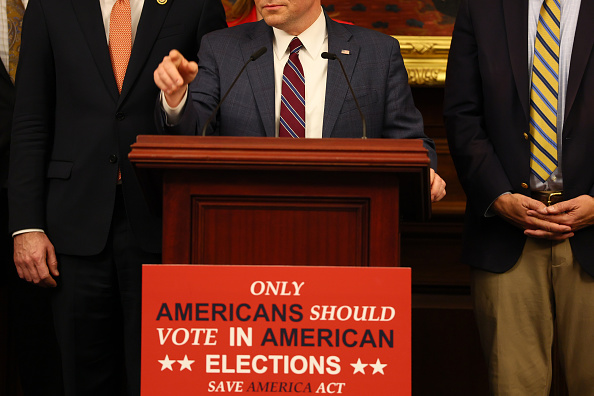
Last week, the Republican-controlled House of Representatives passed the Safeguard American Voter Eligibility Act — aka the SAVE Act — almost entirely along party lines. One Democrat, Texas Rep. Henry Cuellar (boo this man), broke ranks and voted with Republicans.
The bill now heads to the Senate, where it faces long odds. Under current rules, it would need 60 votes to overcome a filibuster, which makes passage unlikely unless Senate rules change (and if the President were able to torpedo the filibuster, something makes me think that the SAVE Act would come down to Susan Collins, which means we’d be screwed because she’s already expressed support). Even then, it would immediately face legal challenges. Still, the fact that it made it this far should terrify anyone who cares about voting rights.
Because if we ever want to escape this dark era of American politics, it is imperative that the SAVE Act never become law.
So what is the SAVE Act?
On paper, the Safeguard American Voter Eligibility Act is about preventing voter fraud — a problem that, at any meaningful scale, essentially does not exist. In reality, it’s designed to make voting harder for millions of eligible Americans.
Under the bill, anyone registering to vote (or updating their registration) would have to provide documentary proof of U.S. citizenship, such as:
1. A valid U.S. passport
2. A government-issued birth certificate
3. A government-issued ID that explicitly states citizenship
4. A military ID, plus documentation showing U.S. birth
5. A naturalization certificate or similar federal paperwork
Most driver’s licenses and REAL IDs wouldn’t qualify on their own because they don’t indicate citizenship.
The SAVE Act would also dramatically curtail online and mail registration, kneecap voter registration drives, and require states to use federal databases to verify citizenship. You can probably see where this is going.
At first glance, it even sounds counterintuitive. Republicans are less likely to own passports, for instance. Passport holders skew younger, wealthier, and more college-educated — demographics that lean Democratic. Birth certificate requirements also disproportionately affect women whose legal names no longer match their birth records.
But those minor wrinkles are completely overwhelmed by the bill’s broader structural impact.
The SAVE Act would primarily hit people who don’t have original documents sitting in a drawer at home — voters who would need to take time off work, pay fees, or navigate bureaucracy just to register. That includes renters, younger voters, lower-income voters, highly mobile voters, and elderly women who changed their names.
Meanwhile, it would be an advantage to older, wealthier homeowners who are more likely to maintain long-term access to vital records.
In other words, it hits younger and poorer voters the hardest — and those are the voters most likely to sign up through registration drives, which this bill would effectively wipe out. Plenty of Republicans would be caught up in the dragnet, too, but the overall burden would fall disproportionately on Democratic-leaning populations.
We don’t have to guess how this plays out. Kansas already ran this experiment. Under then-Secretary of State Kris Kobach, the state imposed a nearly identical proof-of-citizenship requirement. It operated for several years before a federal judge, Julie Robinson, struck it down in 2018.
During that time, roughly 31,000 voter registrations were blocked or suspended — almost all belonging to eligible U.S. citizens. The state uncovered virtually no meaningful voter fraud. And here’s the partisan breakdown of those caught in the system:
* 41 percent were unaffiliated
* 35 percent were Democrats
* 23 percent were Republicans
That’s tens of thousands of legitimate voters sidelined, with Democrats hit harder than Republicans and independents hit hardest of all. Using the Kansas population under this model, the percentage of GOP voters would increase from 45 percent to 51 percent. Likewise, if the same statistics apply to a swing state like PA, the GOP percentage of the vote would grow from 41.5 percent to 47 percent of the vote, while Dems would drop from 43 to 41.
Kansas eventually abandoned the policy. The SAVE Act proposes doing the same thing nationwide.
Back in Washington, the bill still needs 60 votes in the Senate. Democrats are united against it, and at least one Republican, Lisa Murkowski, has raised concerns about sweeping federal election mandates. Even if it somehow cleared Congress, it would face immediate court challenges.
But here’s the real danger: If Republicans expand their majorities in future elections, legislation like this becomes far more viable. And once laws like the SAVE Act are in place, reversing them becomes exponentially harder. This isn’t about election security. It’s about shrinking the electorate, and Kansas showed us exactly how that plays out.


