Old School. Biblically Independent.
By Kayleigh Donaldson | Miscellaneous | December 8, 2025
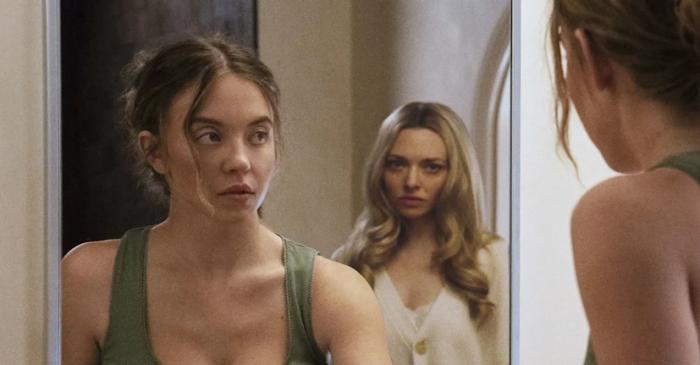
The Housemaid is set to be one of the big movies of the Christmas season. Directed by Paul Feig and starring Sydney Sweeney and Amanda Seyfried, it’s a psychological thriller about a woman with a dark past who becomes the live-in housemaid of the seemingly perfect family. The thriller genre has been sorely underserved in recent years as Hollywood steps away from the kind of adult-driven mid-budget non-IP films that were once a commercial safe bet. Nowadays, many movies in this mould go straight to streaming, like the recent remake of The Hand That Rocks the Cradle. Could The Housemaid turn things around? It has a strong chance to do so, in large part because the book it’s based on is a bona fide publishing phenomenon.
If you’ve spent any time on TikTok or book-related fandoms then the chances are you’ve seen The Housemaid and the many books of Freida McFadden. First published in 2022, this title almost immediately became a monster hit. In the viral madness of TikTok and the book-focused circles that helped to drastically change publishing in the 2020s, McFadden became the face of the BookTok crime and thriller genre. In a June 2024 profile of the author, The New York Times said that The Housemaid had sold over two million copies. Two sequels followed, and soon McFadden’s sizeable back-catalogue took over bestseller lists. In 2025 alone, she released three new novels and a novella. Many copycats followed. As of the writing of this piece, The Housemaid has been on the New York Times bestseller list for 107 weeks.
McFadden started out life as a self-published author. A full-time physician who practices medicine in the Boston area, she released her first book in 2013 on Amazon. Freida McFadden is not her real name, and she admits she hates being the centre of attention so avoids interviews and in-person events as much as possible. By her own admission, she knows her mega-success is partly luck, telling The Gloss, ‘it was a case of right place, right time, right book. I couldn’t replicate it if I wanted to.’ It’s an interesting position to be in, now that she’s popular enough to have a dedicated readership who call themselves ‘McFans.’
So, why did luck bless her books over any number of talented crime and thriller writers? It helped that she had this built-in indie fanbase before she broke out, so it wasn’t a total surprise to see her gain more readers as word of mouth spread. With The Ex, one of her breakout books, she bought a lot of Amazon ads to help encourage newbies to her work. Many of her books broke through on Kindle Unlimited, an ebook subscription service where readers can get unlimited reads for a monthly flat fee. Under this model, authors get paid based on page reads rather than copies sold, and if you’re a prolific author with a hefty back-catalogue, you do very well.
But it’s also the books themselves. I’m generalising somewhat here, but BookTok is a platform where formula rules all. Tropes are how books are sold to the masses, far more so than plot or emotion. It’s a winning practice, an easy way to distil a book’s appeal and package it to its intended audience. For genres like romance and thrillers, which do especially well on TikTok, it just makes sense. If you want to know exactly what you’re getting, McFadden is the ideal crime author for that. These are classic thrillers in modern settings, largely focused on women who are besieged by cruelties and fight back with zeal. It’s domestic peril with the occasional unreliable narrator and the promise of a grand and surprising payoff. Crime is a genre beloved by women and McFadden’s books feels very oriented towards that audience.
Frankly, McFadden’s books are decidedly not for me. The formulas are too rote, the stories either too predictable or too messily executed for the twists to make sense. I see her inspirations and yearn to read those instead. McFadden lacks the impish malice and satirical edge of Gillian Flynn, whose near-legendary novel Gone Girl casts a vast shadow over McFadden’s bibliography. But these books are easy to read by design, so quickly digested and satisfying enough that it’s easy to click ‘buy’ on the next one, then the next one, and so on. McFadden has written a lot of books and she writes them fast, so she’s able to ride the high of her current popularity in ways that a lot of her predecessors never needed to.
One wonders how long McFadden can keep this pace going. She says she feels comfortable writing three to four books a year, but her reviews suggest signs of repetition and burnout. Then again, when the sales are so good, who cares? This cycle of tropes and tics makes her work primed for adaptation, where a savvy screenwriter can pick and choose the best elements to work with and discard the rest (McFadden doesn’t seem to be hyper-controlling of her IP in this regard: take note, E.L. James.) The BookTok trend for McFadden-esque thrillers may die, but as with most fads, the originators at the heart of the cycle tend to endure far longer than their copycats. Maybe she can write a romantasy thriller next.


