Old School. Biblically Independent.
By Kayleigh Donaldson | Film | January 16, 2026
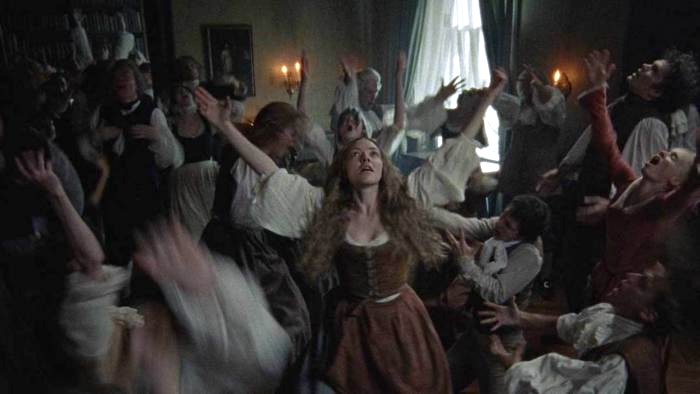
Ann Lee (Amanda Seyfried) is a woman looking for answers. A devout Christian who has longed from an early age to devote herself to God, she finds herself welcomed into a new religious movement. The Shaking Quakers, better known as the Shakers, worship the almighty via ecstatic song and dance, movements that veer between poetic and possessed. As Ann gives more of herself over to the philosophies of the Shakers, she has a vision that she is the second coming of Jesus Christ. What else is there to do about it but sing?
For her third feature film — and most high-profile to date — as director, Mona Fastvold has set herself a mighty challenge. How do you tell the story of a religious leader in a way that fully conveys the overwhelming force of her beliefs? With Ann Lee, she has chosen to make a musical of sorts. After all, in musicals, people break out into song and dance to express their feelings in ways that speaking alone cannot do. With the Shakers, music and movement was their prayer. Indeed, it is in these musical numbers (although one wouldn’t necessarily categorise this film as traditionally of this genre) where The Testament of Ann Lee truly comes to life. Ann and her followers, which includes her loyal brother William (Lewis Pullman), pulse and gasp with ecstasy that is often orgasmic. Some numbers are beautifully choreographed, full of twitching and chest pounding and balletic spins to the ground. Worshippers are lifted above one another, held to the skies like a sacrifice. In these claustrophobic rooms where prayer comes to life, the viewer becomes as engulfed by Ann’s adoration as her followers.
Amanda Seyfried has long been an actress who has been frequently underserved by half-baked material. Here’s a multi-talented threat who can sing, dance, act, and enrapture. Doing a surprisingly solid Mancunian accent, as Ann she is especially gripping. Her magnetism as a sect leader is undeniable, whether she is talking in motherly tones to her devotees or singing angelically with a look of utmost serenity on her face. The camera is often close to her face, capturing a glow that Fastvold is earnestly intrigued by. The contrast between Ann’s bliss in her worship and the agony of losing four children is sharp.
Fastvold (and co-writer Brady Corbet) want you to believe in Ann. This is a surprisingly earnest film about faith that does not care to puncture the Shakers’ ethos or position Ann’s own epiphanies with any degree of irony. She believes it so, through Fastvold’s lens, it is true. And it is often enthralling to watch, but mostly in those musical scenes. Outside of that, the audience cannot help but feel doubt seep in. Lee’s sect is simultaneously joyous in movement yet restrictive in dogma. She preaches that fornication keeps humanity soiled in sin and that her followers must commit to celibacy, a decision that leaves her husband (Christopher Abbott) less than thrilled.
Aside from its set-up and those beautiful musical numbers, a lot of The Testament of Ann Lee is surprisingly conventional. It’s a rise and fall tale about an iconoclast and Fastvold has a lot of ground to cover. That means much of the narrative is conveyed through exposition or the narration of Thomasin McKenzie, who plays one of Ann’s steadfast followers. Moments that would have made for crucial dramatic heft are dealt with off-screen in ways that feel like own goals from the screenwriters. Why not show us the scene of Ann being forced to deal with the ‘patriots’ who demand that she swear allegiance to America rather than have her tell us she did it? The same goes for the growing anti-Shaker sentiments that plague the group on both sides of the Atlantic. There is method behind the decision to keep the story so thoroughly focused on Ann Lee and not outside voices, but then why cut out so much of Ann’s voice?
It also leaves us with an incomplete view of Shakerism. In one scene, we see Lee and her followers scream ‘shame!’ at slaveowners showing off shackled enslaved people on the streets of New York. This is the only hint we get of the faith’s more socially activist qualities. Ann finds emancipation through a rejection of sex and almost everyone else accepts this doctrine willingly, leaving no room for a denser examination of the Shakers. When two of her followers reject this, there’s no fury or dissection of this tenet’s obvious flaws. We just move on. In its rather welcome earnestness, there is a downside: a lack of desire to be thorough in telling a layered and very odd story.
The Testament of Ann Lee is often brilliant but you reach your hands out and hope for more, only to be disappointed. There’s a genuinely phenomenal film somewhere in this ambitious and proudly uncommercial work. Every musical number reminds you of that fact. If only it were as real as Ann’s faith.
The Testament of Ann Lee had its North American premiere at the 2025 Toronto International Film Festival. It currently does not have a release date.


