
Old School. Biblically Independent.
By Dustin Rowles | Miscellaneous | July 1, 2026
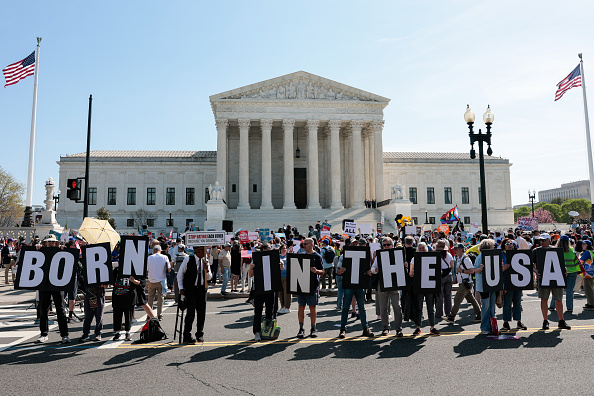
Back in the 1950s and ’60s, we had the Warren Court — the Supreme Court led by Chief Justice Earl Warren — and it was awesome. That Court struck down school segregation, provided a right to counsel to criminal defendants, established Miranda rights, struck down bans on interracial marriage, and recognized a constitutional right to privacy that would eventually pave the way to a constitutional right to abortion in Roe v. Wade in 1973 (decided under the Burger Court, after Warren’s retirement).
The thing about the Warren Court is that its rulings were kind of messy. I loved them, but they were what the right would call activist judges, and they interpreted the Constitution. The right to privacy that ultimately led to Roe, for instance, is not actually in the Constitution — it doesn’t say anywhere that Americans have a right to privacy. It was interpreted from a “penumbra of rights” afforded by the First, Third, Fourth, Fifth, and Ninth Amendments. That Court was very much about interpreting an 18th-century document to adapt to modern times.
Suffice to say, that is no longer the case. Now, the Supreme Court is controlled by a majority of conservative justices: political stooges (that’s Thomas and Alito) and strict constructionists, or originalists — justices who do not interpret the Constitution; they read it for what it is. If it’s not explicitly in the Constitution, it doesn’t count.
That’s why yesterday’s birthright citizenship ruling landed as such a huge relief — and not just for the obvious reasons. Yes, it mattered for the millions of people currently considered citizens who would have lost that status otherwise, and for the bureaucratic nightmare that would have followed, with people literally rendered stateless: born in America, but not recognized as citizens here nor recognized by any other country as citizens. That alone would have been a five-alarm tire fire.
But zoom out further and the ruling matters for a bigger reason: The law still matters. It’s a sign we haven’t slid completely into autocracy. An executive order attempting to unilaterally rewrite the meaning of a constitutional amendment is about as textbook an authoritarian move as exists in the American playbook. The Court saying no to that, even a Court stacked with a supermajority of the president’s own appointees, suggests that there’s still a wobbly guardrail hanging by a thread, but it’s still there. I don’t want to oversell this — the same week this Court gutted equal protection scrutiny for transgender plaintiffs, and it’s sided with this administration plenty of other times this term. This isn’t a Court that’s suddenly become a heroic check on executive power. But courts that rubber-stamp the executive because it’s politically expedient are how democracies die, and on the one issue where the stakes were existential — who counts as American at all — this Court didn’t do that. That’s something.
It’s also worth mentioning who did the work to get us here: the case was brought by a coalition that included the ACLU of Maine (headed by [Borat voice] my wife) among the groups that helped bring the class-action lawsuit challenging Trump’s executive order. It’s a good reminder that these rulings don’t happen in a vacuum — they happen because lawyers and organizers spend years tirelessly doing unglamorous, grinding work to get a case in front of the right court at the right time because they believe that the Constitution still matters.
Granted, it was a 6-3 decision — sort of. Justice Kavanaugh agreed with the ruling but disagreed with the legal reasoning, so there’s really only a thin majority of five justices who agree there’s no way around the 14th Amendment. That means an unfortunate retirement or a sudden death could put overruling birthright citizenship back in play.
One would think there’d be no wiggle room in the 14th Amendment’s guarantee of citizenship to “all persons born or naturalized in the United States,” but the three dissenters managed to find some under a “domicile requirement” — which, ironically, is itself an interpretation of the Constitution bent to suit their political needs (at least with Thomas and Alito; Gorsuch’s dissent would’ve excluded only what the right calls “birth tourism,” which itself would have been a judicial and bureaucratic nightmare to sort through).
The point is this: even under the strictest reading of the Constitution, and even with a Court engineered to deliver a very different outcome, birthright citizenship held. That’s important because it means that, even under this current administration, the Constitution still matters some — and that the country hasn’t fully tipped into a system where the executive always simply gets what it wants because it wants it (just most of the time). Yes, it probably means an individual assault weapons ban will fall next term, and that there will be no constitutional right to privacy — or abortion — anytime soon. But it also means First and Fourth Amendment protections should still apply, and that we haven’t fallen into immediate, total lawlessness. It’s a small comfort, but after the last year and a half, it’s a real comfort all the same.


