Old School. Biblically Independent.
By Kayleigh Donaldson | Film | October 21, 2026
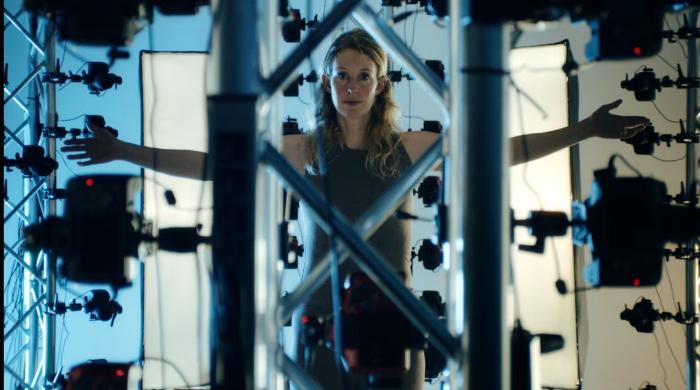
Despite my agonizing efforts to avoid any and all news stories related to You Can See Everything—no mean feat when you’re a professional pop culture writer who shills her wares on the internet—I was suitably spoiled. In fairness, I was surprised I went unspoiled for as long as I did with Noah Oppenheim and Nathan Fielder’s nervy and surprise-laden documentary about Elizabeth Holmes. It’s a film that begs to be discussed in detail. But since A24 isn’t releasing it in the UK until next month, I had hoped to go in as fresh as possible to avoid tainting my perspective. Ha.
Within days of the release of You Can See Everything, the social media posts were revealing everything. That’s to be expected, but I was surprised by how many major publications had spoilers in their headlines. Keep in mind that the film had only opened in 855 theatres. That’s less than a quarter of what the weekend’s other major release, Street Fighter, was screening in. We’re talking about a niche movie, albeit one with unprecedented commercial success at such an early stage. It’s opening wide this week, but now, for many people who were waiting for that release, there will be no surprises.
I must admit that I am usually not a spoiler-phobe. I often find the internet’s endless moving of the goalposts as to what constitutes a spoiled to be tedious and detrimental to the entire practice. How does one remain precious about spoilers when we’re discussing, for example, “Wuthering Heights”, an adaptation of a book written in 1847? I once had someone send me a threatening email for “spoiling” a film when all I had done was mention things that were in the trailer. The clickbait-ification of the internet has turned every minor detail of a film, book, TV show, etc, into something that can be spun as an “exclusive” or “shocking twist.” I’ve lost count of the number of weird, probably AI-created TikToks and Instagram videos where a random out-of-context clip from a movie or series is shared as some astounding reveal when it’s anything but that. When everything is content, everything is a spoiler.
There’s an obvious kind of clout attained by being the one that gets to do the spoiling. For the devoted fan, it’s an opportunity to elevate one’s status. For a publication or content creator, it’s a confirmation of authority, with all the heady SEO clicks that entails. This is not a knock against writing spoiler-heavy reviews or articles. I do that for a living! Google has crushed the system into an unbearable cycle of click-bait and regurgitation, and we’re all doing what we have to in order to survive. I imagine the websites putting the spoilers in the headlines had solid data to justify that decision. Besides, in an always-online life, information spreads too rapidly to be quashed. “Everyone” already knew what was going on in the film, right?
It’s not just that every minute detail can be documented within hours of release; it’s that many of the most important details have been reported on for months prior to even a trailer or synopsis drop. Consider how so many of the big reveals in Marvel films were uncovered by on-set photographs or script leaks (or just various actors in moments of verbal vomit) well before the premiere. It’s fun to find out something before you’re supposed to. It carries a cheeky charge, like being a child and discovering your Christmas presents in the cupboard weeks before the big day. Sometimes that finding can increase your anticipation, but not always. If you’re besieged with enough spoilers, you start to wonder why you should even bother seeing or reading or playing the thing in question.
It may very well be that we now live in a post-spoiler age in many aspects. When your audience, critics, and even talent are incentivized, financially and socially, to tell all, the choice is easy. Still, there are benefits to secrecy, and being able to maintain it is one hell of a power move in the current era. Consider Hayao Miyazaki, who had the means to release his most recent film, The Boy and the Heron, in Japanese cinemas with no trailer, synopsis, or images beyond one poster. Loyal audiences came out in droves because his name was enough to sell it, after decades of being one of the most important directors of his generation. I was fortunate enough to see the film at the Toronto International Film Festival, having avoided the tiny amount of promotional content sent out to critics. Truly, it was an incredible experience. How humbling to be so thoroughly stripped of preconceptions and that nagging urge to speculate. Watching The Boy and the Heron, I was keenly aware that this was an opportunity I would probably never again have.
Maybe it’s a futile exercise to plea for more surprises in pop culture. The age of algorithms and instant satisfaction has rendered such things not only impossible but undesirable. You can get far more attention from spoiling, and as we’ve seen time and time again, there is an audience for it. still, I keep coming back to something that the singer Rosalia said when she was asked if her newest album, Lux, was demanding a lot of focus from its listeners: in the age of dopamine, I find myself craving the opposite. Delayed gratification has never felt more necessary or satisfying. If only the internet made it more possible.


