
Old School. Biblically Independent.
By Dustin Rowles | TV | October 19, 2026
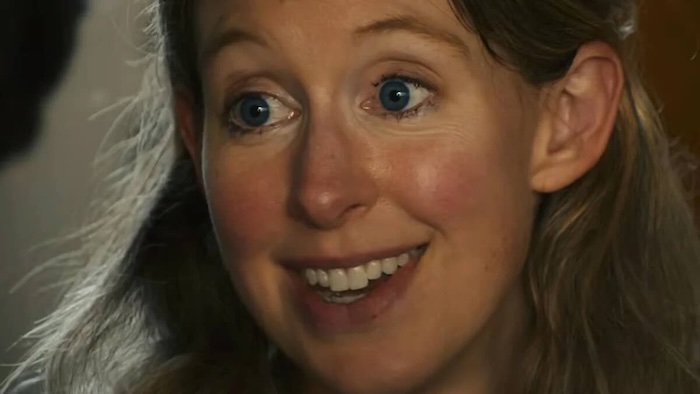
If you haven’t seen Nathan Fielder’s You Can See Everything, stop reading. Don’t read this review. Don’t read anything about it. Trust me: You’re going to love it, or admire it, or have your mind melted by it, and that’s true even if you’re not a Nathan Fielder fan. This will be one of the most talked-about films of the year. Maybe of the decade. Just go. And go see it in a theater, so you can be part of the conversation while it’s at its peak.
For those who have seen it? Whoa. It is somehow both completely unexpected and … unmistakably a Nathan Fielder project. I went in expecting a sort of awkward-off, a cringe cage match between Elizabeth Holmes and Nathan Fielder. But leave it to Elizabeth Holmes to make Nathan Fielder look like the normal one. In Holmes, Fielder has finally met his match in the art of lingering in uncomfortable silence, which makes for an occasionally disquieting experience. More than once, I wanted to hit fast-forward just to escape the tension.
But that’s not really what You Can See Everything is about. Fielder’s mission, it seems, is to find the authenticity that must exist somewhere beneath the Elizabeth Holmes artifice. He also wants to know whether she buys her own bulls***. And at a certain point in the film, he wants to know whether he’s being manipulated by Elizabeth Holmes, too.
The honest answer: It’s not clear.
Most people know the Elizabeth Holmes story. She and former Theranos chief operating officer Sunny Balwani raised $700 million on the strength of a lie: a device that could test for hundreds of diseases and conditions with a single drop of blood. She was convicted of fraud and sentenced to 11 years in prison. Fielder and his crew are granted full access to the lives of Holmes and her fiancé, Billy Evans, in the 35 days before she reports to prison.
The first half is mostly what you’d expect: Fielder asks a lot of uncomfortable questions, Holmes gives a lot of evasive answers, and Billy Evans tries to control everything. What’s almost shocking is that, in the days leading up to her prison stint, Holmes is basically trying to relaunch Theranos. She and Evans are piecing together Theranos 2.0 around a device similar to the old one, except this one uses lasers. And the more time we spend with them, the more obvious it becomes that Billy Evans is a controlling narcissist. What’s less clear — and what is really the central question of the entire documentary — is whether Evans is controlling Holmes or whether Holmes is complicit in all of it.
Then Holmes goes to prison, and the film pivots in a way that makes You Can See Everything even more fascinating: Amanda Seyfried — who played Holmes in Hulu’s The Dropout — essentially joins the documentary. She’s not just there to reenact moments Fielder shared with Holmes off camera (although she does that, too). She’s there to help Fielder interrogate the mystery of whether Billy Evans is making decisions on behalf of Holmes or with her. It’s murky stuff, and it leaves you wondering how much of that same dynamic existed between Holmes and Sunny Balwani. Was Holmes a perpetrator of fraud and a victim? Or is she just spectacularly good at lying?
I don’t know, and Nathan Fielder doesn’t seem to know, either. At first, Amanda Seyfried seems convinced that Holmes is being controlled by her insane, Charlie Kirk-loving fiancé, but by the end, she appears to have switched sides completely and come to believe that Holmes is deceitful. And maybe she is. But if so, she’s the most convincing liar I’ve ever seen. I’ve gone back and forth, and I’ve mostly landed here: Billy is controlling her, but Holmes allows it, because they have two kids together and she’s all he has left. Because she wants to believe Billy is acting in her best interests, even when he clearly isn’t. So, yes: She may be a victim of Billy’s controlling nature, but I also think she’s letting herself be one. Because he’s all that she has. But also, because naiveté is better for her image than grifter.
But really, the miracle of You Can See Everything is that it makes us, Fielder, and Seyfried all rethink what we thought we knew about Elizabeth Holmes, which for most of us had already felt like settled fact. You may ultimately end up back where you started, but not before taking a long trip around the bend.


