Old School. Biblically Independent.
By Tori Preston | Film | October 19, 2026
If the Wikipedia editor for the entire sprawling Capcom franchise sat down to craft a Street Fighter screenplay with a kindergartener all hopped up on Pop Rocks and Crystal Pepsi, the result would basically be the movie playing in theaters now: a love letter to the storied video games you know, mixed with abundant 90s nostalgia and a hefty dose of easy, breezy kick-ass. Just some seriously unserious hot nonsense. Sure, you can get hung up on its plentiful flaws, many of them so wrong-headed and lazy that it’s baffling, or you can vibe on the joyful insanity, rapid-fire jokes, and committed performances from the cast, but no matter what you think of the new Street Fighter film, you’re right.
So I should probably admit up front that I think it’s absolutely perfect as it is, warts and all. My first reaction upon walking out of the theater was that Street Fighter — co-written and directed by Kitao Sakurai, known for his work on The Eric André Show, Bad Trip, and another video game adaptation that’s more fun than it has any right to be, Twisted Metal — understood the assignment. The problem is that the longer I mulled it over, the more I realized I, myself, did not. Still, it’s easy to be swayed by how confident the execution is. It’s clear this movie was made with both passion and vision, and part of the fun is in untangling what that grand design might have been.
The plan had to be, at least partially, a cinematic course-correction from the 1994 film, which remixed the bench of Capcom characters into an action slop plot that centered on General Guile (Jean-Claude Van Damme) trying to take down the villainous despot M. Bison (Raul Julia, who deserved better in his final performance but still went out with class). It’s hard to argue what a “faithful” adaptation of Street Fighter should look like, since the whole point of the games is that they are a mostly plotless tournament of fighters kicking, punching, throwing, and blasting each other that makes Mortal Kombat look like The Odyssey, but one thing is certain: the main characters should be Ryu and Ken. They were the sole playable characters in the very first Street Fighter arcade game in 1987 and have been mainstays in every iteration since. The other familiar figures (M. Bison, Guile, Chun Li, Balrog, Vega, Zangief, Blanka, Dhalsim, and more) originated in the franchise’s most popular entry, Street Fighter II, and though they each had their own motives for participating in the central World Fighting Tournament… let’s be honest, nobody cared! We just wanted to button-mash and make them do cool moves!
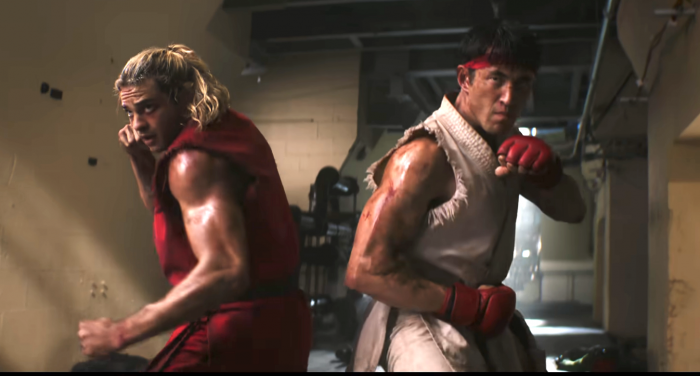
And that’s what Street Fighter 2026 understands. Yes, there needs to be a plot, but if that plot is just a loose excuse to set up a series of fight sequences and comedic bits, well, that’s just fine. Here, the relationship between Ryu (Andrew Koji) and Ken (Noah Centineo) takes its right place in the spotlight, and their backstory is dispensed with in an anime sequence at the top that details the death of their master at the hands of the demonic Akuma, and Ryu’s own struggles against his dark side, during the first tournament. Does that sound too serious? Just wait! Fast forward six years and it’s 1993. Ken is a famous “fighter,” entertaining the world by punching cars and doing MTV bits in between Duracell and Taco Bell sponsorships. The nostalgia is laid on THICK, and if you’re one of the people who complained about Captain Marvel’s overwhelming 90s needle drops, then get ready to be irritated all over again (although the payoff to the repeated use of the classic 4 Non Blonde’s hit “What’s Up?” redeems every musical choice, in my opinion).
Ryu, meanwhile, has disappeared… to the streets, where he’s slinging bad ramen and trying to live a peaceful, less punchy life. Unfortunately, M. Bison (David Dastmalchian, doing his darndest not to let Raul Julia’s shoes overwhelm him) has decided he needs to suck out Ryu’s mystical energy (nobody cares), so he decides to lure Ryu out of hiding by staging a second World Fighting Thingy. The film does a good job letting that motley crew of characters you know and love show up for the tournament without needing full introductions or even “reasons” for being there, and it’s a blessed bit of expediency. Nobody asked for Balrog’s backstory! It’s enough to see 50 Cent doing his best Mike Tyson mugging for a single sequence! Cody Rhodes recreates Guile as a pitch-perfect comedic second stringer, and Jason Momoa as the beastlike Blanka is an unexpected treat. I apparently missed the memo that he’d be starring in and producing Street Fighter; I literally thought they just hired a Momoa lookalike until I realized he was the real thing when the credits rolled. Chun Li gets the most to do out of the extended bench of characters, and Callina Liang makes the fan favorite character her own, though I’ll admit I might be biased because she gets to kick the crap out of Kyle Mooney (you’re welcome, Dustin!).
Still, the film clocks in at almost two and a half hours and doesn’t even reach a real conclusion beyond cheekily teeing up a to-be-continued showdown between Ryu and Bison. Most of the tournament goes down off camera, which is frustrating (though to be fair, it’s because half the characters are punching each other outside of the ring at the time). And while we’re on the subject of warts, we should probably talk about the editing. At one point, the film drops us into the end of an argument between Ken and Chun Li, only to almost immediately flash back to the start of the argument, and it’s as pointless as it is disorienting. As for the film’s vacillation between homophobia and homoeroticism, the most generous explanation I can come up is that it’s all part of the 90s nostalgia gimmick, but that doesn’t make it sit right.
Look, it’s easy to talk about what doesn’t work in a movie, especially when the flaws are so obvious. It’s harder to explain why the flaws don’t matter, or why they don’t outweigh the amount of goodwill the rest of the film generates. The excessive runtime doesn’t ever drag because there’s this frantic propulsion to the whole thing, until by the end I couldn’t even be irritated by lack of a conclusion because I was just so delighted by all the bits the film crammed in before it. I wouldn’t trade a single moment of Eric André’s wholly unnecessary screen time as host Don Sauvage for the world, and I’d say the same thing about almost everything else too. There’s a light touch to the franchise easter eggs and references that’s perfectly balanced to reward fans and go completely unnoticed by casual viewers - the film never pauses long enough to wink at the audience before plowing ahead, and that’s a level of confidence and, dare I say, restraint that’s often missing from these kinds of adaptations. We get all our characters doing all their most popular fight moves, but it’s treated like it’s just a normal part of the world somehow, not a spectacle that needs to be slowed down to make sure everyone recognizes them. And then Dastmalchian, who does such a good job not letting Raul Julia overshadow him, drops a perfect “For me, it was Tuesday” and I melted.
None of it would work, of course, without the right Ryu and Ken, and the actors manage to walk that seriously unserious line just right. I had zero expectations for Centineo, but he’s infectious as the perfect 90s blowhard hunk. He makes the obligatory fanny pack look natural, but can also sell the character’s pain and jealousy in the brief moments where real emotion is allowed (usually before a joke swoops in to move things along). On the other hand, I knew Koji would be great because he’s HIM, and if you don’t know what that means, do yourself a favor and go watch all three seasons of Warrior, then come back to me. Andrew Koji is the guy they hired when they needed someone to play a Bruce Lee character without doing a Bruce Lee impression, and honestly, that’s the best way to describe the energy he brings to every part. Aside from his obvious martial arts chops, he can do stoic, he can do serious, and he can also do stoic and serious in the funniest way possible (see: the scene where Ryu refuses to fight Ken and just dodges every kick and punch while sitting in a chair). It’s not easy to play the straight man and have him be in on the joke rather than the butt of it, but just like every dodge and punch he throws, Koji does it flawlessly.
I keep bringing up the confidence that Street Fighter carries, but it really is the secret sauce that makes every part of the movie sing. It’s not trying to take an arcade game and treat it like a foundational myth of our culture, and it doesn’t settle for an avalanche of cheap references either. It’s absolutely dedicated to taking something from our childhood that was fun, and trying to find a way to translate that fun onto the big screen. I can’t explain every choice along the way, but I won’t argue with the results. Street Fighter is a damn good time.


