
Old School. Biblically Independent.
By Jason Adams | Film | March 31, 2026
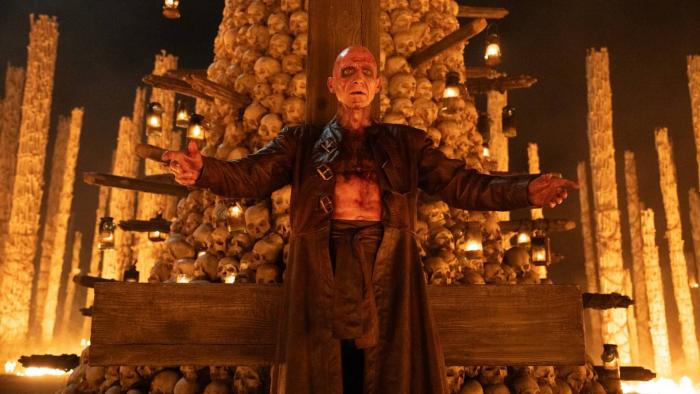
The world's been ending for as far back as I can remember--I was raised Pentecostal, after all. But you'd be excused for feeling Ye Olde Apocalypse even more keenly in this the year of 2026. As I type this, our President is yammering on about invoking the Insurrection Act, and who knows--by the time this review is published, perhaps he will have gone and done it. And with coherency so goes the passage of time, which seems to've itself unraveled--we're a whole two weeks deep into a new year that's already felt like its own morbid century.
In that way, it feels meaningful that the 28 Days Later franchise that kicked off in 2002 in the wake of 9/11 is so intimately tethered to the passage of time, so much so that it's stayed right there in the titles. Days turned to Weeks and then to Years before we knew it, with writer Alex Garland and director Danny Boyle's return to the franchise landing in last year's mixed-bag called 28 Years Later.
And as the "War on Terror" raged about the edges of the first two movies' red-eyed ideas, so too does this decades-on return feel buoyed by a rising tide of political turmoil and disaster--even if the first movie only hinted at its Brexit-ian themes of isolationism, it strode head-long into a muck of toxic masculinity and the dissolution of the family unit that's at the heart of so much of our modern anxiety. Point being--Men are not okay! And damn if these movies don't bite over and over right into the heart-meat of that. (And heck Alex Garland's made a side-career directing his own movies where that's the main theme--see Ex Machina, Annihilation, and indeed 2022's Men most straight-forwardly of all.)
So it's fascinating within that framework then to consider that 2026 is handing us the first film in the zombie franchise to be directed by a woman--Nia DaCosta of Hedda, The Marvels, and the 2021 Candyman re-quel--and the movie which I can confidently say has turned out to be the franchise's best (to date) of them all. No 28 Years Later: The Bone Temple couldn't possibly end up as formative and genre-defining as Boyle's original movie was. ("What if zombies.... but fast???" is a question that will resonate through all of time.) But DaCosta's film is stranger, funnier, more emotionally rich, and eons more forward-thinking than anything of this franchise that's come before it. Yes, in 2026 the Apocalypse is old-hat. But The Bone Temple is showing us the way.
Or as the poet once put it--"We won't cry for yesterday; there's an ordinary world somehow we have to find. And as we try to make our way to the ordinary world, we will learn to survive..." (And more on the Duran Duran of it in a sec.)
Because Apocalypse fiction is after all mainly Post-apocalypse fiction--as much fun as it is to watch the big CG tidal wave wash away New York City and Téa Leoni with it, what we're really looking for is what we're supposed to do once the world's ended. For a lot of us with our ears to the ground it kinda feels like that button's already been pushed anyway--the Climate Change Genie has done gone and escaped its bottle. So that's you could say why we've had seven thousand seasons of The Walking Dead and The Walking Dead spin-offs and rip-offs--in the parlance of a singing vampire slayer who's already died twice, "Where do we go from here?"
Admittedly Boyle's 28 Years Later did begin to introduce those notes to this formerly frantically-paced mid-plague franchise, although to my eye, after 23 years of these things, Boyle & Garland did it rotely, with a chaotic mish-mash of thin characterizations and things that felt, despite Boyle's techno-tinged flair for the frenetic, been-there-done-that. That movie introduced us to 12-year-old Spike (Alfie Williams) and his parents (played by Aaron Taylor-Johnson and Jodie Comer), all of them safely ensconced on a small island within a community of survivors who all would've seemed at home dancing and drinking on the lower decks of the Titanic. And that movie's tale of Spike making his first make-a-man-of-ye trek to the mainland inevitably ended with the boy's comfortable illusions being stripped away--just one skull sitting on a teetering tower of way too many.
But in my review of that movie last year I did more-than-one-time wonder, knowing there was at least one and probably two more movies in the franchise on the horizon, if we were merely witnessing prologue. In particular, the last act introduction of Ralph Fiennes' memento-mori-memorializing character of Dr. Kelson, slathered in iodine and seemingly at peace with death inside that palace of skulls, seemed to point toward more interesting ideas ahead. If the story was willing to trot itself away from all of that hackneyed survivor island stuff and actually follow Fiennes' Pied Piper toward more emotionally and intellectually fertile pastures where us plague rats could scamper and be free of cliche, that is.
Happily it turns out that was the case and then some. The Bone Temple jumps off at what appears to be mere minutes after the bizarre swerve the last movie served up in its closing moments, with little Spike all by his lonesome on the mainland meeting up with a band of merry zombie-slaughtering ninja-chavs in matching tracksuits and wigs, all of them named Jimmy and all of them led by one Sir Lord Jimmy Crystal (Jack O'Connell, slyly stealing his every second of screentime in yet another horror movie so soon after doing the exact same in Sinners).
Calling his disciples his "fingers," Sir Jimmy tosses a knife at Spike's feet and forces the boy into a fight to the death, with the prize being that whoever's alive at the end gets to stay at Sir Jimmy's side, serving his mad whims with the others. Sir Jimmy (whose church-set backstory we actually saw way back at the start of the first 28 Years Later movie) fancies himself a Satanist--the son of Satan no less, whom he calls "Old Nick". And it's their ragtag gang's spiritual duty to spread horror across the land in the name of the unholy father and his tiara-wearing son. Hey, it's a living.
But that's just one of the strange lores that've bubbled up in the survivors reconfiguring of history and myth post-apocalypse--as we saw in Boyle's previous film the island-bound survivors where Spike came from had reverted to a sort of medieval tribalism bearing pretty strict gender roles and rules. But out here in the wild it's a great big beautiful free-for-all of nonsense--one where the Teletubbies are as canonized as Jesus Christ himself. The dusty artifacts from the time-capsules of the Before times are breeding out in a billion bizarre directions--if, as we've been shown, the Rage Virus could only metastasize into three kinds of zombies (the slow ones, the fast ones, and the biggest baddest Alpha ones) then that rinky-dink plague's got nothing on the human imagination.
DaCosta's film settles in on just two strands of where humanity's wandered, and they're admittedly the ones we've been familiar with as foes since even before Max Von Sydow sat down to play chess with Death. Yes it's our old pals atheism & science up against that wily ol' unkillable religion again. But pinning the tails on these two particular donkeys is no small feat here, since they've turned into such fun-house mirrors versions of themselves that there's nothing expected or boring about the movie closing in on this choice.
And so for 50% of the film we're watching Spike traverse the countryside with the Jimmys, causing sick-making mayhem on the bodies of the living and the infected unliving alike, all in a perversion of faith--"charity" is what Sir Jimmy prefers to call it, and it looks a lot like skin sloughing off screaming innocents in fatty clumps. (It's no small feat to say this but this is by far the grossest and the goriest of these films to date--DaCosta has the stomach for some splatter to even out the palate, and bless her for it!)
And then for the other half of The Bone Temple we're thank-the-heavens back vibing with Dr. Kelson in his titular temple of tibia and the like. And for all the words that it's taken me to get back to him, it might be possible to say that Kelson is actually The Bone Temple's main protagonist. And as ever is the case with any movie that can call Ralph Fiennes its main protagonist, he rocks the joint. He rocks its face straight off. (I won't spoil it but I do kinda mean all of this literally, as there is a stand-up-and-cheer scene in the last act of this film that's the definition of why we leave the house to spend two hours trapped in a room staring at a big screen with a bunch of strangers. Get up off your feet and applaud for what will surely one of 2026's scenes of the year.)
So as Spike's off witnessing a steady stream of unspeakable horrors at the hands of the madcap menacing Jimmys (and slowly making sorta friends with one of them played by Erin Kellyman), Dr. Kelson's off on a trip of his own. A trip of the human spirit, that is! One which sees the good doctor bonding with the most unlikely of suspects in all the seven kingdoms--the King Alpha from the last movie, whom Kelson's dubbed Samson (Chi Lewis-Parry) due to his luxurious locks. And who the rest of us probably remember due to his enormous swinging manhood permanently, defiantly, on display, probably always the last thing his many victims would seen as their spines are ripped out. (And hey all things considered that's not the worst sight to deliver one unto the where-ever, if you ask me anyway.)
And this is where DaCosta's film really severs its own neck from the muck and soars straight up into the heavens, as these passages thrum with surprise, emotion, wit, and an impossible swelling of hope. (Not to mention the best use of Duran Duran on screen since Barbarella.) A pas de deux perfectly (and I will have to insist homoerotically) performed by Fiennes and Lewis-Parry--and with no hesitation will I admit I'd give both of these actors Oscar nominations for these indescribably moving turns come the time for them next year. This is where The Bone Temple becomes something more than an allegory about Apocalypse and its awful cycles of degradation and violence. It posits an After. It dances on the grave of nihilism and this film really considers, with decency and love, what real survival in this terrible world could and should mean.
Another thing The Bone Temple does, or at least managed for me? It makes the first 28 Years Later from Boyle seem better in retrospect. I was admittedly tougher on it than many critics and audiences were, and I'm still not sure we needed two whole hours of misshapen prologue to edge us toward the stratospheric highs of DaCosta's killer turn up at bat. But The Bone Temple is truly an Empire Strikes Back or a Godfather Part II level sequel--one that expands our idea of not just the story's own three-decades-now cinematic universe, but of our own decidedly less comfortably-scripted one. It posits a path toward an After. One paved with decency, humor, music, and freely swinging manhoods that are far less scary than the ones that came before. I will call that place Heaven.


