
Old School. Biblically Independent.
By Lindsay Traves | Film | November 6, 2025
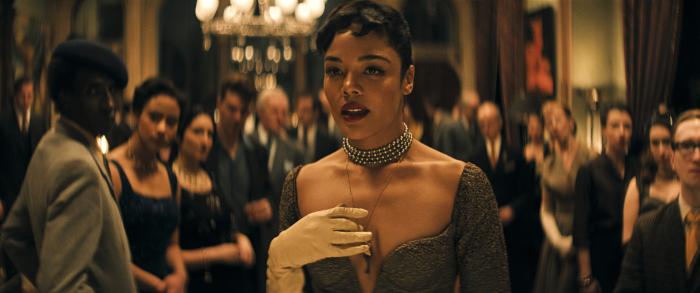
It’s true, this story, set firmly in the 1950s, is a modernized version of its source material. Henrik Ibsen’s Hedda Gabler premiered in the nineteenth century, and Nia DaCosta has plucked it from its setting and placed it within the oppressive walls of a 1950s mega-mansion. In her version, Hedda (Tessa Thompson) is a Black woman experiencing the boredom that comes from a life of security and marriage. Desperate to spice things up, Hedda plays wicked games with party guests coming to gaze at her new home, and the mess she orchestrates creates a night of blood, war, and shattered chandeliers.
Hedda is recently married to an academic vying for a professorship and using the wealth of a judge who looks after her as a means of portraying prestige. That her life is a house of cards is not enough excitement for the sparkling and sassy woman, and she immediately longs for her past full of sex and alcohol that preceded this mundane moment. When a former lover becomes her husband’s career rival, Hedda exploits the opportunity to play games of manipulation with her party guests, whose lives become pawns Hedda delights in knocking over.
DaCosta’s modern adaptation gender- and race-swaps characters to tell a truly unique version of the classic story. Hedda isn’t just oppressed by the bore of a regular marriage but also by racial and sexual norms and paradigms. Her magnetism breaks free of those limitations, allowing her to play games of sex and violence with nearly anyone who walks through her door. She is bored and manipulative, and though the glowing protagonist is impossible to relate to, moments of vulnerability make her possible to root for.
Pivoting to something of a chamber piece and limiting the story to one night adds a level of staccato pluckiness and breathless pace to Hedda’s game of lust and pain. It opens near its ending, with Hedda being asked to recount a shooting, then flashes to her setting up a party and dressing in the gown we expect to be destroyed. Her love for her father’s guns leaves weapons accessible and placed in many hands, leaving a strung-out audience to decipher who will shoot at whom as we witness Hedda’s quick mouth causing trouble at every opportunity.
Thompson is such an inspired casting choice for this character, as her bewitching way and ability to bask in the vile make her fair game for the manipulation she engages in. She is as sexy as the film wrapped around her, and even the most off-putting moments are marked with her appealing laugh. It’s no wonder the character, who has never tread lightly on anything, is so universally admired by her guests and able to so successfully ease the worries of her husband.
Hedda takes a story of a fiery antiheroine and places her within a lush and beautiful home. Though sprawling and plush, it never feels large enough for the woman accused of being “domesticated,” so she uses its confines to her advantage to stir up some drama. Hedda is a modern woman, one we could imagine successfully stirring pots on reality television or making waves in 1890s Europe. DaCosta has proven the character and her story of a woman’s repression to be timeless by placing her in the twentieth century and turning up the gas that ignites Hedda’s flame.


