
Old School. Biblically Independent.
By Dustin Rowles | Film | August 10, 2026
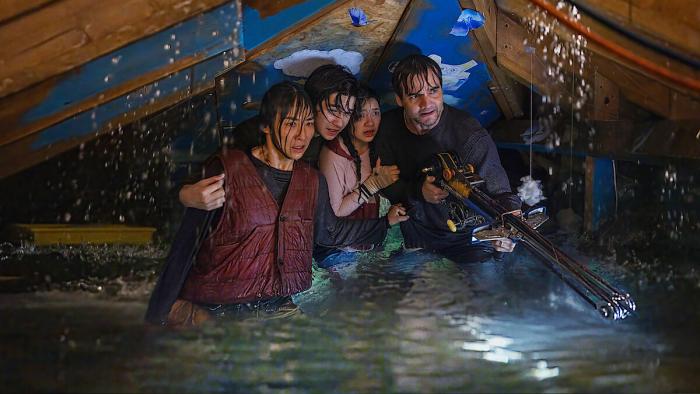
The Last House feels like someone looking for a sci-fi entry point into romanticizing the COVID era, only to realize, at some point, that his characters couldn’t just dick around in their house for the rest of their lives. Unfortunately, escaping the premise of The Last House is a whole lot less interesting (and far dumber) than everything that comes before it.
The first half of The Last House, which is directed by Louis Leterrier (Now You See Me, Fast X), working from a Matthew Robinson (Good Luck, Have Fun, Don’t Die) screenplay, is kind of interesting. A huge storm rolls in, and a close-knit family of four — Ann (Greta Lee), Jason (Wagner Moura), and their son Graham and daughter, Ruth — realizes that they cannot escape their house. Like, the doors won’t open. The windows won’t shatter. The walls, somehow, knit themselves back together in the rain (don’t ask how, because The Last House has no answers).
They soon realize that everyone in the neighborhood and, likely, the entire world is going through the same experience: They’re trapped in their houses, completely unable to get out. The Internet is also out, so there’s no way to communicate beyond their homes, save for chalkboards they hoist to swap messages with their neighbors. At first, they’re like, “OK, well. Let’s make the best of this.” They hang out. They savor family time together. They watch their two DVDs (Annie and Air Force One) over and over. They cook together. They don’t have to go to work or pay their mortgage. It feels like the first few months of COVID, minus the dread and uncertainty.
But then the food runs out, and The Last House gains a sort of fun The Martian vibe: They decide to “science the sh**” out of it, which would have landed a lot better if there’d been any actual science behind their schemes. They pry up the floorboards and turn the living room into a garden, and they rig traps outside their chimney to haul up neighborhood animals (foxes, skunks, squirrels, etc.). This drags on for five years, much of it via montage, and while everyone else around them dies, this family manages to survive on a house garden, squirrels, and Air Force One rewatches.
Alas, there has to be a reason for the constant rain and the inability of anyone to leave their homes, and unfortunately, that’s where The Last House completely falls apart. Spoilers here, but it appears to be some sort of deep, bottom-of-the-ocean mythical giant squid-like sea creatures that have crawled onto land, figured out how to pen everyone inside with magic rain, and — oh yeah — occasionally break into homes and slaughter the owners. Meanwhile, The Last House is beginning to sink (because of all the rain), the daughter spikes an infection after a possum bites her, the sea creatures poison their garden with salt water, and the family decides it’s time to get the hell out of the house.
And that’s when The Last House completely disintegrates, dismantling whatever rickety foundation it had been built upon. Moura and Lee, bless them, do outstanding work propping up the thin script and shoddy camera work (get them Netflix checks, y’all!), but nothing and no one could rescue The Last House from one of the more imbecilic third acts in recent memory. And if that’s not bad enough, Robinson writes himself into a corner so badly that he needs a Sesame Street-like denouement to claw him out. It’s legit embarrassing, souring a disastrous third act into a cringe so violent that my back molars popped out.
There’s a lot wrong with the first two acts, mind you: Mostly in the way that Robinson and Leterrier hand-wave what could have been legitimately interesting science, but even if the non-pedants can forgive that, there’s no forgiving the nonsensical and unrelentingly awful last half hour. The only saving grace is Moura and Lee, who manage to be likable and sympathetic enough that we don’t actually find ourselves rooting for the sea creatures to devour the family, although if they’d swallowed Louis Leterrier instead, I doubt there’d be many complaints.


