
Old School. Biblically Independent.
By Tori Preston | Film | February 14, 2026
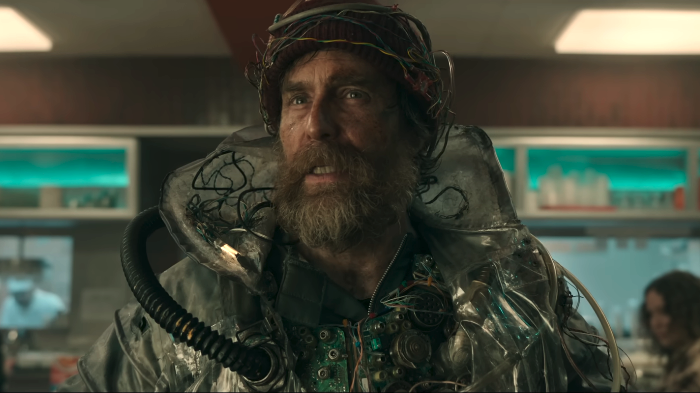
The first hour or so of Gore Verbinski’s dystopian action/comedy, Good Luck, Have Fun, Don’t Die, will have you chuckling despite the pit of self-awareness looming in your gut. When Sam Rockwell, the unnamed Man from the Future, stomps into a diner and demands assistance in preventing a coming AI-run-amok dystopia, it’s impossible not to recognize the dangers he enumerates. People spend too much time on their phones, you see - they scroll their phones first thing in the morning, checking email and social media, until eventually they just… keep on scrolling. They never stop. It’d be easy to say that humanity abandoned reality when it became a barren hellscape, except that it became a barren hellscape because they’d already abandoned it for an easier virtual reality.
Luckily, a few brilliant scientists 50 years in the future have pinpointed the precise moment when this dystopian nightmare might be avoided. Somewhere in Los Angeles, a nine-year-old boy is building the perfect artificial intelligence, the one that will destroy the world through algorithmic distraction, and if The Man can upload a set of operating safeguards to it before it gains sentience, humanity might have a chance. All he needs is the right combination of people, located in the diner, to help him on his quest - a quest he’s been repeating, over a hundred times, until he finally gets it right. Will tonight be the night? It all depends on his team.
There’s Susan (Juno Temple, sporting a wobbly accent), a mother whose son recently died in a school shooting, only to be reborn as a clone. Turns out there’s a booming secret market of cloning, and if your kid dies in a school shooting, then hey - you get a hefty discount! Then there’s Mark and Janet (Michael Peña, Zazie Beetz), high school teachers on the run from a mob of teenagers who have been brainwashed by their phones. Scott (Asim Chaudhry) and Marie (Georgia Goodman) lack the clever backstories that might give them an ounce of plot armor, but it’s more than made up for by Ingrid (Haley Lu Richardson, predictably magnetic), a young woman in a bedraggled princess dress who is literally allergic to technology.
Good Luck, Have Fun, Don’t Die is a zany ride, with unexpected action setpieces and a cheeky sense of humor. It’s a good time all around, and worth the price of admission for Hobo Rockwell and Manic Pixie Haley Lu alone! However, the movie is being billed as anti-AI, and it obviously is, but I’d like to talk about it because it isn’t quite the condemnation you’d expect. When Ingrid’s boyfriend chooses to leave her to live in a new VR game, he explains that life is just better there. Why should we all experience pain and suffering just to grow? Why can’t the world be easier? As on-the-nose as that message is, it does underscore the point that AI is only the problem insofar as it’s a tool. Our desire to take that shortcut, to lose ourselves in the machine, is the real problem. If this evil AI is Skynet, then Good Luck, Have Fun, Don’t Die is here to remind you that machines don’t kill people, people kill people, dammit (but we can still make the tools harder to abuse).
The Terminator is the biggest and most obvious cultural touchstone in Matthew Robinson’s script (especially in the big twist), but it’s hardly the only one. This movie is packed with more references than Ready Player One, though many of them are subtle. They tickle the back of your brain, a niggling familiarity that you know you ought to recognize. Some are visual, like the climactic scene that involves mutant toys reminiscent of Sid’s misfit toys from Toy Story, or even the AI slop it introduces as a plot device, but many are thematic. Is Susan’s backstory just a modernized take on the old myth of the Changeling, of children replaced by fairies? Is Ingrid’s boyfriend’s virtual reality an example of the Metaverse Neal Stephenson wrote about? Which brainwashed-kids tale are Mark and Janet refugees from - Disturbing Behavior, an inverted The Faculty, Children of the Corn? Or is that the point, that there are so many versions to choose from, it doesn’t even matter?
I left the theater thinking about the common complaint about AI art as a plagiarism machine, recycling and regurgitating the work of human artists. In some ways, Good Luck, Have Fun, Don’t Die is a reminder that all art is built on other art. Artists are audiences, after all. Writers are readers, musicians are listeners, filmmakers are viewers. Their work, consciously and unconsciously, will be influenced by works that came before. The difference lies in the meaning that comes from those human experiences. The fears of the future that shape our dystopian sci-fi stories, the instinct mothers have to protect their children - the shared experiences that went into creating the stories in the first place, and which make them relevant to be used as a reference now. Machines can rehash our stories, but they can’t reassemble them into something that brings new meaning to those feelings that created them. Even at its messiest, Good Luck, Have Fun, Don’t Die takes those stories you already know and builds something new from them. And the proof is that pit you feel in your stomach, as you realize you really should put your phone down.


