Old School. Biblically Independent.
By Dustin Rowles | Film | April 8, 2026
Way back in the early days of this site, one of the more talked about movies among our commentariat was The Mist, one of those Stephen King adaptations with an unusually divided audience. It wasn’t quite Love Actually levels around here, but divisive all the same. “It was great … except for the ending” was an oft-repeated phrase, although there are others who insist that Darabont’s ending was better.
Somehow, I’ve gone 19 years (yes, it’s nearly two decades old now) without having ever watched The Mist, and it’s one of the few Stephen King novellas I haven’t read (and before you jump down my throat, TK still hasn’t watched Shawshank). With Mike Flanagan set to adapt it, I thought I’d finally sit down and watch the thing, if only to resurrect an old argument. I love a good sh*tshow.
Here’s what I’ll say for the movie: If I had no idea it was a Stephen King adaptation, I’d still know it was a Stephen King adaptation. If you fed Stephen King’s entire oeuvre into an LLM and asked it to generate a Stephen King movie, The Mist would be the output. It’s maybe the most Stephen King adaptation that ever Stephen King’d.
That’s not an insult, exactly. It’s just so … quintessentially Stephen King. A variation of Marcia Gay Harden’s religious zealot appears in roughly 42 percent of all Stephen King novels, and the rest of the supporting characters slot neatly into their respective King archetypes. But there is a reason Stephen King sells the way he sells: His novels are smart but accessible, and there’s something deeply relatable about his everyman protagonists, even when those everyman protagonists are about to be eaten by something awful.
For the small minority unfamiliar with the setup: After a massive storm strikes a small town in Maine, a mist rolls in. The mist contains something — something that kills people. A group of survivors barricades inside a grocery store and tries to figure out what to do next.
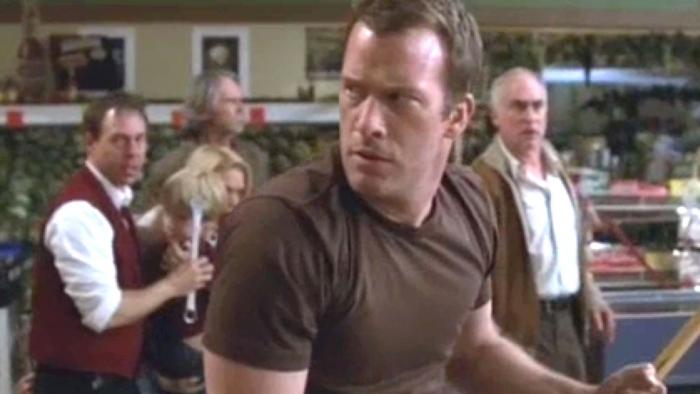
Thomas Jane plays the prototypical Stephen King lead, David Drayton, a man trapped inside with his young son. As the Mist unleashes its creatures and the body count rises, paranoia metastasizes inside the store, and the survivors begin turning on each other — driven largely by the machinations of Bible-thumping zealot Mrs. Carmody (Marcia Gay Harden), who even has a readily identifiable Stephen King name.
My chief complaint with the movie — a largely faithful rendering of the novella, save for the ending — is that The Mist refuses to maintain its mystery. A vague, shapeless, deadly fog would have been far more effective than the rendered creatures lurking inside it, and not entirely because the CGI is so rough (though that, too). It’s creepier when you don’t know what’s out there. The monsters themselves actually undercut the real meat of the story, which is the factions forming inside the store. The more interesting film, in my opinion, might have been one where the townspeople slaughtered each other before anyone ever found out what was in the Mist.
But never mind that. The real question is whether the movie’s ending was better or worse than the novella’s. I Wikied the book ending. I watched the movie ending. I side with Darabont. Bleak is better. And hoo boy, is it bleak.
David manages to escape the grocery store with a small group. Many of them are killed en route to the car, but David and four others — including his son — make it out and drive away. In the novel, they keep driving, and the ending is vague but potentially hopeful.
In the movie, they run out of gas. Convinced they’re about to be killed by whatever is living in the Mist, David uses his last four bullets to kill everyone in the car but himself. The military arrives roughly thirty seconds later. The Mist lifts. David is left sitting in a car full of people he just murdered, doing the math on the fact that if he’d waited two minutes, his son would still be alive. It’s harsh — punishingly so — but I think it’s fitting. Stephen King has said publicly that he preferred Darabont’s ending and wishes he’d thought of it himself. I’m not entirely sure why he didn’t; it seems like a natural extension of the material. But there you go: David survives, and is left to spend the rest of his life with what he did — assuming he doesn’t locate the nearest tall building at the first available opportunity.
The Mist is good, not great — a faithful, competent adaptation that occasionally gets in its own way. But it’s also exactly the kind of raw material that Flanagan tends to thrive on: flawed source material with a strong emotional core that just needs someone to trust the humans over the monsters. I’m genuinely excited to see what he does with it. At the very least, we know the CGI will be better.


