
Old School. Biblically Independent.
By Melanie Fischer | Film | August 26, 2025
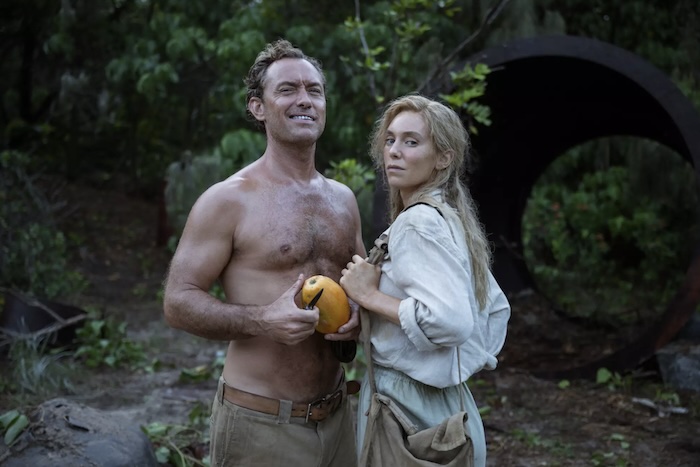
Eden, the new Ron Howard movie dumped even more unceremoniously than the director’s last, Thai cave rescue biopic Thirteen Lives, begins with a young newlywed reluctantly dragged to the edge of the earth (read: Floreana, one of the Galápagos Islands) by her new husband, with her adolescent stepson in tow. The year is 1932, and the woman in question is Margret Wittmer, a relentlessly German young woman who we are told was well on her way to spinsterdom before she accepted the first man to glance her way, but is played by Sydney Sweeney with dyed hair because this is Hollywood.
Her husband, disillusioned WWI vet Heinz Wittmer (Daniel Brühl), embarked on this quest partly in search of a warmer climate that might help his son’s chronic health issues (a subplot quickly forgotten about) but mostly to follow his idol, Dr. Friedrich Ritter (Jude Law), a Nietzsche-obsessed physician turned philosopher who sought out the isolation of Floreana to compose his manifesto, a completely unprecedented work of genius that will, upon publication, save humanity from itself. With Dr. Ritter is his partner Dore Strauch (Vanessa Kirby), who the film truly does not know what to do with; her character can be summarized in that she has MS, a toothache, and really, really loves her donkey.
Dr. Ritter is decidedly unimpressed by his #1 fan, and largely ignores the newcomers, but is even less thrilled by the final arrivals to Floreana: “Baroness” Eloise Bosquet de Wagner Wehrhorn (Ana de Armas, enjoyably unhinged) and her two boy-toys, Robert (Toby Wallace) and Rudolph (Felix Kammerer), who have grand plans to build an ultra-exclusive resort on the island.
Yes, just in case it’s not clear already, this is all based on a true story. It’s too weird not to be. And if any of it sounds at all familiar to you, it’s likely because the debacle that unfolds was also given the documentary treatment a little over a decade ago in The Galapagos Affair.
Eden features a star-studded ensemble cast, but like many ensemble casts, there’s one person who’s just a bit more the main character than anyone else. In this case, it’s Margret, the voice of reason and the fish out of water, who makes for the easiest audience stand-in.
It takes a while for the true villain of the film to be revealed, and until that point Margret’s main conflict is an inner one, namely making peace with the situation she finds herself in. Which is genuinely something the few people who see this movie will relate to, because audience members will also be wondering, how did I get here? Why did Ron Howard make this? Yes, the man clearly loves a good true against-the-odds survival story, but there are so many of those out there. Why this one?
Is this punishment for how the actually quite good Thirteen Lives got screwed over by internal politicking when MGM was acquired by Amazon? Is this Howard being punished for how his Hillbilly Elegy adaptation is arguably the butterfly that flapped its wings and now we all get to live with the hurricane that is JD Vance being vice president now?
All big questions for which we will likely never have answers. And then there are many smaller but equally puzzling questions, like why does Jude Law have metal dentures? Why is Vanessa Kirby sharing a carrot with a donkey Lady and the Tramp style? Is this scene supposed to be funny, or am I just a bad person?
A lot of bad movies nowadays are depressingly understandable — overly safe and bland byproducts of terrified, risk-averse decision-making (see: most Netflix original films) or blatantly misguided attempts from decision-makers so utterly out of touch with audiences that they don’t even realize they’re not even aiming at the right target (M3GAN 2.0, Joker: Folie a Deux). But Eden is a different beast entirely—the good old-fashioned “what on Earth were they thinking?” kind of a misfire that defies logical explanation.
The thing is, Eden is not Megalopolis or Horizon—Ron Howard is still very good at directing. Eden, for its many faults, is well directed. It’s also well cast, well acted, and in several regards truly quite well made. But the screenplay by Noah Pink (Tetris) is just such a weird feathered fish of a story that is neither here nor there and scattered rather everywhere; it’s a blatant non-starter. There is no universe in which this film connects with an audience. It’s too dark to be uplifting, but not dark enough to be horror. Too dramatic to be funny, but the welcome touches of dark humor are too fleeting to ever be called a comedy. The tonal shifts are abrupt enough to inspire whiplash.
To try to categorize that which defies conventional standards, this film can perhaps be best pinpointed as an indulgently Freudian character study at the edge of the world, where all the men have some sort of complex about their masculinity, and all the women have some sort of complex about having babies—namely, there’s the good woman who has babies (Margret), the bad woman who hates babies (Eloise), and the broken woman who can’t have babies (Dore).
On the one hand, Eden is a baffling amalgamation of parts that doesn’t truly really work. It’s not a movie one can in good conscience recommend. But on the other hand, it’s definitely not boring. That, in this day and age, is an accomplishment in itself, because they really don’t make them like this anymore. There’s something oddly fitting in how Eden’s destiny as a weird little footnote in the annals of film history reflects the strange historical footnote that is the story itself — perhaps the one piece of this otherwise baffling puzzle that weirdly makes sense.
Eden is now playing in theaters.


