
Old School. Biblically Independent.
By Kayleigh Donaldson | Books | March 30, 2026
Easy Money: Cryptocurrency, Casino Capitalism, and the Golden Age of Fraud by Ben McKenzie and Jacob Silverman
Really enjoyed reading this while on my trip.
— Kayleigh Donaldson (@ceilidhann.bsky.social) March 14, 2026 at 9:17 PM
[image or embed]
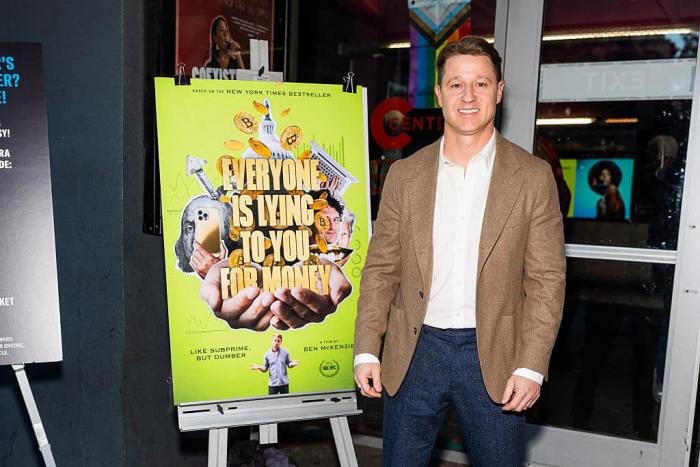
Unsatisfied with being a millennial sex symbol and Mr. Morena Baccarin, actor Ben McKenzie has spent the past few years being one of the most vocal anti-cryptocurrency voices in the entertainment space. As people like Paris Hilton were showing off their pictures of ugly cartoon apes and Matt Damon was negging people in Super Bowl ads, McKenzie was doing the work to show what he, an economics grad, knew to be true: that this bubble was going to burst and leave behind one hell of a mess. History has certainly been kind to him, and with the impending release of his documentary on the subject, Everyone is Lying to You For Money, I felt it was only right to read the book that preceded it.
Easy Money opens with McKenzie wondering if he's the crazy one. He's convinced that crypto is quickly going to fall apart but the numbers keep going up and more and more celebrities are getting involved in the business of blockchains and NFTs. Yet everything he reads only seems to confirm to him that things seem destined to crumble in the most spectacular manner possible. So, he enlists the journalist Jacob Silverman to help him dive into crypto and see where the truth lies. They attend gaudy conventions where the most obnoxious people in the world brag about their riches. The pair travel to El Salvador, where the transparently crooked President is trying to make the island nation a Bitcoin-first country. McKenzie manages to land an interview with Sam Bankman-Fried, the now-convicted fraudster who was, for a time, the baby-faced leader of "responsible" crypto.
There are a few great works on this period of crypto boom and bust that cover a lot of similar territory to Easy Money, such as Zeke Faux's Number Go Up and Dan Olson's documentary Line Goes Up. What makes McKenzie's book so fascinating is how his celebrity shapes both his interactions with the space and how others react to him. A lot of these salesman desperately want to be cool and think that adjacency to the young Jim Gordon can make them cooler. Some of them also seem more willing to bring their guard down around a celebrity who they don't view as a threat in the way that journalists would be to their cause. Big mistake, because Ben brought notes.
This is definitely a good starting point for people who want to know why crypto sucks and have the labyrinthine concepts of blockchain technology and data mining explained in (somewhat) layman's terms. While McKenzie is unsparing in his scorn towards this scam, he's also deeply empathetic towards those who were caught up in the hype and hooked by what is essentially a pyramid scheme with a gambling mechanism sewn onto its sides. There's a lot to take in here but Easy Money is a clear-eyed route through it, with a guide who is savvy, self-deprecating, and driven by a truly noble cause. Well, that and he also wants to be proven right, but who can blame him? He was, after all, right about it all.
Room 1219: The Life of Fatty Arbuckle, the Mysterious Death of Virginia Rappe, and the Scandal That Changed Hollywood by Greg Merritt
mzs.press/Room-1219-Ha...
— MZS.Press (@mzspress.bsky.social) December 4, 2024 at 4:04 AM
[image or embed]
In 1921, Virginia Rappe, an actress and model who had moved to Hollywood to seek her fortune in movies, died. She had attended a party at the St. Francis Hotel in San Francisco, wherein she met Roscoe "Fatty" Arbuckle, the comedic actor who was one of the biggest stars in America at the time. The cause of death: Ruptured bladder and secondary peritonitis. The events surrounding her death, however, have never been fully revealed. Arbuckle was accused of rape and murder, and it took three trials to acquit him. But did he do it?
The Arbuckle-Rappe case was one of Hollywood's first true scandals. For scolding outsiders, it was proof that the brand-new film industry was a hotbed of debauchery and degradation, one that needed to be controlled. In the ensuing century since Rappe's death, it seems as though we've come no closer to uncovering the truth of what happened to her. Greg Merritt, to his credit, doesn't seek to solve the case, although he does offer his own theory at the end. Rather, he is more interested in Rappe and Arbuckle themselves, how they crossed paths, and how the media and legal fallout of her death paved the way for Hollywood's implementation of the Hays Code.
Merritt has to tread a fine line here. The irrefutable facts of the case are often drowned out by hysterical media reports and some witnesses whose testimonies were questionable at best. He has to navigate a seemingly endless amount of newspapers headlines that veer between smearing Rappe as a fame-hungry temptress and painting Arbuckle as a ravenous beast whose appetites for sex and food were never satisfied (the fatphobia that plagued Arbuckle for his entire life is dissected here with sharp insight, noting how the narrative around his body changed as time passed but always retained its moralising edge.) He's fair to Arbuckle without forgetting that the woman at the heart of this story never really seemed to have anyone in her corner, in life or death, who cared about her personhood.
Despite being a vintage Hollywood geek, I must admit that my knowledge of the Arbuckle-Rappe case was rather scant. One of my few experiences with it came with Kenneth Anger's salacious and patently false reimagining of the case as detailed in Hollywood Babylon, a version of the truth that quickly became the default lore for generations of fans. Room 1219 was a clarifying read that mercifully undid Anger's leering whisper campaign with a swift and well-researched rebuttal.
Death on the Nile by Agatha Christie
An afternoon at the theatre.
— Kayleigh Donaldson (@ceilidhann.bsky.social) March 28, 2026 at 9:26 PM
[image or embed]
So hey, have you heard of this Agatha Christie lady? She wrote quite a few books and seems to be rather popular. There's this cool Belgian guy in them who solves mysteries and has a fun moustache. Cool stuff. Okay, yes, we all know about the legendary queen of crime fiction. I'm shockingly new to the lion's share of her work. While many of my friends are Christie devotees (one of them even named her cat Agatha), I just never got around to reading her until my 30s. Fortunately, I had tickets to a theatrical adaptation of Death on the Nile, so I had an excuse to change that and read one of her most famous novels. Spoiler: there is no tragic World War 1 backstory for his moustache. Dammit, Branagh...
You probably know the setup: A boat on the River Nile transporting an eclectic array of individuals; a messy love triangle; some fabulous jewels; a gun or two; and, of course, murder! My friend says that this one isn't one of her favourites because it has too many coincidences for her liking, although the payoff is worth it. I had few Christie novels to compare it to but I certainly enjoyed my time with Death on the Nile. Christie certainly knows how to hook the reader with vibrant characters, a sneaky crime, and, of course, the ever-appealing Poirot. I greatly enjoyed how sardonic he was for the first half of this book, clearly over the nonsense of rich people and their booze-fuelled follies. I keep meaning to read more Christie, and it's certainly not hard to delve into her work, but I'll probably wait until there's another adaptation to give me the motivation to do so. Sorry, Agatha, I just have a lot of books to read.


