Old School. Biblically Independent.
By Dustin Rowles | TV | February 27, 2026
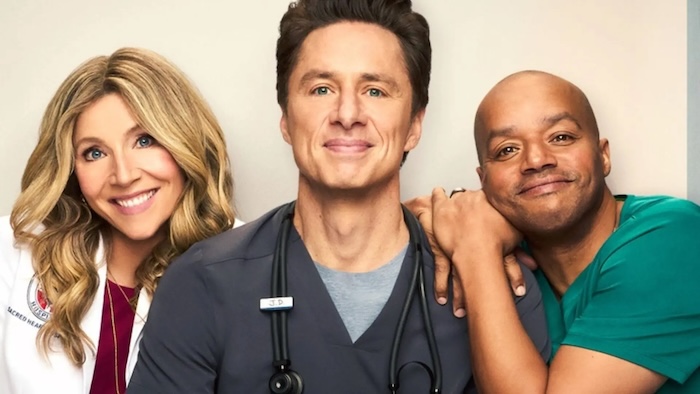
Scrubs is back, and my God, is it perfection. Bill Lawrence and the new showrunner, Aseem Batra (I Feel Bad), have absolutely nailed it by essentially turning the issues with the old Scrubs into strengths. Even the “bad” in the new Scrubs feels necessary to make the revival work, lest there be no conflict and no evolution. The new Scrubs basically brings back its best elements, transforms its most problematic ones, and makes just enough changes so that it feels new.
It is so good to watch a legitimately great comedy on broadcast network television again.
Let’s start with the bad: JD and Elliot are divorced. It’s a heartbreaker, especially because they have kids, whom we have not yet met, though we do meet Turk’s kids, who are old enough now to make us feel very old. It’s also a necessary development for the series. Carla and Turk obviously cannot break up because they are a perfect couple. But we need the comedy-of-remarriage dynamic between JD and Elliot to provide romantic friction and the dozens of storylines that inevitably materialize as they begin dating others, including, hopefully, Scott Foley’s Sean. There’s a moment of heartache, but the series handles it well by not dwelling on the devastation.
The other “bad” is the potential loss, or at least the reduction, of John C. McGinley’s Dr. Cox, who may be my all-time favorite sitcom character. A hilariously abusive character like Dr. Cox realistically does not survive in a 2026 world, and he does not survive as Chief of Medicine in Scrubs, either. He acknowledges that his teaching methods are no longer effective, and may even be a legal liability, and recruits JD to replace him.
It’s not immediately clear what will happen to Dr. Cox. He does not appear in the second episode, although I have to think that Scrubs will find a role for him somewhere. Still, it’s heartening to see in that episode that the show could continue without him. JD graduates from a poncy suburban doctor to Chief of Medicine, injecting his brand of optimism into the hospital and his teaching methods, though they have been leavened by a pragmatism he rarely displayed in the original series.
But the most refreshing, and refreshingly fun, change the series makes is transforming its problematic elements into a comedic superstrength. Over the last couple of weeks, I’ve been rewatching the final season of the original Scrubs, which holds up remarkably well except for some of the racial comedy. It manages to be both funny and tone-deaf, if that makes sense. It’s not that the racial humor was mean-spirited, but the way race insisted itself into the comedy could be uncomfortable.
The new Scrubs manages to have its cake and eat it, too. That brand of comedy still exists, but Scrubs itself, through the Vanessa Bayer character and the charge nurses, calls it out. The show can make some of the same jokes, but the comedy now lies in how those jokes are rebutted. It operates as both a brilliant apologia and an evolution of the sitcom’s humor. The Todd still gets to be The Todd, but he is also rightfully condemned for it in a funny way.
I love it. It’s remarkably funny. It maintains the characters but also grows them and the comedy. I was expecting a pale version of the original trading on nostalgia. What we get instead is a more mature Scrubs that’s as funny for 2026 as the original was in its prime.


