
Old School. Biblically Independent.
By Dustin Rowles | TV | June 9, 2026
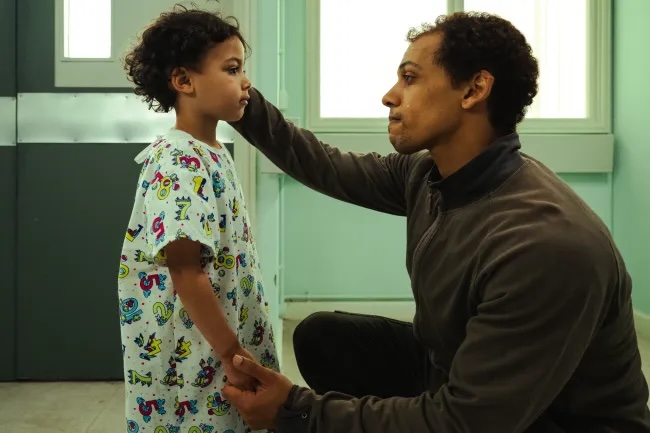
The Witness and The Murder of Rachel Nickell arrived on Netflix on the same day last week — one a dramatization of the botched investigation into Rachel Nickell’s murder, the other a documentary covering the very same case. The obvious question: are they worth watching, and do they tell meaningfully different stories?
Yes, on both counts.
The Witness is a three-episode series centered on the grief and aftermath experienced by André Hanscombe, the partner of Rachel Nickell, following her 1992 murder on Wimbledon Common. The only witness to her death was their two-year-old son, Alex. While Nickell was on a walk in the south London park, a stranger approached her, sexually assaulted her, and stabbed her to death 49 times.
The series dramatizes the London Metropolitan Police’s efforts to elicit eyewitness testimony from a toddler, which ultimately produced a description that seemed to match Colin Stagg, a local man who was wrongfully accused, entrapped, and imprisoned for 13 months. Police had covertly manipulated Stagg into writing about sexual fantasies and used that correspondence as evidence, a tactic a judge later threw out as entrapment. Even after his release, Stagg spent years plagued by the accusation, widely believed by the public to have escaped justice on a technicality rather than his actual innocence.
Nearly two decades later, improved DNA analysis of evidence recovered from Nickell’s body finally pointed to the real killer: Robert Napper, who confessed to the crime. By the time of his arrest, Napper was already confined to Broadmoor, the high-security psychiatric hospital in Berkshire, for other murders he had committed.
Both André and Alex Hanscombe consulted on the Netflix series, and it gets the facts right. But The Witness is as much about grief as it is about the case. A significant thread follows the years-long effort by police and a child psychologist to question Alex, which André eventually refused to permit any further. Fearing the glare of a heavily publicized case, André ultimately moved Alex out of England entirely, hoping to give him something resembling a normal childhood, a decision that worked imperfectly and that a teenage Alex came to resent before, as an adult, he understood it.
In the series’ most damning sequence — set on the eve of Napper’s trial — police present André with evidence confirming what viewers have long suspected: the investigation had been catastrophically mishandled from the start. Had they done their jobs, the implication is clear: Rachel Nickell might still be alive. So might Samantha Bisset, a single mother stabbed to death with her four-year-old daughter, Jazmine, roughly 16 months after Nickell — another victim of a killer police had failed to catch.
This is where the documentary, The Murder of Rachel Nickell, earns its place alongside the drama. It lays out the full scope of the institutional failure more methodically. Police had tested DNA from Nickell’s body sloppily and inconclusively. Napper had been a suspect in a series of rapes years prior; officers visited his home and told him to come in to provide a blood sample. He never did, moved away, and was quietly ruled out — in part because a witness described a suspect who was a few inches shorter than Napper, despite a police sketch that bore a striking resemblance to him.
Most damningly: three years before Nickell’s murder, Napper’s own mother had called police to report that her son had confessed to committing a rape on Plumstead Common. Police never followed up. Had they, it is entirely possible that multiple assaults and at least three murders — Nickell’s, Samantha Bisset’s, and Jazmine Bisset’s — could have been prevented.
The documentary also gives a brief platform to Colin Stagg himself, a man whose life was effectively destroyed by a wrongful accusation — a dimension the series nods at but doesn’t fully reckon with.
Watch both. But if you only have time for one, the documentary does the heavier investigative lifting. The drama makes it personal.


