
Old School. Biblically Independent.
By Dustin Rowles | TV | August 26, 2026
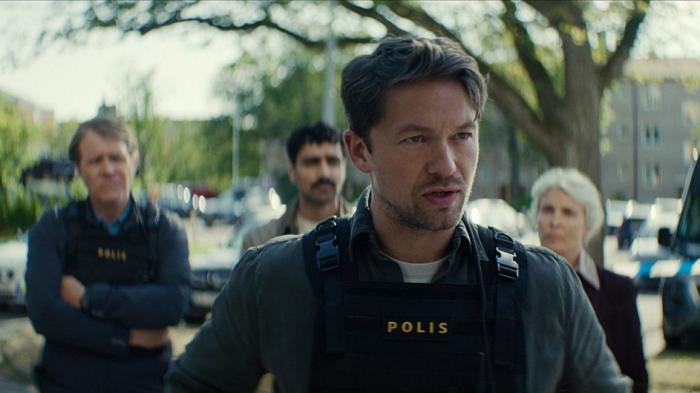
Netflix’s latest scandi noir, Blood Sacrifice, is decidedly grim, but also surprisingly effective for a late-August streaming entry—though that shouldn’t come as a shock, given that it comes from George Kay (Lupin, Gone). The guy knows how to construct a detective mystery. That said, if severed heads aren’t your thing, Blood Sacrifice is decidedly not for you. This is not cozy territory.
The story opens with two patrol officers responding to an emergency call. One enters and doesn’t return. The second goes after him and vanishes too, and the unknown murderer decapitates both. The pattern repeats the following Friday night with two more patrol officers.
Stockholm detective Thomas Berg (Jakob Oftebro) catches the case. He bypasses his regular partner, Max (Henrik Norlén), and recruits the sharp, green detective Natalie Eklund (Electra Hallman) instead — he respects her because she doesn’t defer. Thomas also enlists his estranged father, Alfred (Peter Andersson), a retired detective forced out after planting evidence. The two clash immediately: Alfred is old-school and ethically compromised; Thomas plays by the book and keeps his hands clean. Familiar territory.
The investigation stalls at first, then accelerates as these things do. The character work is thin; it’s entirely plot-driven, but unlike Harlan Coben’s sludgy mystery series, this one moves. A brisk five-episode season without filler. George Kay gets in, solves the serial-killer mystery, and gets out. If taut Scandi noir is your taste, Blood Sacrifice delivers.
If you bailed early because headless bodies posed like gallery installations aren’t your speed—because The Thursday Murder Club is about as dark as you can stomach, here’s how it plays out.
Spoilers
Early on, Alfred deduces the killer is a cop, someone capable of slipping away undetected by blending in with responding officers. One witness provides an unreliable sketch. Alfred cross-references it against male officers with histories of excessive force on duty the night of the killings and isolates a single suspect. He hunts him down on a subway platform. During the standoff, Alfred shoots him. The man doesn’t die but lands in a coma long enough for Thomas to claim credit for the shot — can’t have a disgraced cop getting the win.
Problem: the man Alfred shot isn’t the serial killer. The real killer is Peter Johansson (Magnus Krepper). Two years prior, Peter and his partner responded to a domestic disturbance. An abusive husband dragged Peter’s partner inside, stabbed him, and locked Peter outside. Peter screamed for backup. No one came. His partner died. The department covered it up, blamed Peter, and he spiraled into depression before resolving to exact revenge.
He kills on Friday nights — the same night his partner died — using fake 911 calls to lure officers out. Max, the partner Thomas discarded, actually figures it out first and confronts Peter. He becomes another severed head hanging from a tree in Peter’s backyard. Peter’s endgame: abduct Alfred, take him to the building where his partner was murdered, stab him, wait for neighbors to call 911, then use a rifle to mow down as many responding officers as possible.
Alfred and Thomas upend that plan. When Thomas arrives, Alfred — bleeding from the gut — refuses to let his son help him. Peter shoots Alfred again from the balcony, but Alfred keeps insisting Thomas not intervene. He forces his son to call dispatch and demand no backup. While a delirious, bleeding Alfred writhes on the ground, Thomas sneaks into the building, confronts Peter, and ultimately sacrifices himself by grabbing Peter and dragging them both over the balcony.
Peter dies. Thomas survives. Somehow, so does Alfred. After their hospital recoveries, father and son reconcile and exchange affectionate “Go f*** yourselves” before the credits roll.
The end.


