
Old School. Biblically Independent.
By Dustin Rowles | TV | March 12, 2026
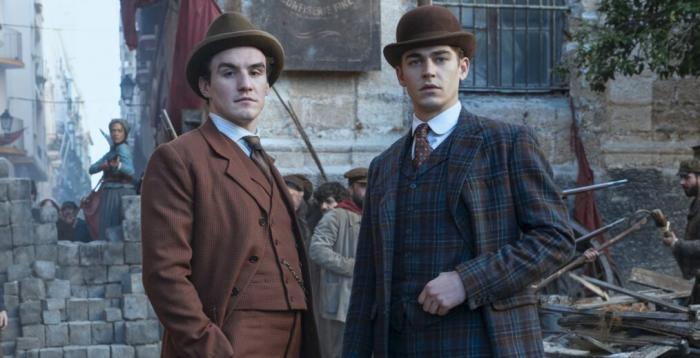
I actually thought that Young Sherlock was a lot of fun — especially the spoilers — so I’d actually recommend skipping this piece (and reading the review) unless you watched an episode or two and it didn’t hook you. Because there’s so little established backstory about Sherlock and his family, there’s plenty of room to maneuver. Creator Matthew Parkhill and director Guy Ritchie took complete advantage.
The series picks up in 1871 at Oxford University, where 19-year-old Sherlock (Hero Fiennes Tiffin) is working as a servant — his older brother Mycroft (Max Irons, son of Jeremy) got him the job. There, he meets and befriends James Moriarty (Dónal Finn), a student at the school. He also encounters Princess Gulun Shou’an of China, who has brought priceless fifth-century BC scrolls of Sun Tzu’s The Art of War. When the scrolls are stolen, Sherlock helps investigate their disappearance, only to discover that someone has planted a bomb in the building, set to detonate during a gala. Sherlock manages to evacuate the building in time, but a professor is found murdered, Sherlock is suspected and arrested, and Moriarty is expelled from Oxford largely because of his association with Sherlock.
It turns out that Princess Shou’an drugged and framed Sherlock. But here’s the twist: Shou’an isn’t actually a princess — she’s a young woman named Xiao Wei who infiltrated Oxford to kill the four professors responsible for the massacre of her entire village. It turns out, however, that Shou’an was being manipulated by a man named Professor Malik, who tricked her into eliminating the professors to prevent them from stealing credit for his discovery: a colorless, odorless nerve agent that was, in fact, the very weapon used to destroy her village. Malik had also been secretly recording the ravings of Sherlock’s mother, Cordelia, while she was confined to an asylum.
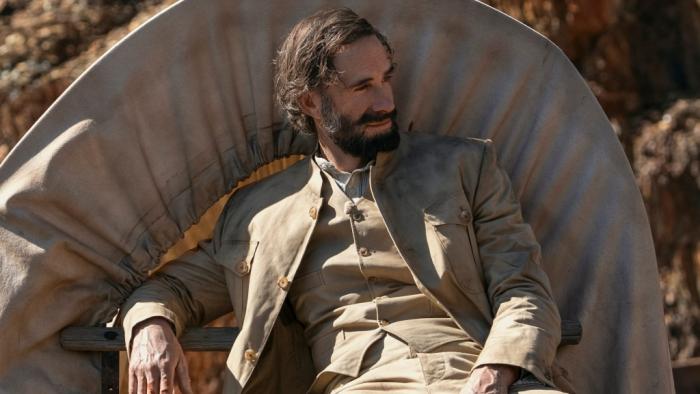
Here’s where it starts to get interesting — around the midpoint of the series: Sherlock’s father, Silas (Joseph Fiennes), returns from his long estrangement. Initially, Sherlock — who has sprung Cordelia from the asylum — embraces his father’s return. But Sherlock and Moriarty soon deduce that something is deeply off about Silas, and they trace it back to the supposed “death” of Sherlock’s sister, Beatrice, twelve years prior.
Fast forward a bit, and it turns out that Silas had been working with Malik all along, with plans to make a fortune selling this colorless, odorless nerve agent to the highest bidder. Moreover, Silas staged Beatrice’s death and used it as a pretext to have his wife institutionalized. Sherlock and Moriarty eventually discover that Beatrice is alive — and that she’s been right under their noses the entire time, working undercover as the assistant to Sir Bucephalus Hodge (Colin Firth) on behalf of her father, Silas.
The highest bidder for the nerve agent, it turns out, is the British government — and Mycroft is working as the go-between. Twist: Mycroft is only pretending to play along; he’s actually working against Silas. Beatrice, meanwhile, comes to realize that her father has been gaslighting her for her entire life, and once that clicks into place, she turns on him too. By the end of the season, every member of the Holmes family has allied against Silas, who is eventually cornered on a cliff. Beatrice, Shou’an, and Sherlock confront him at the edge — and while the women move to kill him, Sherlock tries to intervene, hoping to turn his father over to the authorities. Silas, however, uses Sherlock as a shield and throws himself off the cliff to his death. Presumably.
Before going over the edge, though, Silas leaves Sherlock a clue pointing to a key that will presumably figure heavily into the mystery of the second season. The other major twist: Beatrice and Moriarty become lovers — and before Silas’s plunge, Moriarty manages to snag the formula for the nerve agent, hinting at a potential turn to the dark side, one shaped largely by Silas Holmes’s influence. In other words, Moriarty ends up following in the footsteps of Sherlock’s own father — which is, frankly, a pretty cool piece of setup.
Young Sherlock is basically a family drama dressed up in the trappings of a globe-trotting Victorian thriller — and it works because the Holmes family dysfunction is genuinely compelling. The real mystery of the season isn’t who stole the scrolls or who’s selling the nerve agent; it’s how a brilliant, emotionally raw young man gets shaped into the cold, inscrutable detective we all know him to become. The answer the show proposes — a father who was a monster, a mother locked away, a sister presumed dead, a best friend quietly poisoned by the same corruption — is, in its way, more satisfying than anything Conan Doyle ever bothered to explain. And the neat twist is that Young Sherlock seeds Moriarty’s eventual villainy not in some abstract evil but in the specific wreckage of the Holmes family itself. It’s kind of brilliant.


