Old School. Biblically Independent.
By Dustin Rowles | TV | September 15, 2026
Here’s something crazy: The average age of the 11 acting winners in this week’s Emmy ceremony (11 instead of 12 because Matthew Rhys won twice)—the average age is 64 years old. And that doesn’t include the guest actor categories (which were awarded last week), which included a posthumous award for 78-year-old Rob Reiner.
The youngest acting winners at the ceremony were 51 years old — an age shared by David Harbour, Linda Cardellini, and Matthew Rhys.
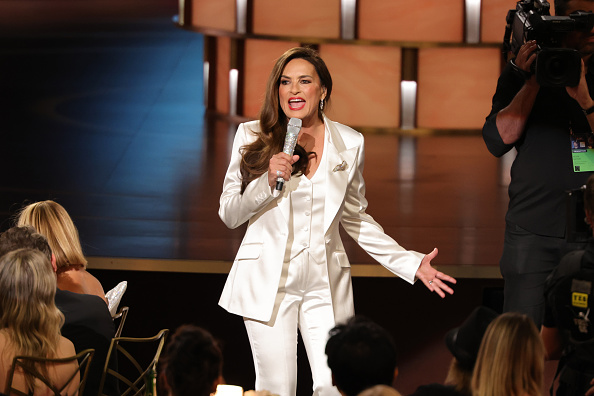
If this isn’t proof that television is an older person medium, I don’t know what is. The average age of the winners is roughly the same as a CBS viewer. That is insane. The host of the ceremony, Mariska Hargitay, is 62 (and looks fabulous, obviously).
And for better or worse, this was a telecast by and for older folks: There wasn’t an edgy joke in the entire ceremony. There was nothing likely to alienate anyone. It was as safe an Emmy telecast as I’ve ever seen, mostly a marketing promo for prestige television and, uh, Baywatch (seriously, what was that).
And if watching beloved 50- to 70-year-old folks win award after award didn’t make you feel old enough, Sarah Michelle Gellar and David Boreanaz presented and commemorated the 30-year anniversary of the premiere of Buffy the Vampire Slayer. Thirty. Years.
I do love Mariska Hargitay, though. I love how game she was for that Joan Jett “I Love TV Screens” number she opened the show with, even if I didn’t love the number itself. I also love how she committed to the monologue. I just wish someone had written a better one for her. The Dick Wolf/Richard Penis joke was the best they had? For Mariska Hargitay? It wasn’t embarrassing. But it wasn’t not embarrassing, either.
Those who might have been watching Monday Night Football didn’t miss much, honestly. The producers obviously recognized that much of their audience likes to turn in early and awarded all the acting categories before 9:30 EST. It was kind of a wild decision to sandwich the writing/directing awards between the major acting awards (which everyone turns in to watch) and the major series winners in each category (which only the hardcore among us stay up too late to watch).
Before we hit the big winners, there were a couple of highlights: John Mulaney presenting an award was probably the comedic highlight of the night, followed by Marcello Hernandez at a distant second and Amy Poehler third.
There was also a very cheesy Taylor Swift/Mariska Hargitay SVU pretape that kind of worked in spite of itself, though I doubt that it lured that many young people to the telecast.
There were some great winners: Rhea Seehorn finally won an Emmy with her fourth nomination, this one for Pluribus (after being wrongfully shut out so many years on Better Call Saul). Widow’s Bay rightfully was the big winner of the night, along with Matthew Rhys, who pulled off a first: Best Winner in both the Lead Actor in a Limited Series category (Beast in Me) and Lead Actor in a Comedy Series for Widow’s Bay. (Stephen Root and Kate O’Flynn also, deservedly, won in their respective categories for Widow’s Bay.)
Stephen Colbert also got a proper send-off, winning Outstanding Variety Series, and paying tribute to his wife in a heartfelt way that was only slightly less heartfelt than Tom Pelphrey’s speech acknowledging his wife, Kaley Cuoco.
Ultimately, because of the weird arrangement of the categories, the air mostly left the room after the acting categories, and it felt decidedly downbeat for around a 45-minute period that included well-deserved tributes to Dolly Parton, Catherine O’Hara, and Rob Reiner, in addition to the In Memoriam section (with Noah Kahan doing a rendition of “Bridge Over Troubled Water”).
They couldn’t recapture what little energy the opening half of the telecast had for the final categories, which went to DTF St. Louis (the overall limited series winner), Widow’s Bay (the overall winner of the night), and The Pitt, which fell short of Widow’s Bay mostly by virtue of all the acting nominees in the supporting categories splitting the vote and making room for surprise winners Tom Pelphrey and Allison Janney.
Ultimately, it wasn’t a great telecast. What’s worse, however, is that it didn’t really even aspire to be. It mostly felt like it wanted to check off all the Emmy telecast boxes and end the show on time. It managed that (it actually would have come in under by a few minutes had the final presenters, Woody Harrelson and Matthew McConaughey, not clearly stalled for time). Given how good television is (at least for the older folks among us), it would have been nice if the telecast had appropriately represented the creativity of the industry instead of just its age.


