
Old School. Biblically Independent.
By Allyson Johnson | TV | September 27, 2023
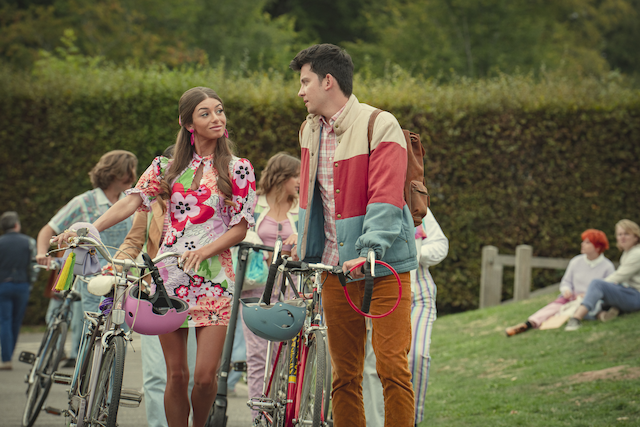
Sex Education, now in its fourth and final season, skillfully navigates the middle ground between its Netflix counterparts, Heartstopper, and the HBO drama Euphoria. This balance isn’t just in tone, though it leans towards the color palette of Heartstopper. Throughout its narrative twists and turns, Sex Education boldly champions honesty in portraying the stumbling intimacy of adolescence — the awkwardness of our bodies in those formative years. The series never shies away from this level of candor. Yet, it appears to have sidestepped the same level of scrutiny that Euphoria has faced, with the latter drawing criticism from those uncomfortable with the idea of teenagers being depicted as sexual beings.
If concerns were solely focused on the potential exploitation of actresses, particularly on a Sam Levinson set, that would be understandable and valid (given Levinson’s reputation.) However, there’s a curious severity, tinged with conservatism, in how people react to Euphoria and similar shows that explore the sexual lives of teens, compared to how they respond to the PG-rated purity, almost chastity, in Heartstopper. In reality, we should be able to appreciate both—although, as Dustin aptly pointed out in his review of Euphoria, there are certainly more sensitive ways to depict it without exploiting the actresses involved. Levinson’s recent show, The Idol, showcases what happens when a showrunner, intoxicated by their perceived creative brilliance, fails to grasp the importance of a skilled editor. Viewers should be more perturbed by his incompetence than his embrace of promiscuity.
It’s when we begin to draw comparisons between shows like Heartstopper and Euphoria that a new wave of prudish discomfort arises. One can’t help but reflect on the general dearth of sexual content in present-day Hollywood, or those who nostalgically praise the Hays Code. As Kayleigh astutely points out in her article, “The notion that contemporary films need censorship to be more ‘creatively fulfilling’ is both laughable and historically ignorant.”
Either Heartstopper is deemed too chaste, a paragon for other teen features to emulate, or Euphoria is criticized as excessively sexualized, an authentic portrayal of real teenagers. The truth lies somewhere in the middle, obscured and made more awkward by the banalities and embarrassments of real life.
This is why it seems that Sex Education skillfully avoids this dichotomy, offering a series that strikes a harmonious balance. It discusses sexuality with both frankness and occasional explicitness, all while infusing humor and heart, highlighting the universal relatability of the subject. Sex Education has been a standout series for numerous reasons beyond its treatment of sex. The writing’s dedication to showing that we’re all navigating this terrain as we go along—yes, even Gillian Anderson’s character—makes it a refreshing addition to the teen drama/comedy genre.
Sex Education recognizes that discussions of asexuality, queer identities, and coming-of-age narratives are intimately connected to exploring our self-discovery through and around sex. These journeys extend far beyond our teenage years. Sex Education succeeds because it doesn’t sensationalize the act; it simply portrays the realities, whether it’s the romantic glow of a bedroom or the harsh lighting of a public restroom.
The portrayal of promiscuity and sexuality in television and film shouldn’t be subject to censorship; the crucial factor is always how it’s depicted, who it’s intended for, and the impact of the moment. To propose Sex Education as middle-ground programming seems to miss the point entirely. The essence is that there should be space in storytelling for both the explicit and the chaste, especially if both offer genuine stories and strong performances. This rings particularly true across these series, all contributing to queer visibility. There’s immense value in witnessing diverse representations of sexuality, especially within the framework of coming-of-age narratives.
When these discussions arise, it serves as a stark reminder of the media illiteracy prevalent today. It makes one wonder how people would react when confronted with the idea that romance, sexuality, and promiscuity aren’t mutually exclusive, that nudity and sex can be employed for comedic effect, that the most sensual scenes on film can involve fully-clothed characters (hello, In the Mood for Love), and that sex can serve a narrative purpose in film and television. There are layers to how characters engage in love and sex, and progressive storytelling demands the freedom to explore all avenues of representation.
Sex Education enjoyed several excellent seasons, and even if it may not have landed its final moments perfectly, its candid discussions about sexuality, the creation of queer spaces, and the ways our bodies evolve through various partners and experiences are quietly revelatory. These coming-of-age series deserve the space to explore without the stifling influence of puritanical objections, as a means of delivering emotionally honest storytelling. Yes, it strikes a middle ground between shows like Heartstopper and Euphoria. Still, it also underscores the universal truth that everyone navigates their sexuality differently, with distinct expectations and experiences. Having this variety of perspectives on television is undeniably valuable.


