Old School. Biblically Independent.
By Dustin Rowles | TV | August 3, 2026
A few weeks ago, Taylor Sheridan — by far the most valuable asset on Paramount+ (despite the fact that he’s leaving for NBC/Universal in 2029) — admitted that he rage-baits his critics. This is not a surprise to any critic who watches his shows. In fact, I’ve almost come to appreciate these random little moments where Sheridan uses a monologue unrelated to his narrative to both express his worldview and attempt to get under the skin of those woke, coastal elites. Landman used to do it several times an episode: Using Billy Bob Thornton as his mouthpiece, he’d go Jack Nicholson in A Few Good Men to rail about the importance of the oil industry, how we’re all sniveling little twits who need those bogeymen to stand on that wall so we can sip our Starbucks from single-use plastic cups.
He often uses Landman or one of his many Montana-or-Texas-set series to complain about woke kids, PETA, or the state of politics in America (and trust, he’s more Rand Paul than MAGA), but he uses Lioness to express his quibbles with U.S. foreign policy. The first two seasons dealt largely with conflicts in the Middle East, but in season 3 of Lioness, he’s moved to the Russia/Ukraine war.
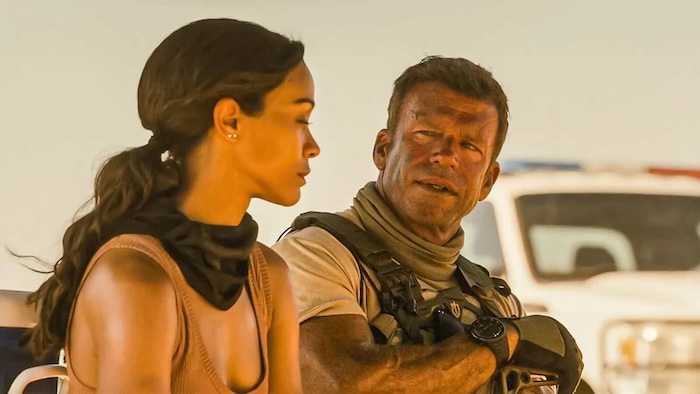
The first episode largely deals with a mission in which Joe (Zoe Saldaña) has to basically kidnap Putin’s right-hand man out of a bunker in Ukraine, and mostly what the episode does is illustrate the horrors of modern warfare: thousands of drones flying overhead while the Russians are also dropping bombs left and right. “It’s like World War I and Star Wars slammed into each other. You got f***ing drones and every concept weapon on the planet being concept-driven out there while soldiers are still charging over trench walls with goddamn bayonets.”
If it’s anything close to what’s depicted in the Lioness season premiere, it’s terrifying. But Sheridan, using Joe as his mouthpiece, also asserts: “We just killed a bunch of people for a chess piece in a war that has nothing to do with us.”
It’s not the first time that Sheridan has expressed an isolationist worldview, but that’s not really the rage-bait in the episode. That comes in the opening, when Nicole Kidman’s character, Kaitlyn Meade, is sitting down for breakfast with her husband, Errol, played by Martin Donovan at his most smug.
Kidman’s character looks at the cover of the New York Times (which Sheridan clearly hates, because he calls out the paper again later in the episode), which reads: “The End of Democracy.”
Meade: “I never thought the headline ‘End of Democracy’ would ring so hollow,” she chuckles.
Errol: “You can only cry wolf so many times.”
Meade: “Seems so shortsighted. An entire industry [journalism] rendering itself irrelevant.”
Errol: “Not if you think about how they were trained and who trained them. Just follow the money. Qatar alone has donated over $11 billion to U.S. universities. China has donated $2.3 billion since 2012, with $12 billion in paid tuition for Chinese nationals at our universities. And you’re surprised that graduates at those schools are espousing communist agendas and declaring democracy is dying.”
Meade: “Doesn’t it scare you a little bit?”
Errol: “Fool’s gold. If you want to scare me, start talking about AI. That’s the real end of democracy.”
The full breakfast scene is Errol talking, but it’s Sheridan’s argument: the real threat isn’t this President, it’s AI, and journalism can’t be trusted to say so because the whole industry was bought and trained by communists. And I don’t even know what to do with that rage-bait, because he’s half right. This Administration is the biggest single threat to human rights in America, but the tech bros and their AI are the biggest existential threat. The problem is that Sheridan needs those to be the same argument, and they’re not. You can be right that AI is a civilizational threat and still be running cover for the people currently dismantling the thing AI would finish off.
That’s the trick of a good rage-bait monologue: it buries a bad-faith premise inside a point you actually agree with, so that swallowing the one means swallowing the other. Sheridan’s gotten very good at it. The tell is that he always makes the smug guy at the breakfast table the one who gets the last word (and trust that Sheridan, and his smugness, is all over this episode, too, as an actor leading the mission inside of Ukraine).


