
Old School. Biblically Independent.
By Dustin Rowles | TV | September 22, 2026
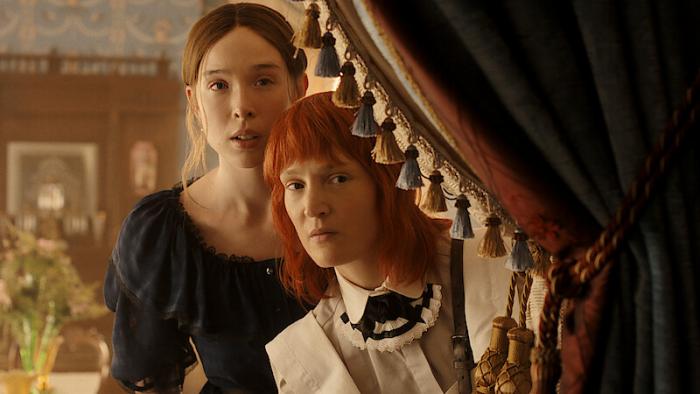
Ryan Murphy’s Monster: The Lizzie Borden Story does what Ryan Murphy productions always do: it mistakes a lavish aesthetic for actual substance. In the process, it commits a very specific, deeply annoying kind of historical violence. It tosses out a fascinating, tragic true-crime mystery and replaces it with a hornier, dumber fantasy custom-built to flatter Murphy’s own obsession with tragic camp.
Is the series gorgeous? Predictably, yes. Is it bloody? Absolutely. Is it completely, profoundly vacuous? You bet your ass. And most damningly, the entire thing is built on a foundation of lies that Murphy is desperately banking on you being too lazy to Google.
Let’s start with the massive elephant in the room: the alleged torrid romance between Lizzie and the family’s Irish maid, Bridget Sullivan. There is literally zero contemporary evidence this affair existed. None! Lizzie called Bridget “Maggie” because that was the name of the previous maid, which is its own special brand of gilded-age casual cruelty — but beyond that, the romantic backbone of Murphy’s series is pure fanfiction. He didn’t “re-examine” history; he pulled it straight out of his ass.
And look: There was already a wildly compelling story right there waiting for him.
The actual Lizzie Borden case is genuinely fascinating. Lizzie was a woman in her 30s — a “spinster” by 1890s standards — trapped in a wealthy, stifling household that lacked even basic indoor plumbing because her cheapskate dad refused to pay for it. Andrew Borden’s remarriage to Abby Gray had thoroughly poisoned the well with both of his daughters. The resentment festered. The financial control tightened. And then, on August 4, 1892, Andrew and Abby were hacked to death in their home. To this day, nobody really knows who did it.
Lizzie was arrested and tried before an all-male jury. The prosecution pointed at her wildly inconsistent statements and damning timeline; the defense leaned heavily on reasonable doubt and Victorian respectability politics. The evidence was circumstantial as hell, but spicy. Ultimately, she was acquitted. But she was never, ever absolved. She spent the rest of her life as a social pariah, dying in 1927 as a deeply wealthy, profoundly lonely woman who never said a peep about the murders again.
That is a story! It’s about gender, class, and the Victorian justice system. It’s about what happens when a woman of means is suspected of a gruesome double murder but shielded by her polite society status — a lesson in how money can simultaneously condemn you to social death and keep you out of a gallows. It’s a dark, claustrophobic look at the rot lurking beneath polite society, and the birth of America’s obsession with true-crime media circuses.
The family dysfunction alone is prime prestige-TV material: the cold, miserly patriarch, the stepmother hatred, the desperate struggle for financial independence. The motive was real. The resentment was documented. The ambiguity — the glorious, unresolved un-knowability of it all — is why we’re still talking about it 130 years later.
So naturally, Ryan Murphy threw all of that into the trash.
Instead, he gives us an invented queer love story with a made-up motive, softening Lizzie into a sympathetic victim of tragic romance fighting against the big bad world. He strips away the psychological edge, the weirdness, and the icy calculation that makes the real Lizzie so fascinatingly ambiguous.
And then — because Ryan Murphy physically cannot stop himself — he inexplicably shoves an Aileen Wuornos subplot into the mix? Apparently, this was to make Lizzie’s violence feel like some kind of heroic feminist revenge saga by association. It’s bloat. It’s tasteless. It’s nonsense.
What he’s done here is take a grim, unsolved historical enigma that exposed the deep anxieties of late-19th-century America and sanitized it into a slick, pop-feminist revenge fantasy. He took a case defined by mystery and made it tidy. He took a deeply suspicious woman and made her a girlboss martyr. He took actual history and made it fit the Ryan Murphy house style.
The real Lizzie Borden story is infinitely more interesting than Murphy’s version. It’s about a woman who remains a complete cipher, trapped in a house of rage, whose trial hinged on whether a lady could be delicate enough to wear lace and brutal enough to swing an axe.
But Murphy didn’t want to tell that story. Real history is messy. It doesn’t neat-and-tidy itself into a clear narrative arc. It doesn’t give him an excuse to dress everyone in silk, blast Natalie Merchant, and pretend he’s saying something profound.
So he erased the truth. And in doing so, he erased the real, complicated, probably terrifying Lizzie Borden in favor of a hollow archetype whose only job is to serve his aesthetic. It’s deeply exhausting — but honestly, at this point, expecting Ryan Murphy to respect historical truth is on us. The man has never met a real tragedy he couldn’t completely miss the point of.


