
Old School. Biblically Independent.
By Dustin Rowles | TV | April 27, 2026
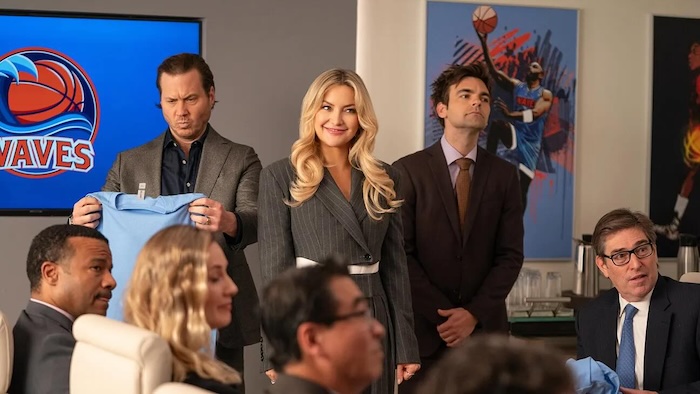
Running Point is precisely the kind of half-hour comedy that might suffer from a sophomore slump: There was some novelty to the first season (a “messy” female taking over a family-owned professional basketball team after her brother goes to rehab) and a strong cast of comedic talents (Kate Hudson, Brenda Song, Justin Theroux, Scott MacArthur, Max Greenfield, and Jay Ellis), and that novely is bound to wear off.
The second season deals with a new complication — namely, the successful President of the Los Angeles Waves hanging on to her job — and the whole thing slides into a comfortable rhythm. Arguably, too comfortable. The series comes from a lot of broadcast sitcom vets (Mindy Kaling, Ike Barinholtz, Elaine Ko, and David Stassen), and it sometimes feels as though it veers into broadcast network sitcom territory. Not that that’s necessarily a bad thing, but it does start to feel more a little more rigid and formulaic (the cold open introduces a problem, and the episode resolves the problem by the end).
It all makes for decent comfort television with more than a few laughs, but it doesn’t have quite the same energy as the first season. The pratfalls feel a little too staged, the setups a little too predictable, and even the jokes feel a little canned. Also, there’s less Jay Ellis, and Jay Ellis is R-I-D-I-C-U-L-O-U-S.
The second season sees Justin Theroux’s character, Cam Gordon, return from rehab. He wants his old job as President of the team back, but because Isla (Kate Hudson) has been so successful in his stead, he can hardly push her out. So he tries to not-so-subtly sabotage her leadership from the shadows, egging on conflicts between players, engaging in some light embezzlement, and bringing in a disreputable outside investor (and Ken Marino is always good in a sleazebag role).
Things slowly begin to tear at the seams for Isla: There are financial problems, unsatisfied players, fights over girlfriends, and egos to manage, not to mention a facility falling apart. She’s also set to marry the perfect man (played by Max Greenfield), though she still has residual feelings for the Waves’ old coach, played by Jay Ellis, who has since moved on to become the head coach for the team’s biggest rival, Boston. Scott Speedman also does a couple of episodes as a possible third suitor.
It all mostly works out the way one might expect from a comedy with no grand narrative ambitions. But the jokes are mostly solid, Drew Tarver and Scott MacArthur steal half the show, and Chet Hanks is sidelined for most of the season (which is, I hate to say it, a detriment to the comedy).
It’s not bad at all; it’s actually still quite good. But it does feel a little more like a late-season sitcom that’s already running out of ideas than one only in its second season. That’s not to say the 10 episodes don’t go down easy (I binged it all on a very relaxed day of flights), but it doesn’t quite live up to the promise of its freshman season.


