
Old School. Biblically Independent.
By Dustin Rowles | TV | October 10, 2025
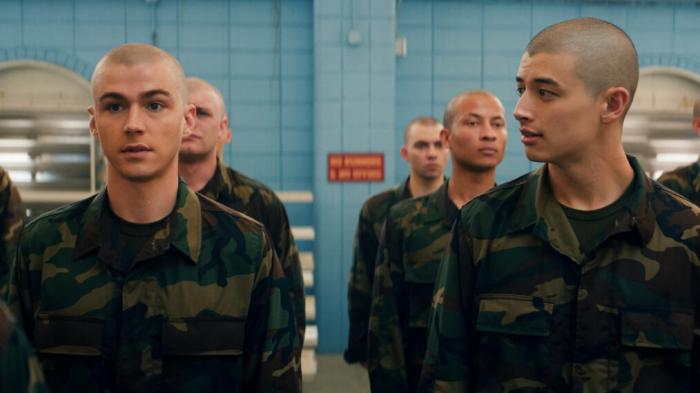
I didn’t know what to expect from Netflix’s Boots, which stars Miles Heizer (13 Reasons Why) as Cameron Cope, an 18-year-old closeted teenager in the ’90s who’s been bullied his entire life. In an act of defiance, he joins the Marines with his best friend, Ray (Liam Oh). Boots follows their grueling 13 weeks in boot camp.
At first, it plays like a Stripes-style comedy, filled with the usual boot camp archetypes anyone who’s seen a military movie will recognize: the hard-ass drill instructors with creative insults, and the expected lineup of recruits — the Asian guy, the Black guy, the toxically masculine guy, the newlywed obsessed with his wife, the mismatched twins (one overweight), and the unhinged one. Then there’s Cameron, trying to find his footing — at first desperate to escape, then slowly bonding with his fellow recruits as he transforms into a Marine.
But because this is an eight-episode series and not a two-hour movie, those stereotypes gain dimension. Each character’s backstory and motivation gradually unfold: Ray joins to earn his father’s approval; the married guy wants to hold onto the fleeting moment when his wife saw him as a “real man”; Nash (Dominic Goodman) enlists to pad a future political résumé so he doesn’t become another Jesse Jackson; the twin brothers were raised in constant competition. What starts as cliché becomes surprisingly human.

Cameron’s story, though, remains the heart of Boots. One of his drill instructors, Sgt. Sullivan (Max Parker), is also closeted. He’s convinced that repressing his identity — burying it under layers of macho aggression, bar fights, and self-loathing — is the only way to survive. To him, being the “perfect Marine” means erasing any trace of vulnerability.
Cameron sees this self-destruction up close. He wrestles with whether to emulate Sullivan’s denial or chart his own path — to serve with integrity while honoring who he is, even if “coming out” in the Marines of the 1990s is still unthinkable.
Based on Greg Cope White’s memoir The Pink Marine, the series becomes a layered, empathetic exploration of what it means to be a man — and specifically, a gay man — in a world that equates masculinity with violence and conformity. It balances humor and heartbreak, occasionally veering dark but always finding its emotional footing. Heizer is phenomenal, embodying Cameron’s strength and confusion, and Parker is equally compelling as a man consumed by the very system that shaped him. Even Vera Farmiga, in a brief comic turn as Cameron’s mother, adds some unexpected warmth and levity.
I’d planned to sample a few episodes and move on, but Boots hooked me. What begins as a familiar boot camp comedy evolves into a powerful, deeply relevant story about identity, courage, and the meaning of manhood — especially resonant now, as figures like Pete Hegseth and this administration try to dictate what kind of men “belong” in uniform. Masculinity isn’t about domination or cruelty; real men don’t become bullies — they stand up to them.


