
Old School. Biblically Independent.
By Dustin Rowles | TV | January 27, 2026
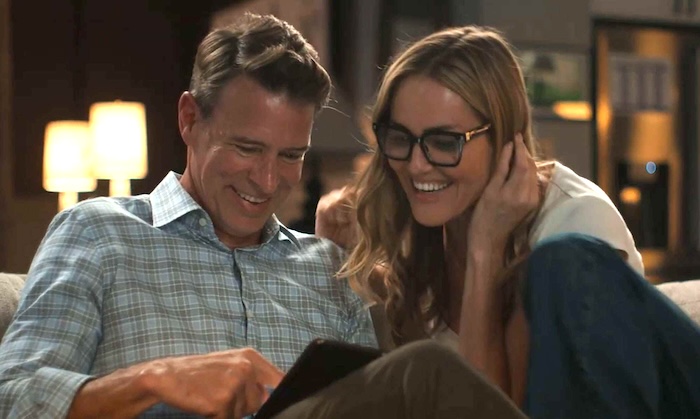
I was recently sent screeners for a new series called It’s Not Like That. I’d never heard of it, but there were people in the cast I love, like Scott Foley of Felicity and Scrubs; people I like, like Erinn Hayes, who was inexplicably chased off Kevin James’ Kevin Can Wait; and people I can tolerate, like J.R. Ramirez from Manifest. What hooked me most, though, was the trailer’s promise that the show came from writers associated with Parenthood. For reasons I can’t entirely explain, I leapt to the wrong conclusion that Jason Katims of Friday Night Lights was involved.
He isn’t. But the series does come from Ian Deitchman and Kristin Rusk Robinson, frequent Katims collaborators on Parenthood, Rise, and As We See It. And watching it, I quickly realized something else: my expectations, my enthusiasm, and later my hesitation said less about the show itself than about my own baggage around a certain kind of television.
It’s Not Like That fits neatly into the Katims-adjacent lane: sweet, inoffensive, and quietly heartfelt. It centers on Malcolm, a pastor played by Foley, who is navigating family life and his vocation a year after his wife’s death, and Lori, played by Hayes, his late wife’s best friend, who is rebuilding after her divorce from David, played by Ramirez. They may have feelings for each other, feelings they are understandably reluctant to act on given the closeness of their families. Their kids, meanwhile, are working through the kinds of emotional fallout that follow death and divorce at different ages.
I binged four episodes. It’s not earth-shattering. It’s pleasant, gentle, and very much Parenthood-lite. Curious where it would land, I looked up its streaming home and discovered that it’s a co-production between Amazon MGM and a Prime Video subscription network called the Wonder Project.
The Wonder Project curates “stories that inspire hope and restore faith.” In other words, it’s faith-based. And I suspect a lot of you just felt the same internal brake I did. That pause is understandable, but I’m increasingly convinced it’s also a little lazy.
There is nothing inherently wrong with faith-based programming. I’ve seen faith-based films that were genuinely decent, like Alan Ritchson’s Ordinary Angels or Jennifer Garner’s Miracles from Heaven. “Faith-based” shouldn’t automatically be a pejorative. Nobody Wants This is, in its own way, faith-based. It’s just Jewish rather than Christian. Entire religions are routinely flattened and judged by their worst self-appointed representatives, a dynamic that has long plagued Jewish and Muslim communities as well.
I’m a liberal, and I’m from the South, and I’ve absorbed enough cultural shorthand to sometimes conflate an entire faith with a particular political ideology. That association is learned, reinforced, and often understandable, but it’s still not fair. It’s Not Like That, which features mixed-race families, interfaith gatherings, and a pastor who may or may not be having sex out of wedlock, would likely be dismissed as “woke” or “DEI” by the same people who loudly claim exclusive ownership over Christianity.
The larger point is this: dismissing faith-based programming wholesale because some people use religion as a cudgel to justify bigotry is an intellectual shortcut, not a moral stance. That doesn’t mean you should subscribe to yet another streaming service, and I am absolutely not arguing that Scott Foley’s charm and dimples justify a new monthly bill. The show isn’t that good.
But I’m also not inclined to write off an entire platform that aspires to be “HBO for a faith-based audience” simply because someone like Kim Davis insists she speaks for Christianity. If anything, It’s Not Like That offers a version of faith that feels humane, inclusive, and aspirational, which makes it more interesting as a cultural counterpoint than as television. Even when it’s only fine, that kind of representation is worth existing. The fact that it comes from Amazon, in fact, should actually be more damning than the fact that it comes from a faith-based network.


