
Old School. Biblically Independent.
By Lord Castleton | TV | February 10, 2026
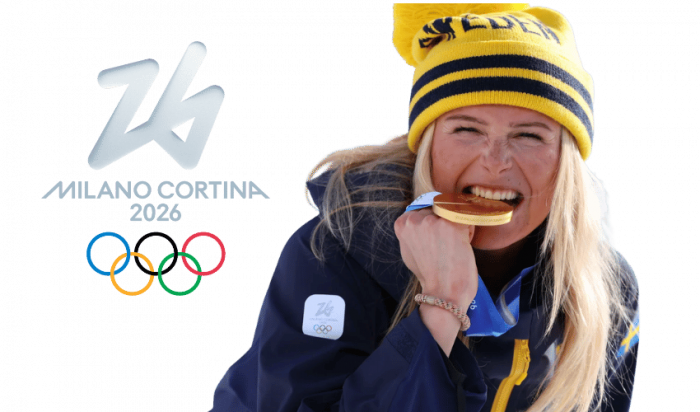
At their purest, the Olympics are a place where all people can come together around a shared love of sport. As an American, it also means you blissfully to watch them without compartmentalized, captive-audience sponsorship.
-- No Gatorade halftime report.
-- No Quiznos Coach-cam.
-- No Budweiser player of the game.
-- No general sponsored idiocy and no sports betting ads, the ubiquity of which has rendered leagues like the NFL borderline dystopian.
Not to fear, though, the robber barons who own all media are not-so-cleverly trying to inject as much ad revenue as possible, running advertisements in split-screen concurrently with events, and making streaming watchers wade through hip-high deluges of unskippable ads, the way god intended. After all, what good is anything wholesome if it can't be monetized?
Despite these transgressions, the Olympics remain a place where we can still feel inspired by the triumph of the human spirit, the tenacity and perseverance of the athletic mindset, and the innovative ways that homosapiens continue to push our bodies to the limit. Oh, and because it's the Winter Olympics, there's the added bonus of a lot of hot Nords. Can't forget the bounty of hot, hot Nords.
Nevertheless, some people skip the Winter Olympics. Maybe it's as simple as this:
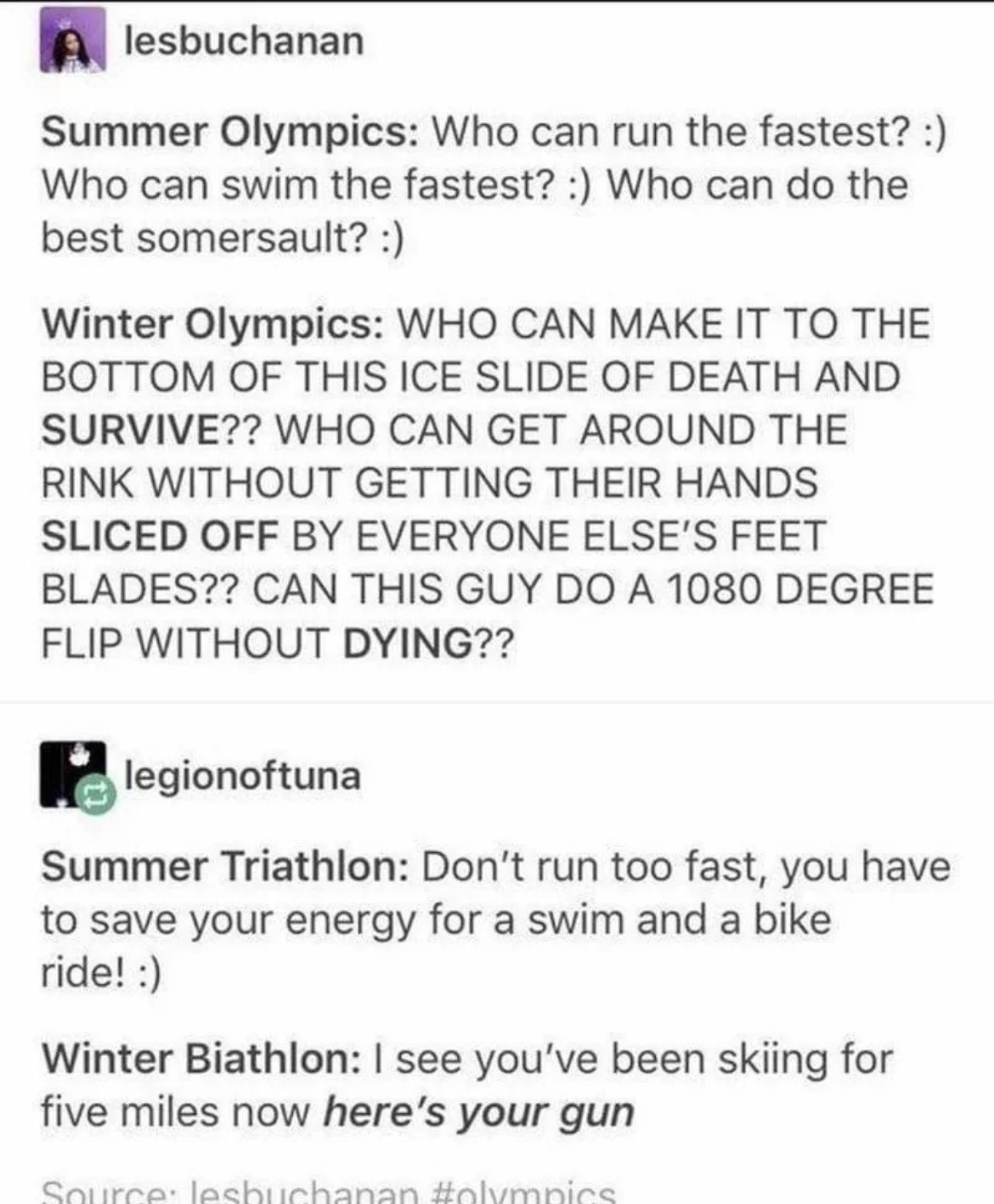
If you're one of those, this piece will hopefully either catch you up on what you missed, or whet your gaming appetite enough for you to dive back in yourself.
So. The Milano Cortino Winter Olympics.
Did you know that the city of Cortina is known as "The Queen of the Dolomites"? Well, now you do. If only anyone knew what a dolomite was. I assume it's a race of alpine sasquatches or something. Or a high-altitude, burrowing insect. Damn these godforsaken dolomites!
Meanwhile, Milan is known as "The Fashion Capital of the World." Yawn. Whatever works, I guess. You do you, Milan, but no matter how much Armani or Prada or Dolce & Gabbana you wear, you will never command a near-immortal race of alpine sasquatches. Unless I'm mistaken and you have some sort of handshake deal with Cortino.
Just a sec...producers chiming in, and...mountains. They're telling me the Dolomites are mountains. How about that?
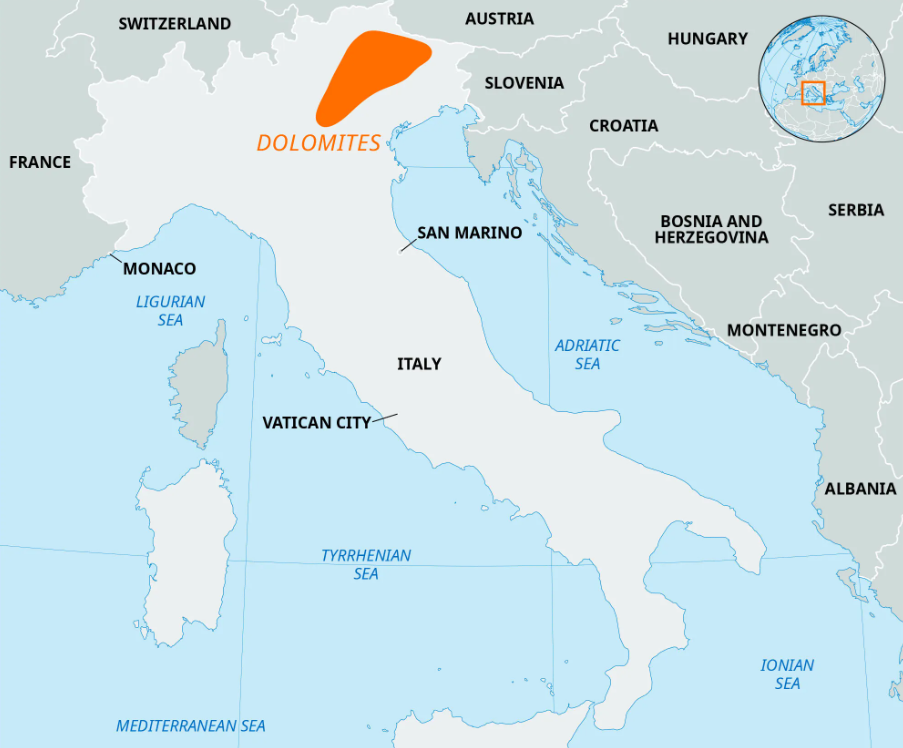
Aaaaaaand that's where the winter games are, in the mountains of Milano and Cortina. As you read this it'll be Day four or later and with every new Olympic day comes new stories, so let's get cracking on what's happened up to this point.
I'm not going to rank these because one woman's feast is another woman's famine, or something like that, but here's a smattering of moments from the first few days of competition from the lens of an American who jumps out of bed at 5am eastern every day to watch the events live. Like it's Christmas.
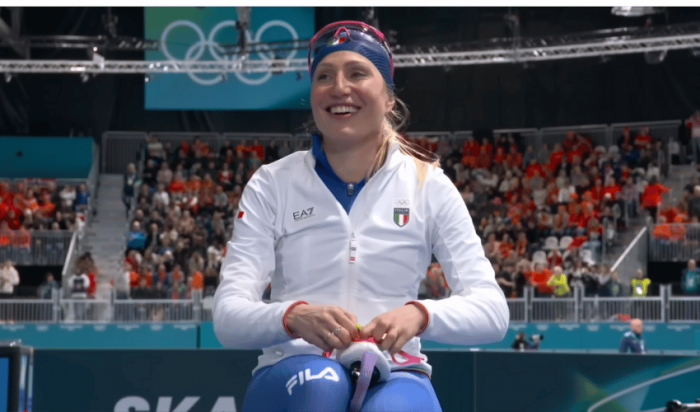
Italy's first medal was an amazing one - Francesca Lollobrigida smashes the Women's 3000m Speed Skating Olympic Record
On the brink of retirement, thirty five year old Italian Francesca Lollobrigida decided to stick around because the games were in her home nation. (Yes, if you're wondering if she's related to famous Italian actress Gina Lollobrigida - it's her great aunt.) In the video below you'll actually see her strapping on her skates and singing before the race with the crowd. That breezy disposition is something you typically don't see from athletes prior to a big match. She was actually smiling during the race, something I don't think I've ever seen before, and then, powered by the cheers from her home crowd, she broke the Olympic Record and took gold. It was amazing - and it wasn't a gimme. All three medalists actually broke the old Olympic record. Then the moment was capped off by Lollobrigida celebrating with her three year old son. Watch the whole thing here since stupid ass NBC doesn't allow embeds.
Note: also a great race by fellow thirty-five-year-old Valérie Maltais, who represented Canada's first trip to the podium in these games, as well as her first individual Olympic bronze medal. You won't catch me missing an opportunity to celebrate our amazing neighbors to the north.
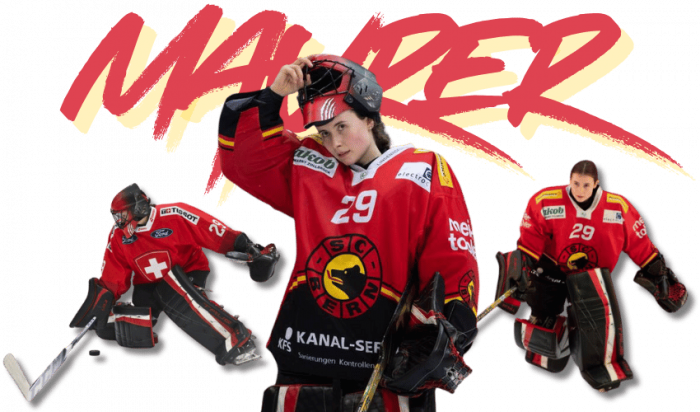
Saskia Maurer - Switzerland's Goalie Was A Wall
Sticking with Canada for a moment, if you watched the women's hockey game against Switzerland, you saw about as one-sided of an affair as you ever will. Canada peppered Swiss goalie Saskia Maurer with 55 shots while the Swiss only managed 6. 55 to 6 is like a horror film. 55 to 6 is Gallipoli. 55 to 6 is The Marvels box office. From the opening puck drop, Team Canada was relentless. Still, Maurer only let in 4 goals on 55 shots and played her heart out to keep her team in the game. That's the type of performance Shoresy would call "setting the tone." Appropriate, since she's currently the goalkeeper for the St. Thomas Tommies, which is an NCAA squad up Minnesota way, dontchaknow. After that performance, there's little doubt that she put herself squarely on the PWHL radar.
The Unlikely Blowout in the Men's Short Program
Speaking of dominating on the ice, you can't overlook the excellence and mastery on display during an exhilarating performance on Day 1 by Japan's Yuma Kagiyama.
Leading into the Olympics, all the chatter was appropriately on America's 21-year-old phenom, Ilia Malanin. Dubbed the "Quad God" for being the only person to land a quadruple Axel in competition, Malanin's Olympic future is bright. But Saturday was all about Yuma Kagiyama. His short form program was about as flawless as you can get, and his 108.67 score meant that the judges agreed. More than that, though, Kagiyama skated with love and passion. It may be recency bias, but I'll admit that watching his fluidity and grace, and the elegance of his compact body, it hearkened back to some peak Scott Hamilton moments for me. Hamilton knew how to work the crowd, and Kagiyama took a page from that book. It was a treat to watch, and added some additional intrigue to the team competition between USA and Japan. Watch his performance here.
But the US Breaks Back
The following day, Malanin got his revenge. Despite missing one of his jumps, he casually added a triple in later in the program (ho hum), in addition to landing four quads. He's truly in a league of his own, and can seemingly just annihilate the opposition with his technical difficulty scores. Netting a 200.03 point performance, despite losing his footing and saving himself from a fall by quickly putting his hands on the ice. Still. 200 points.
That was incredible, no doubt. Malanin is the definition of a wunderkind, and he will anchor the US team for years to come. Malanin's 200 point performance put pressure on Japan's 22 year old skater Shun Sato to beat his score. Sato has never broken 200 before, and he also didn't on Sunday, but he skated his heart out, producing a flawless, masterful performance which just didn't have the technical difficulty to catch Malinin. Sato landed three quads and netted a 194.86, which is a score high enough to beat just about anyone.
Except someone like Malinin.
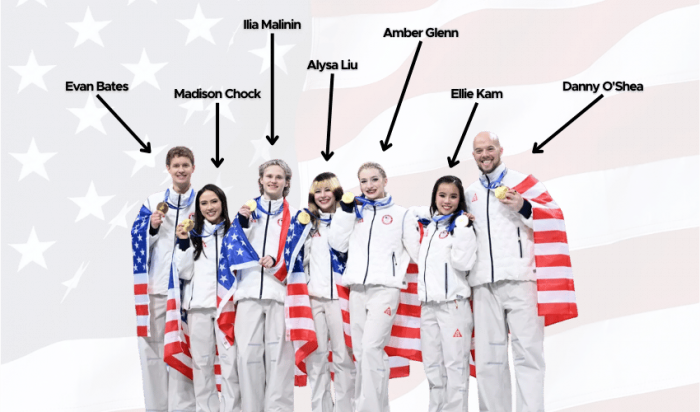
Still, that's not the moment. The moment I loved was Sato, who had just skated the best routine of his career, crying as his scores came in because he had let his team down. Now, that's a teammate you can get behind. He gave it everything he had, left nothing in the tank and maxed out his score and it wasn't enough to get his team the gold medal. Someday, he'll have the perspective and peace of mind to realize that he did everything he possibly could have, but in that moment, I saw a person who loved his team more than himself, and that's a powerful sight to behold. Whether a superior technical performance with a half-fall should even be able to beat a less technical and more artistic program with nary a hitch of any kind is a question for another day.
In the end, USA took gold in the team event, narrowly edging out Japan by a solitary point, 69 to 68. I adore the American team, but I can't say enough about the excellence and integrity of Team Japan. I look at the image below and I just swoon with admiration for every one of them.
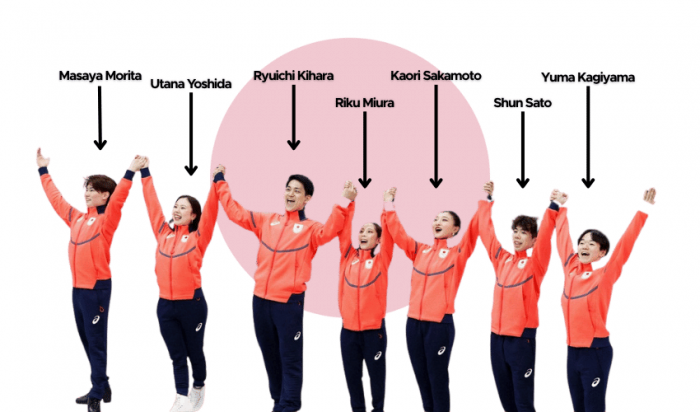
I could write this whole piece about Kaori Sakamoto, who is universally beloved and a treasure in the figure skating world. When she had to rise to the challenge in the team event, she did. That was the hallmark of the battle between these two teams. Skaters rose to every challenge. Alysa Liu was amazing. So, of course was Kaori Sakamoto. The Americans desperately needed at least one point in the pairs competition, so Ellie Kam and Danny O'Shea skated a personal best routine, despite the 35 year old Team Captain O'Shea being the oldest U.S. Olympics pairs skater (at 35) since 1932, and the oldest figure skater from any country to make his Olympic debut since 1948. To counter, Japanese pairs phenoms Riku Miura & Ryuichi Kihara had to win the free skate portion outright, so they did. They make it look effortless. Sometimes it felt like the US was Maverick, a little wild, a little risky, while the Japanese team was Iceman: dependable, textbook, perfect. In that situation, you'd honestly expect Iceman to win. It took real grit for Team USA to pull out this victory.
Thirteen Seconds and then Silence
Not every memorable moment has to be a victory. Certainly, watching Lindsay Vonn crash 13 seconds into her women's downhill run was something I'll never forget. I felt hollow when they interviewed her sister after she had been helicoptered off the mountain. No one knew the severity of her injury (it has since been called a broken leg) but for a grisly moment on the mountain, the mics picked up Vonn's cries of pain and on certain international broadcasts they reported being able to hear her moans as the crew of medics worked to stabilize her and load her onto the stretcher to be med-evaced away.
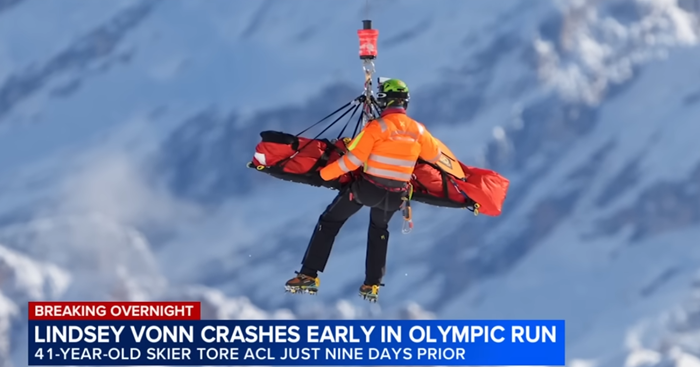
I'm not saying we need moments where athletes are in pain - ever - but when it happens, it definitely serves to level set what the athletes are really contending with.
Another notable moment was when, after the conclusion of the men's Big Air competition, one of the commentators was caught on a hot mic complaining how boring the even he had just covered was. There's been a lot of negative reaction to the way NBC is covering the games, how they hollowed out many of the better paid producers and now they're left with a gaggle of corporate middle managers and yes men who have no idea how to properly cover the Olympics. Camera teams have cut away at finish lines, missed landings, and generally caught way, way, way too much buzzing drone audio over the first few days. Some people are paying an arm and a leg to watch the games ad-free on Peacock and still they're getting bombarded with ads over and over whenever they have the audacity to switch events. It can be difficult to find live events. Oh, and the Big Air, specifically has become a bit of a shoulder shrug because the technical ability of the athletes has risen so precipitously, that it's more or less just about how many revolutions a jumper can do, also derogatorily referred to as "spin it to win it."
The Best Cross Country Skier Norway Has Ever Produced
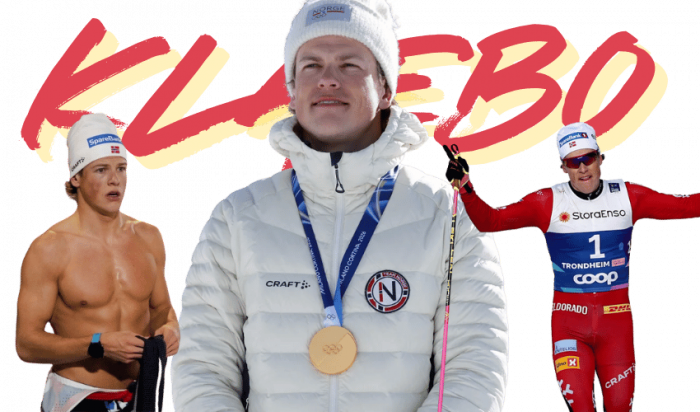
While improvements in Big Air have led to a saturation of spins, some events continue with grueling certainty. I'll admit that watching cross country skiing is not one of the most exciting events, but the endurance of these athletes is stunning. Norway's Johannes Hoesflot Klaebo won his sixth cross country skiing gold medal on Sunday, his first in the skiathlon. Klaebo is like a Rodin statue on planks. This is uphill. Up. This dude must have iron adductors.
A Shoot 'Em Up In The Mountains
Then of course you have the biathlon, which I have to admit, I really enjoy. Yes, it's cross country, but twice a round, the competitors do this:
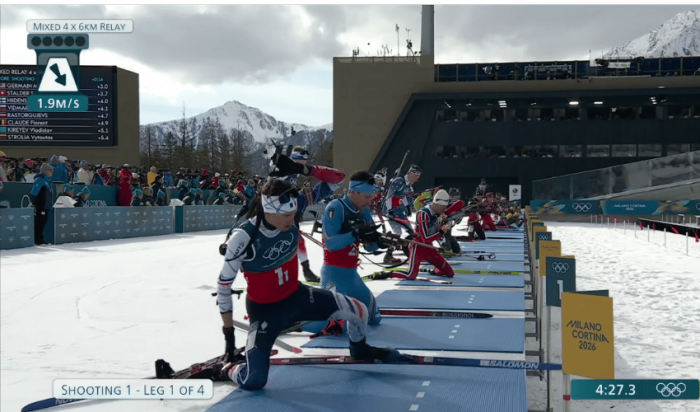
Yes, they pull a .22 rifle off of their back, quick as they can, and fire at a target from either the prone or standing position. While standing, athletes have to hit a 115mm (about 4 and a half inches) target five times. In prone position, the target is only 45mm (less than 2 inches) wide from a range of 50 meters. I find this wrinkle of the sport really unique. What if you had to stop and drain ten three pointers halfway through running the Boston Marathon? The focus shifting is fascinating.
One second, people are pumping across the white on skis and then, seconds later, they're like this.
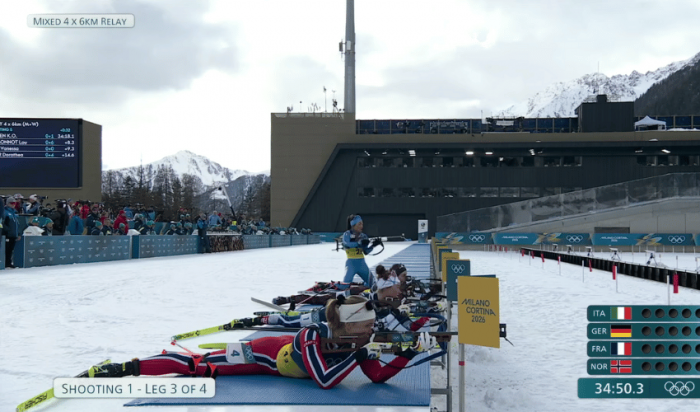
Team France won gold in the recent Mixed 4x6 kilometer relay and watching French anchor Julia Simon go 5-for-5 in both prone and standing was unreal. You could hear the crowd gasping with every shot. Just check out the ice in her veins starting at the 5:17 mark.
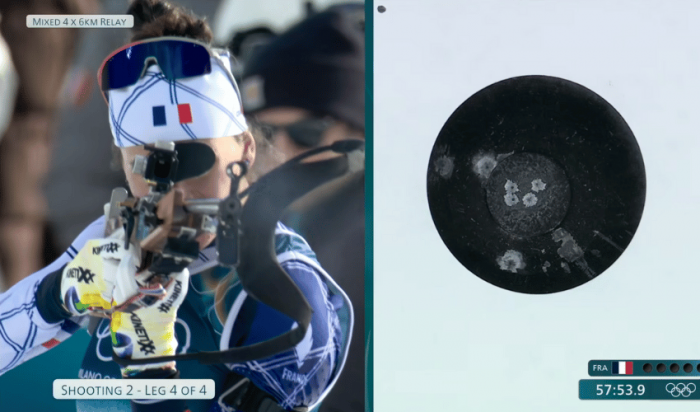
Incroyable! Zut alors! And check out those kicks.
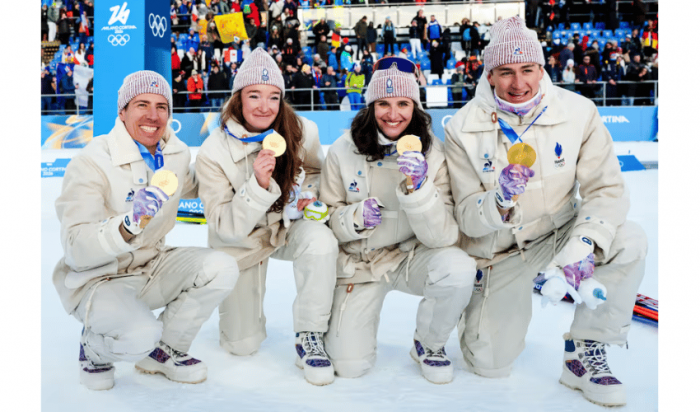
Biathlon, oddly, is the one sport the USA has never medaled in. That may seem odd, considering the infatuation with guns by a large percentage of the American populace. But if recent events have proven anything, it's that 2A enthusiasts are full of hot air anyway. They'd do far better with a new Olympic event where you have to eat Doritos and shoot your television from a reclined position whenever it shows something obscene to the fascist gaze, like the amazing Bad Bunny halftime show, or people being able to make their rent.
A Stunning Upset As USA Knocks Out Reigning World Champs in Curling Mixed Doubles
Most of us only watch curling every four years, and then the sport that feels the slowest - relative to the others - often packs the biggest punch. That's how it was on day three for American mixed doubles team of Cory Thiesse and Korey Dropkin a.k.a "The Coreys," as they knocked off the defending gold medalists and reigning world champions Italy.
One of the things I love about the Olympics is that you end up getting insights into athletes you've never heard of and likely won't ever see again. Sometimes it's just a glimpse of their tenacity. Sometimes you actually see an athlete kick into a lower gear and it sparks something inside of you. Sometimes watching an athlete in the ideal shape of their lives, resonating on the highest level of their personal existence is magnetic. Sometimes you just get a sense that you're watching a perfect moment, or that an athlete is in the ideal place for their skill set. Sometimes it comes down to simple charisma. Whatever it is, moments like these are what create indelible memories for viewers around the world.
That's kind of how I felt when watching Italian mixed doubles player Stefania Constantini. Whenever it was her shot, the intensity of her focus was so all-encompasing, it was like seeing a human in their ideal situation. Like, of course she ended up in curling. Where else could she combine this level of concentration with this level of touch?
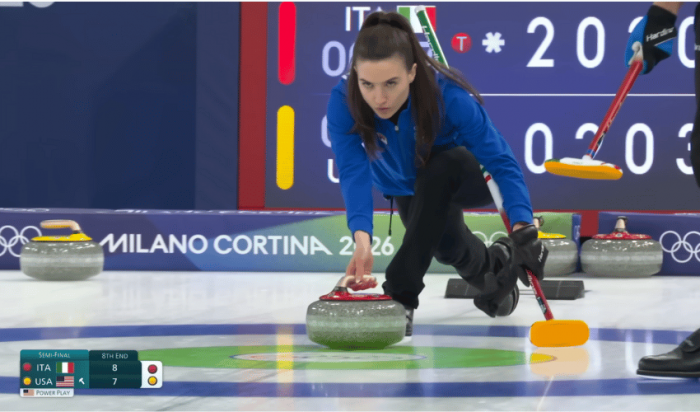
I honestly don't know how they do it - the touch. I'm the kind of donkey that shoots every puck off the end of the table in shuffleboard. Sometimes, I miss the opening of my water bottle when I'm filling it at a dispenser. But these athletes can sail a 40+ pound disc of polished granite more than 21 feet away to a 12 foot in diameter circle called the "house," often landing it effortlessly in the center circle called the "button."
On day three, The Americans managed to edge out the Italian team of Constantini and Amos Mosaner, advancing to the gold medal match vs. Sweden.
On the one hand, your heart breaks for the Italian team not being able to close the deal at home. But the shotmaking from the Coreys on that day - something the Italian team excels at, was not to be believed. Here you can see the match, shot for shot, and the stunning way that Team USA was able to come from behind and win. It's not every day you catch an upset of this magnitude.
The Little Engine Who Could, And Did
I opened with the host country and the utterly compelling Francesca Lollabrigita, and hopefully I've established how I love when athletes rise to the occasion under superhuman pressure.
If you can be anything in the Olympics, be clutch.
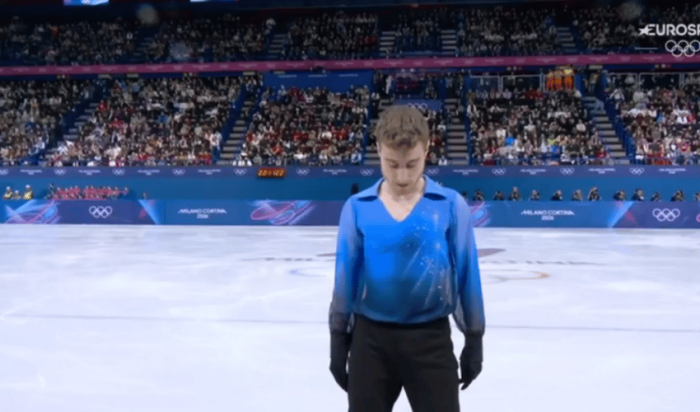
Perhaps my favorite example of this so far was when Georgia was in third place and Italy's Matteo Rizzo had to have a perfect program to push Team Italy into the bronze medal spot. I have no idea why this video isn't available, but let me just say that the tension that the diminutive Rizzo was skating with was palpable. But he kept hitting jumps until he only had three left in his routine. The announcers called them out...boom he hit the third...two left...boom he hit the second...one left.
When he landed that one, he actually fist pumped during the landing. Click below.
From then on it was just by rote, finishing out the rest of his routine with the Italian home crowd losing their fucking minds and him skating with the biggest smile on his face. When he finished, he dropped his head to the ice, bawling.
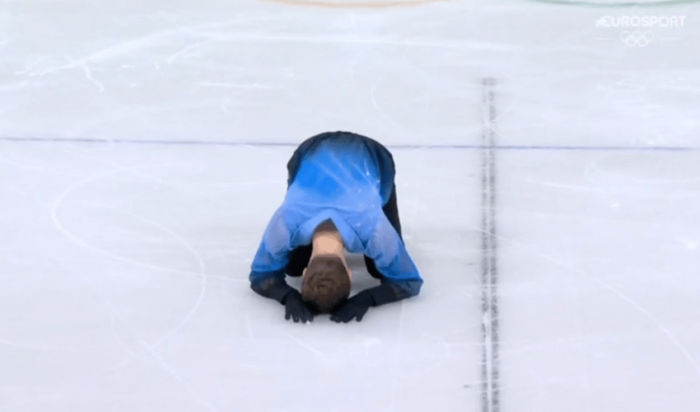
Then, in true Italian fashion, went from crying in shock to primal elation. He slid across the ice toward his team on his knees like a soccer player who had just won the World Cup.
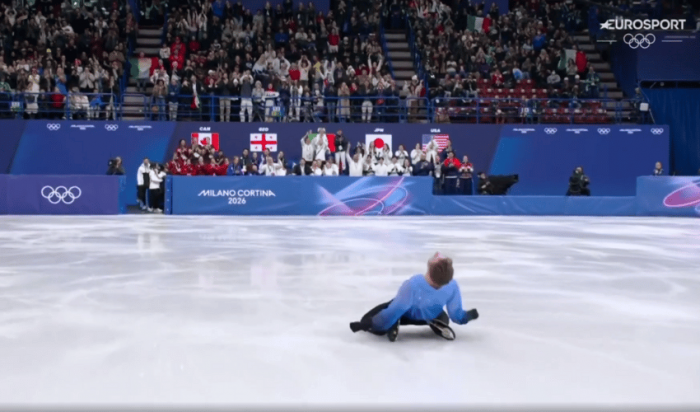
He crashed over the boards to hug his teammates on Team Italy who were going absolutely apeshit. Everyone yelling Andiamo! (Let's go!)
It. Was. Magical.
What a moment for Matteo Rizzo and for Italy. It just hits different when you see someone who isn't only playing for themselves. Matteo Rizzo carried the hopes of an entire team and an entire nation on his shoulders throughout that program, and he managed to will them all onto the podium.
The Olympics are beautiful.
I hope you enjoy the games as much as I do, and even though everyone can't win, that striving to be the best is intoxicating to watch. Good luck to all the nations in competition, and, win or lose, fingers crossed for all of them to get home safe and sound.


