Old School. Biblically Independent.
By Dustin Rowles | TV | September 21, 2026
The way I start the year in my social studies class is to look at the “Who shot first?” scene in Star Wars. In the original, it’s obviously unclear who shot first. We only know that Greedo ends up dead. But the idea that our hero, Han Solo, shot first was unpalatable for a lot of people. If Han Solo shot in self-defense, he’s a good guy. If he shot first, it’s not so clear cut, is it?
Twenty years later, in the 1997 re-release, George Lucas put the issue to rest (sort of). In the rerelease, Greedo did shoot first. Han Solo shot back. Han Solo is cleared of any moral ambiguity. That’s how history works. Those in power rewrite it to suit their needs. Lucas’s need was to ensure that Han Solo was depicted as a hero. Merch sells better that away.
When an enslaved preacher, Nat Turner, killed 55-60 white people in 1831, he was seen as a terrorist. Laws were passed in the South to make it even more difficult for enslaved people to rebel. Obviously, history appropriately regards him far differently now, as a hero of the anti-slavery movement, mostly ignoring the fact that a number of those white people were uninvolved women and children. But that’s history for you. The heroes and villains change, depending on who is telling the history.
What does this have to do with the third season of Lioness? I don’t know. Nothing? A lot. I know of someone who knows history well, is regarded as incredibly progressive, and who probably doesn’t spend a lot of time online who thinks that the Yellowstone franchise is one of the most progressive shows on television. From a certain perspective, he’s not wrong: At its heart, that show is about all the terrible things that happened over generations to a family who stole land from the Native Americans and, in the end, Native Americans reclaimed that land.
Seeing Yellowstone through that lens has actually made me re-examine Lioness. I mean, the writing is still bad, the action is muddled, and the worldview is often incoherent. But the latter is kind of the point, one that Taylor Sheridan really zeroes in on in a particularly messy third season.
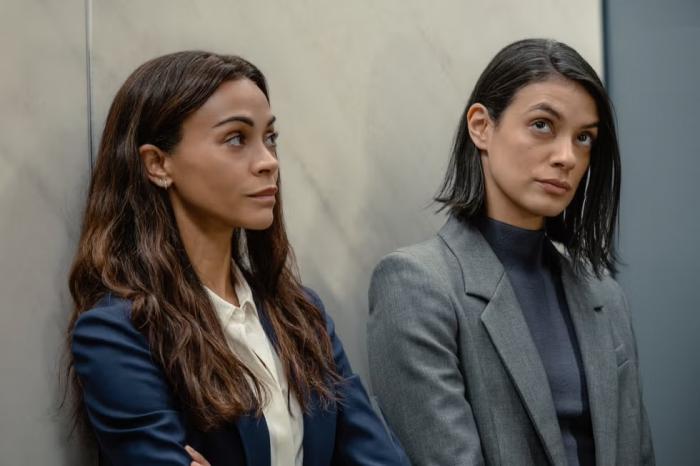
The long and short of it is this: Joe McNamara (Zoe Saldaña) is kidnapped and tortured, and the CIA basically spends the season trying to figure out how to retrieve her, who took her, and why. The American soldiers are clearly depicted as the “heroes,” but while there is the occasional patriotic moment, they mostly complain about being involved in wars that have very little to do with American interests. The Administration — the people making the decisions — mostly orders soldiers to detain people (often in GITMO) and kill people without all the facts, and brushes off their many mistakes.
But what’s interesting is that in the third season, it’s never more clear that America are not the good guys. Nothing here is done in pursuit of freedom or whatever bulls*** American ideals most shows like this feed to us. It’s about power, and corruption, and using the world map as a chessboard. Who is the bad guy? Ukraine? Russia? Israel? Iran? China? No, it’s all of them, America most especially included.
Taylor Sheridan is clumsily telling a story about ugly, bumbling, corrupt American imperialism and, yes, he often throws the media under the bus, too, for essentially conspiring with this fictional administration to whitewash their many mistakes. In the finale, for instance, after a CIA mission goes awry, the administration feeds the media ICE as a scapegoat because their standing can’t get any lower.
What’s almost comical in the finale — and it ultimately negates all the guessing games and the subsequent shoot-‘em-ups of the entire third season — is that in the last second, we finally find out who was behind the abduction and torture of Joe. It wasn’t Ukraine or Iran or Russia or China. It wasn’t even a country. It was a callback to a character, Aaliyah, in the first season that Joe and the Lioness program screwed over in order to kill her billionaire businessman father. It was not geopolitical. It was personal. I rolled my eyes, but also kind of applauded Taylor Sheridan for not casting a singular government as the boogeyman, because they’re all the boogeymen. And we’re all just pawns on the boards of the corrupt and powerful.
Granted, I don’t think most people are going to leave the third season with that takeaway. But it’s there if you’re willing to look: It’s a story about ugly American imperialism. It’s up to the history books — and ultimately us — to decide who the heroes are and who the villains are. From what I can see, there are no heroes. Just villainous governments and the occasional survivor.


