
Old School. Biblically Independent.
By Dustin Rowles | TV | October 15, 2026
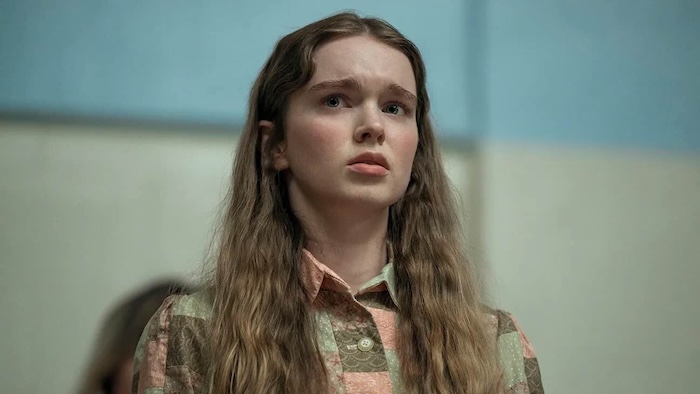
The best piece of criticism aimed at Mike Flanagan’s Carrie is our friend Roxana Hadadi’s critique over on Vulture. It’s brilliant. It’s scathing. It’s accurate. And importantly, it isn’t aimed at the ending — which everyone seems to dislike — but at the show itself. Her argument is that Carrie is about everything except Carrie: bullying, parenting, social media, Margaret’s and Chris’s quests for online fame, a parade of misunderstood women from history. Meanwhile, Carrie herself has been sanded down into a sweet, pretty, endlessly supportive girl with no rage and no inner life, a character the show is so desperate to protect that it never lets her grow up.
I read it before watching Carrie, and I read it again after. Roxana is right. She’s also a better writer than I am, and a better television critic. This Carrie is a blank. Summer H. Howell does what she can, but the show never lets her get ugly, or horny, or petty, or anything but nice. King’s Carrie is a powder keg. Flanagan’s is a puppy.
But man, I had a soft spot for Carrie. Look, I’ll admit it: the ending is not great. You know it, I know it, and the internet has spent the last week insisting upon it. Carrie White, one of the great tragic figures in American horror, survives prom, wakes up in a car with her imaginary friend, and drives off into what is very clearly Season Two, Season Three, and possibly a Dark Tower crossover event. Boo. Hiss. Mike Flanagan robbed this tragedy of its tragedy. Do we have to ruin everything with expanded universes?
But two things can be true at the same time: the ending sucked, and Carrie is good, actually. I liked it a lot, and I’m not going to let eight minutes of franchise-building talk me out of the seven episodes before it.
For most of its run, Carrie is a horror Mean Girls, and it’s terrific at it. It’s Do Revenge with higher stakes. Flanagan’s smartest move is making Carrie a newcomer instead of a girl who’s been put upon her whole life. She shows up to public school hopeful, eager, a little weird, and desperate to be liked, which makes it so much worse when the machinery of teenage cruelty starts grinding. And that cruelty takes a very 2026 form: the bullies don’t just torment Carrie; they post her. Every humiliation is content. King wrote a book about a town that couldn’t stop talking about one girl, and Flanagan figured out how to put that town on Snapchat.
And then there’s Emaline. I loved that twist. Here I thought Carrie had a friend, then I thought Emaline was Tyler Durden from Fight Club, and then Flanagan double-bluffed us with a reverse Sixth Sense. It’s the kind of trick he’s been perfecting since Hill House, and it’s the moment I stopped watching Carrie as a remake and started watching it as its own thing. Maybe I’m too easily manipulated by twists, but I thought it was clever.
Even the big swing everyone’s yelling about — that it’s the reporter and not Carrie who kills Margaret White — kind of worked for me, and not just because I like Flanagan’s wife, Kate Siegel. It’s a mercy. The book’s Carrie dies a monster in the eyes of everyone who survived her. Flanagan looked at that girl and decided she’d suffered enough. Roxana might say that’s the whole problem: a show so busy protecting Carrie that it never lets her choose anything, including her own sins. She’s probably right. But I’m a dad, and a softie to boot, and I watched all eight episodes yelling at the screen, “Leave that poor girl alone!” Turns out Mike Flanagan was yelling it too.
Now, the expanded universe stuff. I get it. We are all tired. Every movie is a pilot for another movie, every show is a “world,” and every ending is a trailer.
But it’s not exactly out of character for Stephen King. It’s not even out of character for King’s Carrie, which already ends with a sequel tease. The last document in the novel is a letter from a woman in Tennessee bragging about her granddaughter, a toddler who can make marbles move by themselves. King hinted at an expanded universe half a century ago, and every adaptation since has ignored it. Flanagan didn’t.
And King’s entire career is a shared universe. Derry, Castle Rock, the Shine, the Crimson King. The man was building a cinematic universe before anyone knew what one was. It’s why Castle Rock worked as well as it did before Hulu cruelly canceled it.
Granted, King earned his. He wrote a book, then another book, and eventually noticed they were connecting. What people hate about modern franchises is the opposite: a story bent out of shape to make room for stories you’re not watching yet. Flanagan has been openly talking about a three-season arc and a possible line to The Dark Tower, and that’s where the ending stumbles. Carrie surviving isn’t the problem. Carrie surviving so she can be on the poster for the next thing is the problem.
So is it a flawed ending? Yes! Is it a cash grab? I don’t know. Flanagan has said the ending had to work even if it’s the last we ever see of this Carrie, and that he wanted to send her off into the world he thought she deserved. That’s not Kevin Feige talking. Maybe Mike Flanagan just loved the character too much to kill her. I’m willing to forgive him.
Is the ending bad enough to sink the season? Not even close. Watch the first seven episodes. Watch the eighth if you must. And if you hate it, take comfort in the fact that there’s a perfectly good tragic ending sitting right there on your bookshelf, where it’s been since 1974. I wasn’t looking for another remake of Carrie. We got one in 2013. It sucked. This, at least, is different, and I may be one of the few who trusts Mike Flanagan to do right by her in a second, and maybe third, season.


