Old School. Biblically Independent.
By Dustin Rowles | TV | January 19, 2026
I do not typically watch Star Trek series. It’s just not my thing, which is not an indictment of Star Trek itself. Every once in a while, I give it another shot (I watched about half a season of Picard and a season and a half of Discovery, for instance) to see whether my tastes have changed or whether Star Trek has become more accessible to me. Part of the issue is sheer volume: there is just too much of it, and it often feels as though I’m missing enormous chunks of mythology. I neither have the time nor the inclination to catch up on a dozen different Star Trek series.
Over the weekend, however, I read that the latest entry, Starfleet Academy, had been review-bombed by viewers who felt it was too “woke” or disliked its tone and themes. That alone was reason enough for me to check it out.
I thought it was great. It also functions as a solid entry point for newcomers, though some familiarity with “The Burn” is helpful. Starfleet Academy is set 120 years after The Burn, a galaxy-wide catastrophe that occurred around the year 3069 in the franchise’s fictional timeline (and aired on Star Trek: Discovery in 2020). The Burn rendered nearly all dilithium inert at once, causing most warp-capable ships to explode and shattering the Federation. When Starfleet Academy begins, the galaxy is in a fragile post-Burn recovery: the Federation is rebuilding from collapse, warp travel remains constrained, and Starfleet is training a new generation tasked with restoring trust, cooperation, and interstellar stability. In short, the goal of Starfleet Academy is to rebuild both Starfleet and the Federation by teaching cadets ethical leadership and cooperative exploration in a galaxy still recovering from systemic failure.
Think of it as a post-Trump America analogue: there is a great deal of work to be done to regain the world’s trust and reestablish ethical leadership. Starfleet Academy is, at its core, a school designed to teach people how to act right again.
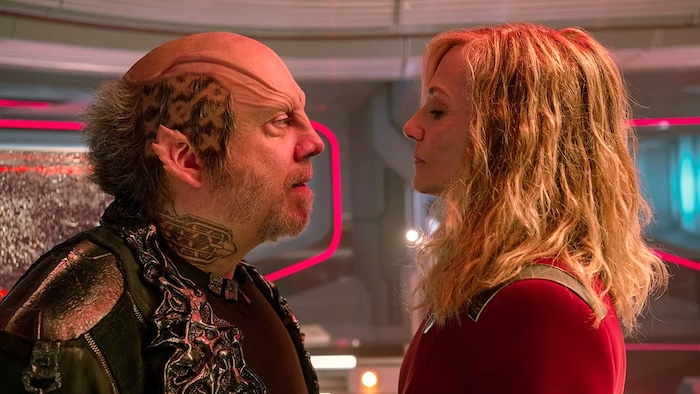
Captain Nahla Ake (Holly Hunter) has been chosen to run the new Academy because of her reputation for ethical leadership. She also carries an ethical failing of her own. Around 15 years earlier, a menacing pirate, Nus Braka (Paul Giamatti), stole food for a mother and child, Anisha and Caleb Mir (Tatiana Maslany and Sandro Rosta). When Braka was sentenced to prison, Anisha was effectively punished as a co-conspirator, and Captain Ake made the decision to separate mother and son, a choice that proved deeply traumatic for Caleb.
Caleb was placed in foster care, escaped, and has spent the last 15 years getting into trouble while trying to find his mother. When Captain Ake takes over Starfleet Academy, she recruits a reluctant Caleb. He’s the bad boy with the big heart, essentially The O.C.’s Ryan Atwood in a Starfleet uniform.
The series largely centers on older teenagers, and in the first episode Caleb uses the Academy’s communications system to try to reach his mother. This act draws the attention of the escaped Nus Braka, who attempts to seize control of their ship. Long story short: while Caleb causes the crisis, he also helps Starfleet repel Braka and ultimately agrees to enroll in the Academy after Captain Ake promises to help him find his mother.
Not all of the criticism aimed at Starfleet Academy stems from accusations of it being “woke.” Some of it appears to come from Star Trek purists who bristle at the idea of a YA-leaning series. But this is not The Summer I Turned Pretty. The show engages with weighty themes of diversity, representation, and, most importantly, empathy. Yes, there is a potential love triangle among the students, and Kerrice Brooks’ character, SAM, is undeniably adorable, which may not sit well with old-school Trekkies who prefer their franchises a little less cuddly.
It may also be that the very fact I liked the series is part of the problem. Its accessibility could feel threatening to hardcore fans who are protective of the franchise and wary of newcomers wandering in because Caleb is hot or because the casting of Holly Hunter, Paul Giamatti, and Tatiana Maslany sparked curiosity (even if the latter two appear to be recurring at best).
Still, it works, at least for my soft sci-fi brain. It’s fun, heartfelt, and refreshingly easy to navigate, even when the technobabble ramps up. It won’t compel me to catch up on every other Star Trek series, but it does feel like an inviting doorway into a larger universe that has often felt, to me, impenetrable.


