Old School. Biblically Independent.
By Kaleena Rivera | TV | June 26, 2026
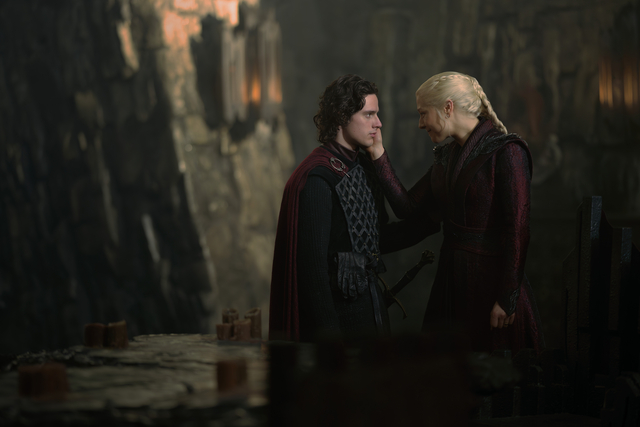
I’m vexed. There’s no other word to describe my reaction to the House of the Dragon third season premiere. A lot of the blame can be placed on the choice to set what feels firmly like a mid-season episode as the season opener for a show that last aired two years ago. In truth, however, my dissatisfaction set in even before the opening credits or even the recap; it started when an HBO ad briefly displayed a shot from A Knight of the Seven Kingdoms. While I should have been sitting there amazed at the massive dragon dining on some extra crispy sheep, all I could think was, “Damn, I miss Dunk and Egg.”
Admittedly, it’s not an entirely fair comparison. Despite them both being adapted from source material written by George R.R. Martin, they deviate wildly in terms of scope and tone. What A Knight of the Seven Kingdoms got very right, however, is a willingness to be its own creative work, while House of the Dragon has suffered the more it tries to resemble Game of Thrones; I maintain that its first season was its strongest, especially when it functioned primarily as a family drama.
The ensuing battle of Houses Green and Black was guaranteed to become a big sprawling hulk of a saga by the end of the first season, but as season two lumbered on and added a host of new characters, the drama dissipated. Noblemen, pirates, and bastards, oh my! Their introductions were brief enough that they left only the faintest impression in my mind; during last Sunday’s episode, during the dragon riders scene, in lieu of their actual names (just a few of the many details I’d forgotten over the past two years), I made do with labels like, “drunk one,” “big noble guy,” and “oh yeah, that kid.”
Speaking of kids, they’re decidedly not alright. It serves as a great reminder that characters making bad decisions doesn’t equate to bad storytelling. But that didn’t stop me from being enraged by Rhaenyra (Emma D’Arcy) and Daemon’s (Matt Smith) progeny. Youthful folly and pride led to a series of mistakes so profoundly terrible—Rhaena’s (Phoebe Campbell) boneheaded decision to take a non-battle tested dragon into the fight only slightly ekes out Jace’s (Harry Collett) idea to play war hero—the end result is a pyrrhic victory and a dead crowned prince,
Each season thus far has kicked off with a dead Targaryen. It’s the sort of thing that could easily become a darkly hilarious bit on A Knight of the Seven Kingdoms, though it would be done with the unique panache that viewers quickly came to love (see: the absurdly large male full-frontal shot with a surprising reason behind it). But it’s not necessarily the humor that makes A Knight of the Seven Kingdoms such a rousing success, but how steadfast it holds to the central premise: Ser Duncan’s (Peter Claffey) pursuit of legitimacy as a knight is the established goal (per storytelling 101), but the heart of the story rests squarely on his relationship with Egg (Dexter Sol Ansell).
House of the Dragon would do well to relocate the center of its premise. What’s most frustrating, even more than being expected to remember wisps of storylines held over from the previous season, is that the show has put everything that initially made it work and pushed it aside in favor of spectacle. House of the Dragon has demonstrated that it’s more than capable of portraying war, but if it hopes to maintain its viewership, it’ll need to show it has heart, too.
House of the Dragon season three airs Sunday nights at 9pm EST on HBO/HBO Max.
Kaleena Rivera is the TV Editor for Pajiba


