Old School. Biblically Independent.
By Dustin Rowles | TV | September 19, 2025
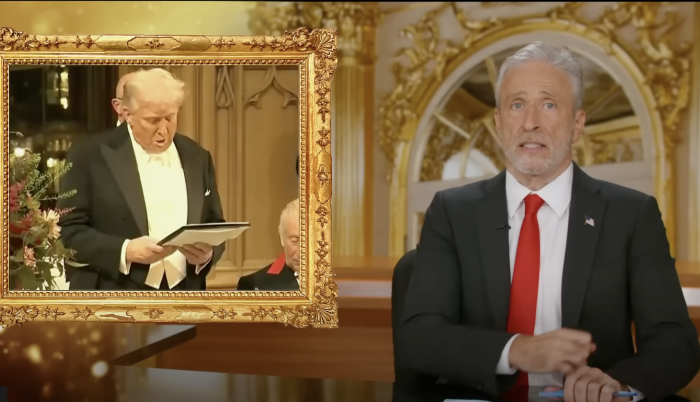
Last night on The Daily Show, Jon Stewart returned (during his vacation) to do an episode in response to the suspension of Jimmy Kimmel by Disney/ABC. Those hoping (like myself) for 20 minutes of righteous rage might have been disappointed, as Stewart opted for satire: He leaned into a “Dear Leader” bit, pretending to comply while mockingly praising Donald Trump’s idiocy. The staff even closed with a song in Trump’s honor. True to form, The Daily Show also exposed the many, many, many hypocrisies of an administration that insists only one side can dehumanize opponents or celebrate political violence.
It was good, though Stewart’s interview with Nobel Prize-winning journalist Maria Ressa was even stronger. She drew stark parallels between the Philippines’ slide into authoritarianism and what we’re experiencing here — only faster. The United States, she warned, is following the dictator’s playbook, and our unraveling is accelerating. It’s a sobering, incisive conversation worth your time.
You should also check out Seth Meyers’ “Closer Look,” where he praises Kimmel as a friend and reflects on the irony of working in a country that “purports” to value free speech.
I actually thought Stephen Colbert’s monologue was the sharpest of the night, calmly laying out the chain of events that led to Kimmel’s suspension. Colbert, of course, has little left to lose — he’s already been fired.
Props to all three — and even to Fallon, who offered his version of support: “To be honest with you all, I don’t know what’s going on — no one does. But I do know Jimmy Kimmel, and he is a decent, funny, and loving guy. And I hope he comes back.” Yes, Jimmy, a truly ferocious defense.
Still, watch them while you can. About three minutes into Stewart’s conversation with Ressa, it hit me that by the end of Trump’s second term, it’s likely none of these hosts will still be on the air. By 2028, late-night may be gone altogether. Some of that is economic — ratings and profits are down — but most of it will be the inevitable consequence of our illiberal democracy.
These hosts, excluding Fallon, have continued to do what late-night has always done: skewer those in power, regardless of party. The critiques feel sharper now because the stakes are higher. And for that, they are being targeted, one by one.
The Washington Post used to declare — as recently as eight months ago — that “Democracy Dies in Darkness.” But The Post itself dimmed the lights and bent to this administration. The late-night hosts, by contrast, refused to dim theirs — so billionaires and corporations are shutting them off instead.
We must figure out how to resist this. As Ressa warns, clawing back freedoms once stripped away is nearly impossible. I don’t pretend to have the solution. But I do know this: comedy has always been one of democracy’s most potent weapons. It punctures power, exposes lies, and keeps us sane in the absurdity. These late-night hosts have not only been the loudest leaders of our resistance, but they have provided real comfort on some of our darkest days. If late-night television dies, let it be from changing tastes and fractured media, not from the suffocation of authoritarianism. And if the lights go out on these stages, we owe it to ourselves to light new ones — to keep laughter sharp, dangerous, and defiant — and continue to pierce the veil of authoritarianism with comedy. If that goes, then what do we have left?


